All animals, both terrestrial and marine, have built-in defense mechanisms that can range from passive to hyper-aggressive. The goal of these defense mechanisms is to eliminate any threats and survive. Marine animals, specifically, employ a wide variety of defense mechanisms, such as, marvelous camouflage, shedding limbs, etc… and each one is extraordinary in its execution. Let’s take a look at just five fantastic defense mechanisms of marine animals which use them on their undersea battlefield.
5 Fantastic Defense Mechanisms of Marine Animals
In our article, We will present you with 5 marine creatures with 5 different defense mechanisms. Our list includes:
- Sea cucumber.
- Pufferfish.
- Hagfish.
- Squid.
- Boxer crab.
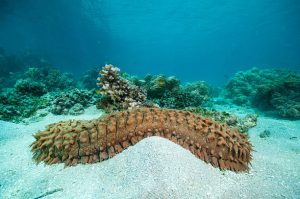
Sea Cucumber
Marine predators consider the sea cucumber among not being good eating animals, because of their toxin content, and also due to their bizarre defense mechanism: when the sea cucumber is under attack, it ejects a mass of sticky tubules from its anus which are designed to entangle predators.
Some species also simultaneously release a toxic chemical. This ingrain the power of the defense mechanism of this marine animal.
Pufferfish
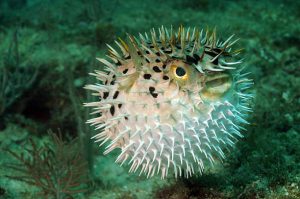
This chubby little pufferfish may appear to be good eating from afar, but any predator that tries to swallow this creature will be surprised. The exterior part of the pufferfish is covered in small spines that lay flat only if the fish isn’t agitated.
Upon agitation, water or air that the fish inhaling pop those little spines right up and into any creature to be close enough to get poked. Ingesting a puffed-up pufferfish can lead the predator to be choked or meet its fate later on as the body of the pufferfish is full of tetrodotoxin.
Hagfish
It is not an exaggeration to say that the hagfish has one of the most disgusting defense mechanisms of marine animals, as if having Hagfish as a name wasn’t enough.
Since marine creatures don’t make a habit of becoming acquainted by the names that we call them, any marine predator trying to eat one of these eel-like fish, the fish will release a load of slime secreted from glands existing along the flanks of it, resulting in clogging of the predator’s gills leading to suffocation.
Squid
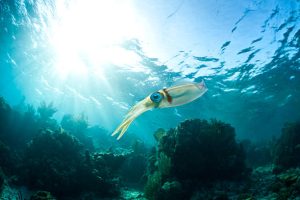
The cuttlefish and octopus are famous for the iconic ink that they deploy to evade predators. Some species of squid, such as the Octopoteuthis deletron species can also detach its arms if necessary to avoid becoming the next meal of a predator.
Using hooks at the end of the arm, Octopoteuthis deletron has hooks at the end of its arm that it can embed them into the predator’s flesh in the right time and jet away, leaving the arms attached to its assailant. Another added defense mechanism, this species also has organs that can emit light on the ends of its tentacles that enables it to distract and confuse the predator until it can run away.
Boxer Crab
Boxer crab also called “pom pom crab”. The boxer crab is anything but adorable when there are any threats, as it holds anemones with both tips and waves them in front of him as if it challenges any hungry predator to a boxing match.
The boxer crab gets benefit from the stinging venom in the anemones. That quickly lets enemies know this awesome creature means business. This is one of the defense mechanisms of marine animals that is considered a great example of a symbiotic relationship in marine nature, since the anemone also gets benefit when it spirited away to a variety of new sources of food on a constant basis. Corals and sponges can also be a suitable substitute for anemones in the boxer crab’s defense when it hardly find anemones nearby.