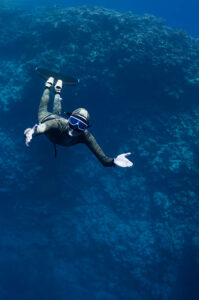
When scuba divers talk about buoyancy, the conversation usually will be about the perfect trim and mid-dive finesse. But what about the journey down—and back up? Descending and ascending may seem like simple transitions, but they’re considered basic skills that often get sidelined.
For new divers especially, mastering a slow, controlled descent while keeping good posture isn’t just helpful—it’s essential. Like any core technique, it deserves practice, attention, and a fresh look at how we train for underwater balance. Let’s know together some weighting techniques for buoyancy control.
Weighting Techniques for Buoyancy Control
Getting your weighting right is the secret to smooth, stress-free diving. Let’s break down simple weighting techniques for buoyancy control:
- Take note.
- Aim low.
- Conduct a proper weight check.
- Control your descent.
Take Note
Use your logbook to keep track of the amount of weight you’re using on each dive, and whether you are diving in salt or freshwater, it will be better to keep an exact record of the type of the used equipment:
- Note the type of the tank: steel or aluminium.
- Record the tank size: 10L, 12L, or 15L.
- Log the style of the wetsuit: short or long.
- Include wetsuit thickness: 3mm, 5mm, or 7mm.
All of these things help you to estimate accurately the amount of needed lead on the next dive. Ensure you’re writing down all the details as possible, because this will help both you and your next dive professional to decide either adding or subtracting some weight based on the previous dives.
Aim Low
Many scuba divers don’t realise that descending should take effort. If you’re sinking fast while descending, you’re likely to be over weighted.
ensure carrying as little weight as possible, especially when shore diving or visiting a dive site with challenging diving environments (It is insane to carry an extra 10kg up a beach, when all you need is eight or six).
Conducting slow descents and trying to maintain good buoyancy throughout the entire dive – safety stop – are serious skills to master, but once you have these skills in your pocket, you’ll gradually drop your weight.
Conduct a Proper Weight Check
Changing any factor, such as the diving environment, exposure suit, or even body mass – conduct a proper weight check before diving. If you are properly weighted, you should float at your eye level while holding a normal lungful of air in addition to an empty BCD.
While doing your check, take care not to kick or scull, as this will only keep you near the surface. Hang yourself vertically in the water column with minimal movement, and then exhale fully.
If you are sinking fast like a sack of bricks, you need to drop some weight. Ideally, your dive will start with you sinking slowly, while giving yourself sufficient time to equalise early and several times on your way down.
Control Your Descent
Descend like your weight check as you fully deflate your BCD and motionless vertically without kicking! Empty your lungs completely.
Make any inhales as small as possible, and emphasise the exhales, so that your out-breaths are much longer and stronger than your in-breaths. As you feel yourself start to freefall, use your abs to bring your upper body into a face down, horizontal position so that the weight of the tank can’t pull you over backwards.
Squeeze your glutes and push your belly out to bring your hips and legs up behind you, and add some air back into your BCD to avoid contacting the bottom.
It takes time in the water to really get comfortable and realise what works for you, so it’s worth experimenting not just with the amount of weight you carry, but how you carry it too.
Take time to get good at ascents and descents, and you’ll find that the rest of your dive gets easier too! Take the PADI Peak Performance Buoyancy course to further improve your buoyancy skills.
If you have your Open Water Diver certification but had forgotten some of the skills associated with ascending and descending, it may be time to ReActivate your diving skills.