When seconds count, three simple letters can mean the difference between life and death: CPR. You’ve probably heard this term in movies, first-aid classes, or even everyday conversations — but do you really know what CPR stands for?
Behind this short acronym lies a powerful skill that empowers ordinary people to become lifesavers in extraordinary moments.
In this article, we’ll break down the meaning of CPR, explore why it matters, and show how understanding these three letters could one day help you save a life.
What CPR Stands For?
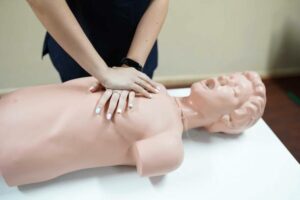
CPR is an acronym for cardiopulmonary resuscitation, and it is a medical procedure which can be used in emergencies involving a victim with cardiac arrest to improve their chance of survival.
In most cases, CPR is a combination of chest compressions besides with rescue breaths. You make these actions together as an opportunity to maintain the lost supply of oxygen to the brain and other critical organs that happened due to the failure of the heart.
Contrary to popular belief, it is important to say that CPR is not regarded as a technique to restart a heart, but fortunately, the heart can restart in rare instances.
The key function of CPR in simple words is to keep the body alive until the heart can be restarted. This helps in avoiding long-term damage to the body which can happen as a result of the absence of oxygen.
Heart-restarting treatments vary, but the automated external defibrillator (AED) is often one the easiest to access. In many countries, you can find these devices in public areas, especially in schools, malls, airports, and businesses.
If the patient has received an unsuccessful AED and the heart cannot be restarted on site, he should be transported by medical professionals to a hospital for further treatment.
When Should You Perform CPR?
In emergency situations, you must know when to perform and not to perform CPR. Generally, the clearest sign that tells you “CPR is needed” is the absence of normal breathing.
Checking for a pulse can signal a CPR need, but in high-stress moments it risks wasting critical time.
Steps of CPR
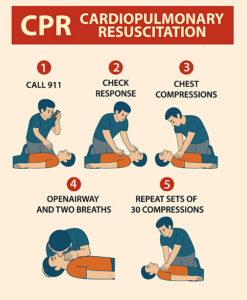
If CPR is needed, don’t forget that basic CPR is made up of:
- Scene Assessment – Ensure that both of you and the patient are safe in your area, and there is no thing surrounds you can cause danger if you decide to act.
- Chest Compressions – Perform 30 compressions by a rate of 100-120 compressions per minute. Keep your elbows locked and arms straight when leaning over the patient.
- Rescue Breaths – After conducting a set of 30 compressions, provide 2 rescue breaths. Tilt the patient’s head back to open the airway. Pinch his nose gently and administer two slow breaths.
In addition to that, it’s important to note that CPR is not a one-size-fits-all technique. The correct CPR technique for adults different from that for children and infants.
Does CPR Make a Difference?
Determining the degree of success is CPR for saving a life depends on many factors. However, in simple words, surely the victim has a better chance to survive if CPR is performed.
Where Can I Learn CPR?
CPR is a life-saving skill that everyone should be aware of. Fortunately, individuals have many different options to learn CPR. Both online and in-person courses are available to teach the basics.
With some organizations, after completing these courses, you get a CPR certification or Basic Life Support (BLS) certification (sometimes required by employers).
Emergency First Response (EFR®) offers a wide range of courses, covering the topic of CPR, in addition to many other first aid skills. The PADI EFR courses that cover CPR include the following:
- Emergency First Response Primary Care (CPR) Course.
- Emergency First Response. Secondary Care (First Aid) Course Content.
- Emergency First Response Refresher Course.
- Emergency First Response CPR & AED Course.
- Emergency First Response Care for Children Course.
- Emergency First Response Workplace Course.
Ready to acquire the needed skills and knowledge in a medical emergency? Enroll now in the Emergency First Response course with DRAR DIVING Center.