Wreck diving in Hurghada offers a unique chance to combine adventure, history, and underwater exploration. Beneath the surface of the Red Sea lie fascinating shipwrecks, each with its own story waiting to be discovered. From the historic El Mina minesweeper to the Mohamed Hasabella fishing boat and the marine life-covered Balena wreck, these sunken vessels attract divers eager to explore the past while enjoying some of Hurghada’s most memorable dive sites.
In this guide, we’ll look at the top wreck diving destinations in Hurghada and share essential safety tips for a rewarding underwater adventure.
Wreck Diving in Hurghada
If you want to practice wreck diving in Hurghada, you have three wrecks that worth visiting located in Hurghada itself:
- Balena wreck.
- El Mina wreck (El Minja) and Mohamed Hasabella .
Balena Wreck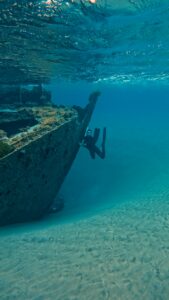
It is the wreck of a Norwegian transport boat. The boat was built in 1952 and sank in the Red Sea in 2001. The boat has a length of 41 meters and a width of 7 meters. It is very well preserved with a maximum diving depth of 9 meters. The site has strong currents.
The great advantage of scuba diving on Balena wreck dive site in Hurghada is the abundance of flora and fauna. Here, you can spot various species of nudibranchs, young barracudas, shrimps, lionfish, pufferfish rays, and a great variety of other species of fish. You can also find beautiful, colorful soft corals growing on the wreck. Due to the shallow depth, divers with an OWD license are able to dive on this wreck, too.
El Mina wreck (El Minja) and Mohamed Hasabella
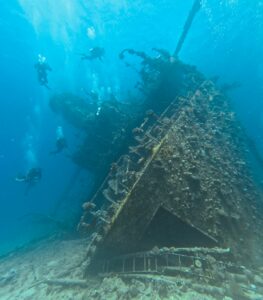
El Mina wreck was an Egyptian minesweeper that was built by the Russians. The sunken boat lies on its port side. The wreck has a length of 70 meters, with a depth of 24 meters from its right side to 30 meters from its left side. The sinking of the boat mostly happened due to its bombing by an Israeli fighter in 1969.
The wreck is marked with a buoy attached to the stern. The location of the wreck is near the new marina of Hurghada, on the bottom which is sandy and rocky, so you will dive here in a slight poor visibility. On the right side, close to the bow, there is a large hole that you can swim into – watch out for the sharp edges of the wreck. Because of its depth, Only scuba divers with at least an AOWD level can access this wreck.
The wreck of the Mohamed Hasabella fishing boat is another wreck that is located a few minutes of swimming from the El Mina wreck. If you are an experienced diver with good air consumption, you can visit both the two wrecks in one dive.
When scuba diving in Hurghada in Egypt, it is worth diving on wrecks. Diving in wrecks is different from those on coral reefs, but some scuba divers may find them interesting and exciting.
Wreck Diving in Hurghada– Safety Rules
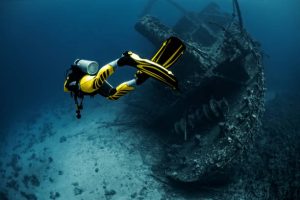
Before exploring the fascinating shipwrecks of Hurghada, it’s important to understand the basic safety rules, including the following:
- Currents during wreck diving
- Sharp edges on wrecks
- Poor visibility during wreck diving
- Depth
- Stability of Wreck Elements
- Entanglement During Wreck Diving
- Underwater life on wrecks
Currents During Wreck Diving
Quite often when scuba diving on wrecks we encounter currents. When scuba diving in Hurghada on the El Mina wreck (El Minja), you are expected to dive in a strong surface current. After delving into the water, you should hold on to the current rope, then swim to the rope placed along the side of the diving boat, and pull yourself along it until you reach the descent rope.
You should hold the descent line with the right hand, and use your left hand for the inflator on order to control buoyancy both while submerging and ascending. If groups pass each other on the descent line, priority is given to the group that has completed the dive and emerges from the wreck.
Sharp Edges on Wrecks
Many wrecks feature sharp edges. You shouldn’t get contact with them while maintaining neutral buoyancy. You should wear gloves while wreck diving in Egypt.
Poor Visibility While Wreck Diving in Hurghada
When scuba diving on some wrecks in Hurghada, the visibility is expected to be poorer when comparing it to diving on the reef, when diving on the Balena wreck for example. Also on El Mina (El Minje) the visibility is usually not spectacular.
Depth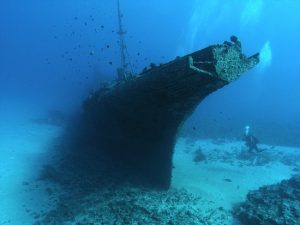
Many wrecks here are located at great depths. Therefore, if we want to visit sunken boats at a recreational dive, you should have at least an AOWD license, which enables you to dive to 30 meters. Diving with nitrox here is also a good idea, which enables you to extend the no-decompression time when compared to scuba diving with normal air.
El Mina wreck (El Minja) in Hurghada – has a maximum depth of 30 meters, wrecks on Abu Nuhas – with a depth between 12-25 meters, Balena wreck in Hurghada with a maximum depth of 9 meters. All these wrecks will be available when getting an OWD license.
Stability of Wreck Elements
Sunken boats are affected by corrosion and are exposed to sea currents and waves. Over time, these factors can collapse their parts. If you have any doubts about your safety before diving in the wreck, never risk entering it.
Entanglement While Wreck Diving
Fortunately, you will almost certainly get entangled in fishing nets when wreck diving in Hurghada. However, Sunken boats may contain cables and other structures that can potentially trap a diver. For this reason, you should pay close attention to the spot in which you are swimming and if you get entangled, all you need to do is to:
- Stay calm.
- Check the air pressure in your diving cylinder.
- Ask your dive buddy for help.
To guarantee your safety underwater, it is best to take a knife with you while wreck diving (It should be positioned so you can easily reach it with each hand).
Underwater Life on Wrecks
Wrecks are usually considered a home to diverse marine life. Balena wreck in Hurghada is an example, which is a type of “kindergarten” for young individuals of many species. You can also spot sea urchins and lionfish inside the wreck – So if you need to hold onto an edge, do that with great care.