Is talking about diving communication systems an incredible topic for you? As an enthusiast of diving, have you ever asked yourself,” How do divers talk underwater?”. Well, humans through the ages have invented many types of gestures, sounds, drums, symbols, smoke signals, and paintings as a type of communication.
We have thought of everything to express feelings, inform, persuade someone or stay in touch on the land, so, what have divers invented to communicate underwater?
Many people dive to disconnect, but that doesn’t mean that they don’t have something to share. In this article, we will tell you all you need to know about various underwater communications systems. Still interest!! Keep reading.
1- Hand Signals Underwater
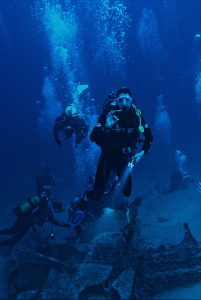
For most divers, to communicate underwater, you just make simple manual signals and gestures to other divers, but if you want to go deeper, you can get a seat in the initial OWD course where you will learn to communicate underwater by using signal code to say something like “are you ok?”, “I have a problem”, “everything is ok” etc…
If you are an advanced diver who do deeper divers, you will need to be more precise for example in indicating the gas remaining in your tank. This can be done by using technical diving communication signals.
As a detailed example, you need to indicate by numbers how much pressure is in your tank. Only by hands, you can say members from 1 to 5 by facing your palm out and pointing the fingers upwards. while for numbers from 6 to 9, use your palm facing in with your fingers pointing side.
To refer to the number 0, make a complete circle using your fingers and thumb. Divers can also indicate the depth and the time with the help of this communication system.
If you are interested in cave diving, you can search about the international underwater communication system that is standardized for cave diving. You will find it a little different to what we have explained.
This is a brief paragraph about hand signals underwater which is consedered the easiest diving communication system to use, if you want to learn more you can read this: Up to 20 Hand Signals You Should Know Underwater.
2- Light Signals Diving Communication System
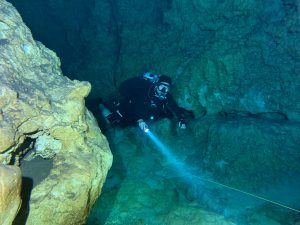
As an advanced diver, you don’t dive in overhead environments, but you usually perform a night dive using limited visibility similar to these of caves, so using light signals in this case as a diving communication system is the best choice.
As a short brief, if you want to ask your diving body if he is okay or to answer that everything is okay, make a circle with your primary light beam. While if there is something wrong and you want to get your buddy’s attention, move the light beam from one side to the other.
In night diving the hand signals diving communication system in which the diver uses two hands have been modified. These modifications include:
- Signals are done using one hand.
- Raising a hand to signal is useless.
- You shouldn’t point the light beam on the buddy’s face, just point it down or sideways at the signaling hand.
3- Sound-making Devices Diving Communication System

This type of diving communication System is preferred for some divers and guides. Tt depends on the devices which can be metal objects that make a sound when you hit the tank with and by this you will get the attention of your partner.
As another example, you can use gadgets that use the air in your tank to create sound when you press a specific button connected to the BCD’s inflator.
Despite the advantages of this type of communications and its good visibility, there is a big problem, The problem is that you can’t indicate the direction of the sound’s origin, as sounds underwater seem to come from all directions. So, this type is used only to verify if the buddy is underwater, but you can’t follow the sound’s origin to find them.
4- Written Dive Communications
Among all diving communication systems, the dive slate is considered a lifesaver. It consists of pieces of plastic which similar to whiteboards and comes with an attached wax pencil.
These slates can either be large which used in writing complete sentences or compact and clipped onto the wrist and can be come with magnets. Another type like dive notebooks contains multiple thin plastic sheets.
5- Communication by Body Contact
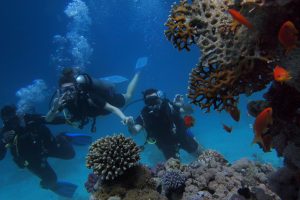
On diving in low visibility environments, it is a must to communicate regularly with your diving buddy. The communication by body contact is the suitable type for severely reduced visibility environments, as the physical contact is considered the only way to talk.
There are standardized scuba diving communications protocols made for cave divers to follow in zero visibility situations. These protocols involve holding your partner’s arm and using physical contact by arms as hand signals to communicate or give instructions to emerge safely from the cave.
6- Tech Communication Systems Underwater
As we mentioned before, communication is very important underwater, you need to communicate with other divers while exploring the ocean, collecting data, coastal security, and for your safety too. Technically, there are many ways to send information, such as using optical, acoustic and electromagnetic waves.
A)- Underwater Acoustic Communication
With the improvement of technology and using modems to send information wirelessly. We have invented devices called transductors which used for picking up the sound signals and turning them back into digital information.
Acoustic modems are considered a special type of modem. Its job is to turn digital information into sound signals that can then travel underwater. This technology used in the transducers is useful in many things such as:
- monitoring the ocean.
- talking to divers.
- controlling underwater robots.
There is one problem in this acoustic communication related to the distance between the beneficiaries, as it is hard to send information over long distances because the further the information has to travel, the weaker the sound signals become and so, it will be difficult to get it.
B)- Underwater Optical Communication
This type of communication is based on the transmission of electromagnetic waves in the visible spectrum. the attenuation of the signal depends on the turbidity of the water and also the absorption of it in a way like the colors are absorbed.
Now, the underwater telecommunications industry is working on modern systems which will be hybrid communication systems combining the advantages of technical diving communication systems. In this way, the signal will transmit through different channels by breaking down into replicas of the original signal that helps in avoiding fading.
c)- Underwater Electromagnetic Communication
We can use electromagnetic waves to communicate underwater as in radio frequency. RF waves can be easily stopped by the water. The higher the frequency of the waves, the more the seawater’s ability to stop them.
Only extremely low-frequency waves can travel far away through water. This is very useful for submarines to communicate underwater. The disadvantage of this type of communication is that it needs a big antenna and the signals still get weaker as the distance that the signals will travel through is big.