On diving with a partner, good communication between you is essential if you want a safe and enjoyable dive. Underwater, you can use your hands to give directions, ask your buddy if they are ok or not, how much air is remaining with them or inform them that you have a problem and need help.
But, what about diving in low visibility? If there is a slit or plankton that affects the visibility underwater, you are diving deep in the darkness or you just prefer night diving, how can you communicate with your partner in these conditions?
Well, a diver’s communication in low visibility has many shapes. Just keep reading to get more information
Diver’s Communication in Low Visibility
There are many underwater communication systems divers can use on diving in low visibility which include:
- Torch signals.
- Sound signals.
- Rope signals.
- Touch contact signals.
Torch Signals

Light signals are considered the most effective type of diver’s communication in low visibility especially during cave and night diving. Unlike hand signals, there are only a few torch signals, but they are enough to attract another diver’s attention to inform some basic messages, here are the most used light signals:
-
“Ok” Torch Signal
You can say ok with light signals by signaling a circle with your torch. It is used both as to ask ” Are you ok?” and to answer ” Ok” or ” I’m ok”.
Like the “Ok” diving hand signal, it is a demand-response signal, as your buddy should respond to you back with another “OK” signal. If you don’t get a reply, you should find out why. Your buddy may be in trouble, struggling with something or simply looking elsewhere.
-
“Attention” Torch Signal
There are two ways to attract your buddy’s attention. The first method, wave your torch up and down in a slow and controlled motion, which means it isn’t an emergency and you just want to attract his attention.
The second method, make a circle around your buddy’s beam and drag it to where you want him to look. You can signal this when you want to communicate directions or to show him some cool critter.
-
“An Emergency” Torch Signal
If you are in an emergency situation, wave your torch back and forth in a horizontal motion and repeat that quickly.
-
“Hand Signal” Torch Signal
If you want to communicate with more complicated information, make hand signals in front of your torch by facing the torch light to your chest, then make the hand signal you want.
Tips on Torch Signals
- When you want to make a light signal and your buddy is looking in your direction, don’t shine your light directly in his face. Just point your light down or to the side.
- In a panicking situation, A diver may forget about the distinction between the horizontal and the vertical flashing signals. So, it is best to assume that when your buddy makes sudden and fast flashings means he is in an emergency situation until proven otherwise.
- If you get separated from your partner, stand up vertically and shine your torch outward while turning a full circle. If your buddy has found you, they should respond with the same signal.
- When ascending to the surface, but you are far away from your dive boat, point your light at the boat until you are sure that you got the crew’s attention, then shine it down on your face to be seen well.
- Make sure that you know the simple torch signals well by reviewing them with other devices before making a dive.
Sound Signals
On diving in low visibility, sound signals aren’t considered an effective type of communication. If the diver isn’t using a special underwater communication system to talk, they have very little things to convey through sound.
You can attract your partner’s attention by making a noise such as hanging in your tank, however, underwater, it is an extremely difficult thing to determine the direction and the distance of the sound source.
So, even if your partner hears you, it is difficult for him to find you and unfortunately, if there are any currents, the high flow will sweep the sounds away as the wind does.
Rope Signals
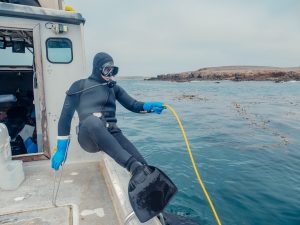
This type of diver’s communication in low visibility is used when visibility at the diving site is below 6.5 feet (2 meters), as in this case, you should use a buddy line to maintain good contact with all the diving group.
If the visibility is below 3.2 feet (1 meter) a lifeline from the surface to you or your buddy will be an important thing to do.
The importance of that buddy line or lifeline lies in that you can make basic communication using this rope. There are no standards in the rope signal system, as a result, every organization uses its own different signals.
Touch Contact Signals
If you and your diving buddy are swimming along the line and you can reach your buddy’s arms or legs, you can use touch contact signals. The basic touch contact signals include:
“Go” Touch Contact Signal
As a rear diver, if you want to say ” Go” to the lead diver or to signal that everything is okay, make the ” Go” signal by pushing on his arm or leg.
” Stop” Touch Contact Signal
If you want the lead diver to stop, just pull his arm or leg.
” Back Up” Touch Contact Signal
This signal is for asking for help, if you are facing a problem, just repeat the ” Stop” signal intensively.