Through scuba diving, people may fully immerse themselves in the wonders of marine life and ecosystems, providing a riveting peek into the undersea world. Divers’ experience and safety are improved by knowing the many kinds of dives, in addition to the fundamental gear and skills. Drift diving, semi-drift diving, and Shamandora diving are three of these that are particularly distinctive and provide different difficulties and opportunities.
Drift Dive: Floating Along with the Flow
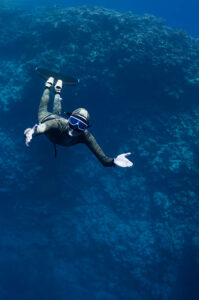
In drift diving, divers let the natural ocean currents carry them along, much as when they fly underwater. In contrast to conventional diving, which involves swimming against or across currents, drift diving entails swimming with the flow, skimming over reefs and over underwater scenery with ease.
Important attributes:
-
Current Dependent: The predominant currents at the dive location play a major role in drift dive operations. Divers follow the current, which dictates where they go in and out of the sea.
-
Effortless Exploration: Longer dives and more exploration are possible since less energy is used swimming because divers are carried by the current.
-
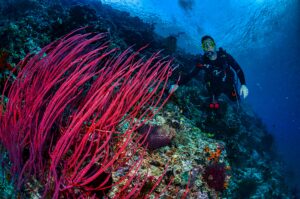
Beautiful Scenery: Divers may enjoy unrivaled vistas of underwater ecosystems during drift dives, which frequently occur behind walls filled with marine life or along beautiful coral reefs.
-
Drift diving may be thrilling, but it also calls for sophisticated buoyancy management and navigational abilities. Divers must stay at the right depth and distance from the reef in order to prevent collisions and harm to the delicate marine ecosystems.
Semi-Drift Dive: Juggling Currents and Control
Both drift diving and conventional diving methods are used in semi-drift diving. Semi-drift dives allow divers to take advantage of the current while maintaining some degree of control over their motion.
Important attributes:
-
Partial Current Utilization: Semi-drift dives require divers to actively control buoyancy and propulsion in order to move through the water, in contrast to drift dives, when divers completely give themselves up to the current.
-
Versatility: Semi-drift dives are appropriate for a broader variety of ability levels because they strike a compromise between the thrill of drifting and the control of standard dives.
-
Adaptable to Conditions: Divers may modify their direction and pace to account for changing underwater topography and current strengths, which improves safety and pleasure.
-
Enhanced Dive preparation: To ensure a smooth and enjoyable dive, successful semi-drift dives need meticulous pre-dive preparation that takes into consideration current patterns, entrance, and departure sites.
Shamandora Dive: Deciphering Mysteries in Underwater Caves
Discovering underwater cave networks, or cenotes, is the exciting but difficult specialty of scuba diving that is known as shamandora diving.
Important attributes:
-
Underground Exploration: Shamandora dives transport participants to the bottom of caverns and cenotes, where sunshine permeates the earth’s cracks and reveals stunning rock formations and glistening pools of water.
-
Technical Expertise: Shamandora diving requires specialist training and equipment, including cave diving certification and experience with cave navigation procedures, because of the particular environment of cenotes.
-
Safety Measures: Because cave systems are contained, there are certain inherent risks. These risks include limited sight, possible entanglement hazards, and the potential for disorientation. Ensuring proper safety measures, such as consistently following guidelines and carefully planning dives, is crucial.
-
Despite the difficulties, Shamandora dives provide access to pristine underwater environments that are frequently home to unusual creatures that have evolved into the cave environment. Divers may come to captivating structures like stalagmites and stalactites.
Finally, it should be noted that scuba diving offers a wide range of activities, from thrilling drift dives to challenging cave exploring. Divers of various interests and ability levels can find something to suit them on each given type of dive, which comes with its own set of rewards and difficulties. The world below the seas welcomes explorers to explore and uncover its delights, whether they want to glide easily with ocean currents or trek into the enigmatic depths of cenotes. Happy and safe diving!