In the scuba diving world, the Dive watch is one from the few iconic dive accessories. But what exactly sets the dive watch apart from other scuba diving equipment and accessories.
In this article, we will dive deep into the intricacies of dive watches, explore the construction of them, functionality and why they are considered a staple for both professional and recreational divers. Let’s go deeply into the fascinating world of dive watches.
What’s a Dive Watch?
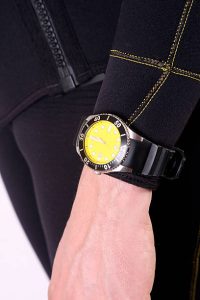
The dive watch is a watch that is designed to withstand the underwater pressure until 100 meters (330 feet) deep. Of course, scuba divers don’t reach that depth but this rating is to ensure that the watch can bear to recreational depths 18 meters (69 feet).
It’s important to say that not every waterproof watch is a dive watch. When you say that a watch is water resistant means it’s designed to hold up in humidity as when getting contact with splashes of water.
On the other hand, a waterproof watch is a watch that can bear certain depths, but usually unable to withstand the pressures while scuba diving.
The Differences Between the Dive Watch and the Dive Computer?
A dive watch is a watch that is designed to withstand the underwater pressures until 100 meters (330 feet) deep. It’s considered a normal watch that you can know the time from it
On the other hand, a dive computer is a digital device that can calculate several critical types of information related to scuba diving including:
- Dive time.
- Your depth underwater.
- The water temperature, etc…
Dive computers use algorithms to calculate some information such as no-decompression time. Some novice scuba divers can refer to dive computers as a dive watch because they are usually worn on the wrist but there are almost two different devices.
The dive watch tells you the time without using any algorithms, in turn it can’t calculate no-decompression limits so they can’t replace the dive computers.

Choosing a Dive Watch
Whether you choose to focus on the style, practically or function, choosing a dive watch is almost up to you. But here are some points to take into consideration:
The Size
There is no specific size that can be called the right size, but you should put into consideration the distance between lugs, which is the dimension between the attachments of the bracelet or strap from top to bottom.
This distance should be less than the width of the Watch in order not to get an overhang watch. For example, if a man has a wrist up to cm (7 inches) around, then a watch with 46 mm (2 inches) in diameter looks best.
The Price
Have a wide range of prices. You can buy a well-crafted dive watch with a very stylish model for a price less than a smartphone without the need to worry about becoming an ancient model with the next update of the software.
The Movement
Automatic dive watches which are self winding and powered with solar are popular due to many advantages, as they are robust, convenient and accurate. In addition to that, they have the ability to be winded manually.
The Style
Do you want a dive watch which is 200 meters in length that also looks at home from your suit’s cuff? Or just a dive watch that only a scuba diver would wear? it’s up to you.