Envision sinking under the surface of the water to a calm, exotic realm teeming with colorful aquatic life and the rusting remains of lost ships. A routine dive suddenly becomes dangerous when you get hooked on an invisible fishing line. A diving knife, a little but vital piece of gear attached to your leg, keeps you cool when panic breaks out. This invaluable instrument has the power to distinguish between a slight annoyance and a potentially fatal circumstance. More than merely cutting instruments, dive knives are vital safety equipment that each and every scuba diver has to have on hand. Explore our guide to learn why these knives are essential for any underwater expedition.
The Use of Diving Knives
During a dive, diving knives perform a number of crucial tasks:
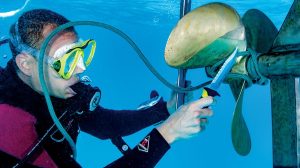
- Emergency Cutting Tool: Nets, kelp, and fishing lines are examples of entanglement risks that divers may run across. A diver can be easily released from these entrapments using a diving knife, averting stress and possible mishaps.
- Equipment Maintenance: Underwater adjustments and repairs to diving equipment can be made with dive knives. For a safe dive, cutting away broken straps or untangling tangled gear might be essential.
- Spearfishing: A dive knife is necessary for spearfishers in order to quickly and humanely remove their catch of fish.
- Safety Signaling: Hitting a tank with a knife can provide an auditory signal to draw attention in poor light or during an emergency.
- General Utility: A diving knife comes in helpful for a variety of underwater activities, from scraping away marine vegetation to prying open things.
Essential Elements of Dive Knives
To make sure the diving knife you choose fits your demands, take into account the following features:
- Material: Titanium or stainless steel is frequently used to make dive knives. Although they are inexpensive and long-lasting, stainless steel knives need to be maintained often to avoid rusting. Although titanium knives are more costly, they are lighter and have a high level of corrosion resistance.
- Diver knives are available with a variety of blade styles, such as serrated, straight, or a mix of both. While a serrated edge works well for cutting through harder materials like rope and netting, a straight edge works well for slicing.
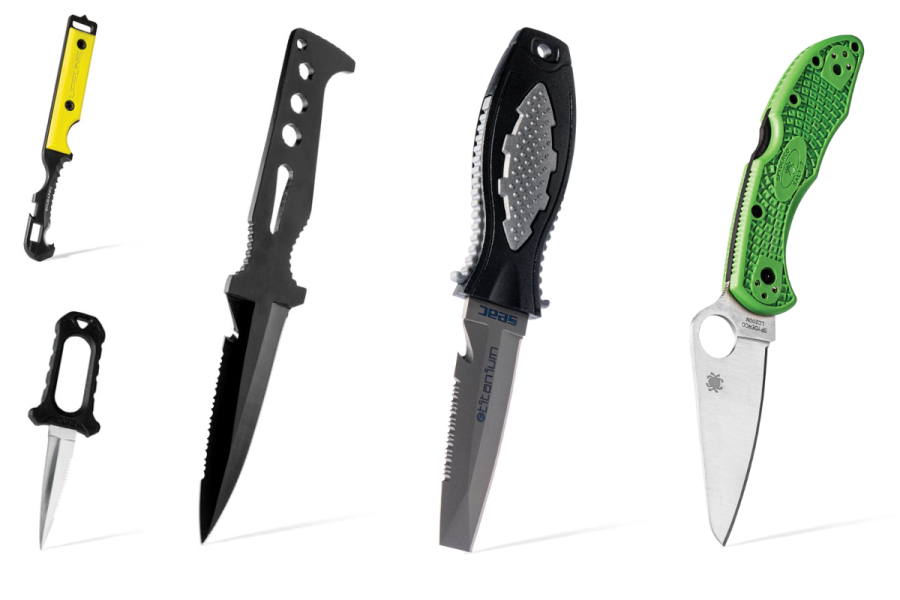
- Style of Tip: Knives can have tanto, blunt, or pointed tips. Pointed tips can be dangerous if not handled cautiously, although they are adaptable for a variety of jobs. For digging or prying, blunt points are safer and more effective. Tanto tips provide a powerful and accurate combination.
- Size: There are tiny, lightweight types of dive knives as well as bigger, more durable ones. While a bigger knife has more cutting power, a smaller knife is more manageable and convenient to keep.
- Sheath and Mounting Options: For convenience and safety, a safe and easily accessible sheath is essential. Leg straps, BCD (buoyancy control device) mounts, and hose attachments are typical mounting options. Select a mounting solution that permits simple access without impeding mobility.
- Handle Grip: Even with gloves on or in the rain, a firm handle grip guarantees that the knife can be grasped firmly. Textured grips and ergonomic features improve use.
Best Scuba Diver Dive Knives
These are a few of the top diving knives on the market, chosen for their dependability, style, and usefulness:
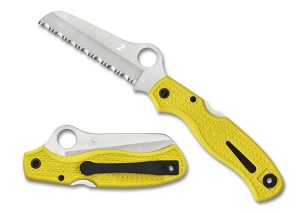
- Spyderco Atlantic Salt: This knife’s serrated edge and blunt tip, together with its rust-resistant H-1 steel construction, make it ideal for slicing through difficult materials without running the danger of unintentional punctures.
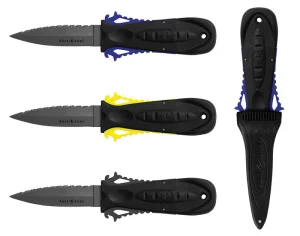
- The small knife, known as the Aqua Lung Squeeze Lock, is equipped with a special locking mechanism that ensures the knife stays safely inside its sheath. It comes in titanium or stainless steel and has both straight and serrated edges.
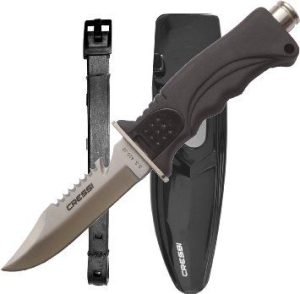
- Cressi Skorpion: This style of multipurpose knife has a pointed tip and a combined blade with a straight and serrated edge. The handle’s ergonomic design guarantees a firm grip.
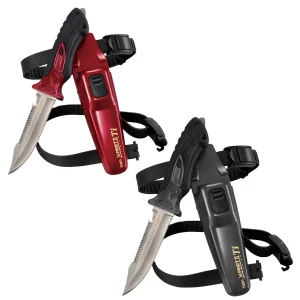
- FK-940ti X-Pert II from TUSA: This knife is made from premium titanium, is corrosion-resistant, lightweight, and has a tanto tip for precise cutting. Easy access is ensured by the quick-release sheath.
An essential equipment for any scuba diver, a diving knife may be used for cutting, prying, and signaling in a variety of underwater situations. Through comprehension of the essential characteristics and selection of a premium knife that fulfills your diving requirements, you may augment your safety and readiness for each dive. A dependable diving knife is an indispensable tool that may greatly enhance the safety and enjoyment of any underwater activity, be it exploring shipwrecks, kelp forests, or just taking a leisurely dive. Happy and safe diving!