Depending on where you are practicing cave diving, you may experience completely different types of underwater caves.
If you are a cave diver who wants to gain valuable information about caves, dive with us in this article to satisfy your curiosity about the different types of underwater caves.
Types of Caves

Under the deep blue, you can find different types of underwater caves that differ in the nature of their formation, as well as how to dive in them, or even whether they are safe for scuba diving or not.
- Sumps.
- Mines.
- Ice caves.
- Blue holes.
- Sea caves.
- Lava tubes.
- Coral caves.
Sumps
Sumps are the passages which are filled with water in dry caves. This is considered from the original and less refined originations of sidemount diving.
Sidemount diving is different from cave diving in that sump divers are usually trying to move from a dry cave area to another using different scuba gear because they have to crawl and climb their way through cave systems rather than swimming.
Mines
Flooded mines gain popularity as they allow scuba divers to explore caves in the places that don’t have natural caves.
Mines are considered more inherently risky to dive than natural underwater caves because they are created by man without having the intention to be flooded and explored by scuba divers. Cables and other equipment can pose additional risks.
Strip mines don’t usually have an overhead environment, on the other hand, both shaft and tunnel mines may have. Tunnel mines are regarded as the most similar to the traditional underwater caves because they may contain one main passageway in addition to multiple side passages.
Ice Caves
Ice caves are considered both incredibly dangerous and rare. They are formed when water flows through icebergs and glaciers.
Regardless of hypothermia, the constant freezing and refreezing of ice make it very rare to find a scuba diver who is interested in exploring ice caves.

Blue Holes
Blue holes are very similar to solution caves, as they are formed as a result of coral growth and the differentiation in water levels that are related to ice ages.
The depth of some blue holes can be up to 200 ft. Although the hole itself isn’t considered an overhead environment, it may contain several side passages through its wall that can be qualified as caves and caverns.
Sea Caves
Sea caves are formed due to the tidal motion that results in eroding a cliff or sea wall. They don’t usually extend very far. Although, you can find a few which are significantly lower. Unfortunately, these one of the types of caves that are considered tricky to dive.
Lava Tubes
Lava tubes are considered the youngest types of caves because they are formed from the flows of lava across the surface.
After cooling and hardening the outer layer, the inner layer continues flowing through leaving a series of tubes which can be similar to solution caves. If the lava tubes are immersed in water, it will be accessible to qualified cave divers.
Coral Caves
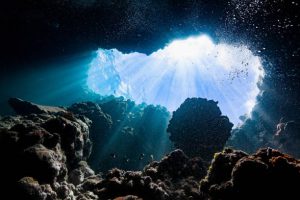
Most scuba divers in tropical areas are familiar with coral swim-throughs which are archways of coral reef which you can enjoy swimming through.
These coral swim-throughs may extend to an area where you aren’t able to see the entrance or even the natural light. That makes them similar to caves or caverns.