


When it comes to entering the water, scuba divers have 3 Ways to start a scuba dive. Don’t ever think they are as easy as they might look! You should agree on the dive plan with the rest of the group and decide what you are going to do on your diving day.
Your plan will depend on many factors including the type of your boat or entry point, in addition to the conditions of both the water and weather of that day.
In our article, we are going to give you a close look at the three main ways to enter the water from a boat when scuba diving, so you know which one to choose for the next adventure beneath the waves.
3 Ways to Enter the Water From a Boat When Scuba Diving
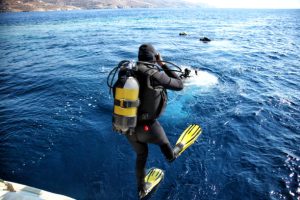
As a scuba diver, you have 3 different ways to enter the water from a boat when scuba diving:
- The giant stride.
- The backwards roll.
- Negative entry.
The Giant Stride
The giant stride technique is your best choice when being in bigger boats like yachts or liveaboards or any entry where you need to drop yourself to get in the water.
To perform the giant stride technique que, it is necessary to put on all of your scuba diving equipment (ensure to perform a buddy check before jumping) and face the water.
After standing on the end of the entry point or boat, it is important to ensure you have enough air in your BCD (buoyancy control device) to guarantee you will be positively buoyant on the water’s surface. Having completely full BCD is wrong because this will cause a great impact when hitting the water. To keep both your mask and regulator in place, Place the palm of the right hand on your face, and use your left hand to hold your weight belt to ensure it won’t open and fall off in the water.
Look forward and take a big step, you will go underwater for a while, then bob straight back up. Now it’s time to make your BCD fully inflated and remove your regulator from your mouth, put a snorkel on your mouth if you want to replace it when the water is choppy.
The last step is to signal “OK sign” to the other divers on the boat or shore and wait for them to join you in your adventure beneath the waves.

The Backwards Roll
If you are scuba diving from a zodiac or any other small boat, the backwards roll technique will suit you more than the giant stride one.
To perform the backwards roll technique, first put on all your scuba diving equipment (don’t forget the buddy check) ) and sit on the boat’s edge while making your back to face the water.
Hold your weight belt using your left hand, and wear both your mask and regulator in their place with your right palm, then push yourself in the water with a mostly full BCD not only in order to soften your blow but also to allow you to be positively buoyant on the surface. Just as you do in the giant stride technique, fully inflate your BCD when you become in the water, remove the regulator (replace it with a snorkel if you need), and signal (ok sign) at the end.
Negative Entry
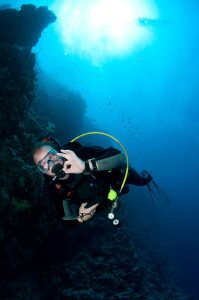
The last technique in our list for the ways to enter the water from a boat when scuba diving is the negative entry technique which is also called a negative buoyancy descent, this technique adapts the previous techniques allowing you to head straight underwater to start your dive, instead of going up.
If the dive site has strong currents on the surface or big waves, you can separate from your dive group easily. Thanks to this technique, you can all jump together with other group members and descend immediately, then meet again deeper in the calm conditions.
To perform the negative entry technique, first put on your scuba diving equipment, perform a buddy check, ensure that you have all you need, including diving cameras and extra items because getting back to the boat is very hard after starting your dive.
Choose one of the previous techniques (depending on which one appears to be suitable), and use it. Before entering the water, ensure to hold your weight belt and keep the scuba mask and snorkel firmly in their place.
This time, your BCD will be empty. If a buoyancy check has been performed before scuba diving, you will still be positively buoyant on the surface even when using an empty BCD without the need of extra weight.
You need to exhale once you hit the water, just like when you do in a buoyancy check. A full exhalation will send you underwater successfully. While descending, position your body with your feet down or even with your head down, and ensure to keep your body as straight as possible to remain streamline. Meet other dive buddies and continue diving together.

Things to consider when performing a negative entry:
- Equalize several times: You will be descending fast while thinking about many things. But your ears should be at the top in your priority list. Once you hit the water, equalize your ear, and several times as you can while descending, before feeling any pain or discomfort. Remember that pushing your ears can cause long term damage, or just cut your dive short if you are lucky.
- Discuss your dive plan with other dive buddies: regardless of the regular dive briefing, it is essential to agree the depth at which you will meet up with other buddies after doing the negative entry technique (which is usually 10m/33ft). You should also agree on a plan in case of separation or be unable to find other members of the group. Ensure to count yourself when you meet up again underwater.
- Check dive gauges: ensure to keep a close eye on your depth while descending, you can easily dive deeper than you are supposed to. A good trick to avoid this is to add a little air into the BCD while you descend to slow you down, keep adding another amount of air until you reach neutral buoyancy at the agreed depth.
Now you have all the information you need about the 3 main ways to enter the water from a boat when scuba diving, so you can now make an informed decision of the best way by which you enter the water for a dive.
It is better to practice these techniques in calm waters before you try them out in waters with strong currents or big waves. If you feel uncomfortable about diving in a specific dive site having rough conditions, trust your gut and don’t dive there.
Happy Jumping!


