Underwater photography is one of the fascinating hobbies that you can have as a scuba diver and it also seems like a good and easy switch for any experienced photographer.
However, there are some common light challenges that face underwater photographers in the deep blue. These challenges require a little adjustment to get the same high quality you may be used to.
Like photography on land, it is essential to understand the role of light in underwater photography to be able to correctly compose your images. Let’s take a look at the three common light challenges that face underwater photographers in the unique environment beneath the waves.
Common Light Challenges That Face Underwater Photographers

In the unique underwater environment, there are some challenges that underwater photographers face to take high quality photos, among these challenges is light challenges. Here are 3 common light challenges in underwater photography:
- Refraction.
- Light absorption.
- Color absorption.
Refraction
Light bends when passing from one medium to another, this phenomenon is called refraction. Refraction occurs when the traveling light through water passes through the glass then the air of your underwater camera, as a result of that, objects appear approximately 25 percent larger and closer than their real weights.
As an underwater photographer, you have to understand this effect, especially if you have a camera with autofocus features, as refraction can make it difficult to focus properly on the subject, leaving you with blurry images.
Using an underwater camera with an infrared autofocus assist will be a good choice, but those having laser rangefinders will have a problem on focusing, resulting in blurry pictures. Ensure that the lense of your camera always focuses at infinity or just buy a camera having a manual focus setting. Consider this 25 percent magnification when compose your underwater shots to avoid distortion and blur.
Light Absorption
It is a fact that water is considered an excellent natural light filter. It absorbs a substantial amount of light that travels through it the deeper it gets. There is a general formula for light loss underwater in which half of the light is lost for every 10 meters deep we go underwater.
So at 10 meters deep, you have nearly 50% of the light that is at the surface, and at 30 meters of depth, you just have 25% of light, etc…
Your available light won’t only be the same on the same depth, as it also depends on other factors, for example, the time of the day. Generally, the period between 10 AM and 2 PM is regarded as the best hours for shooting underwater photos, as The sun in this period is directly overhead and the surface of the water is reflecting the least amount of the light.
Weather also plays a vital role in the available light. If you are scuba diving in stormy, choppy water, this will significantly impact the light conditions in this dive spot. Water clarity obviously has an essential impact on how much light you’re getting on the shooting subjects as well. The best depth to stay within is from 0 to 10 meters if you are planning to shoot photos with natural light. If you are going to go deeper, you will need a strobe in order to illuminate the shooting subjects.
Color Absorption
Color absorption can be considered the most frustrating light challenge in underwater photography “when photos displays no hues but blue or green”. This is because that the red, yellow, and orange colors have short wavelengths of light, as a result of that these wavelengths absorb quickly in water and disappear at depths below 10 feet.
Blue and green significantly have longer wavelengths which enable these colors to reach much further into more depths. At a depth of 80 feet, blue is the only color you can see before everything turns black.
To overcome and address the problem of dull colors in your images in a common and inexpensive way, the best solution is to use color-correcting filters.
But, it is important to keep in mind that these m filters can only enhance the colors which are present in the available light without adding colors where there is not enough light to illuminate them. And the filter itself may cause reducing the amount of available light as well, so they are only suitable for very shallow waters.
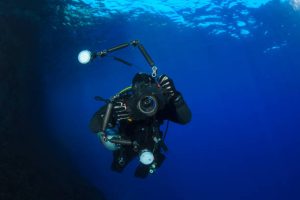
The second way to address the problem of color absorption in underwater photography is using a strobe. Most strobes have adjustable settings that enable the underwater photographer to control the output of the light for each image, making them able to create the perfect light every shot. When you get close to your subjects, this will reduce the distance that the light will travel underwater, which in turn increases the efficacy of your strobe unit.