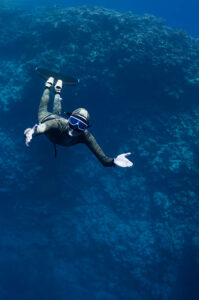
Safety stops are considered a common practice nowadays. Every scuba diver knows that he must stop at 5 meters/15 feet for 3 minutes before ascending for the aim to help off-gas the nitrogen that his body absorbed while scuba diving.
The importance of the safety stop is to unload nitrogen, to be more accurate to give your body time to release the absorber nitrogen slowly. If the nitrogen is forced out too quickly, that can create bubbles and the diver begins to suffer from decompression sickness.
Another purpose of the safety stop is to remind scuba divers to look out for any obstacles that may force them while ascending.
The History of the Safety Stop

The safety stop is regarded as a crucial part of the scuba diving experience. It helps scuba divers to safely ascent to the surface without suffering from decompression sickness.
The concept of the safety stop has evolved through decades as our understanding of the physiology of Diving and the theory of decompression has advanced.
In our article, we will discuss the evolution of safety stop through the following decades:
- 1970s.
- 1980s.
- 1990s.
- 2000s.
1970s
Recreational divers have been using many practices that taken from military divers diving with an ascent rate of 18 meters/ 60 feet per minute is firstly selected by US Navy as a compromise between hardhat commercial-type diving needy and free swimming combat scuba divers.
The navy recently has revised it to a slower rate (10 meters/ 30 feet per minute). In 1974, Andrew pilmanis made the first study on safety stops in which he examined ascent rated and its effect on bubble formation in the bodies of scuba divers.
1980s
In the 1984 edition, the PADI Open Water Manual started to recommend safety stops. The recreational dive planner introduced safety stops to a more wider audience in the release of 1988.
This step besides the PADI’s S.A.F.E diver campaign was considered a big help in divers education. Slowly ascending from every dive became a common acronym for scuba instructors along with new scuba students.

1990s
In 1994, Donna Ugyccion i-who is a graduate student- expanded on the work of pilmanis’s studies from the 1970s and wrote her Master’s thesis on safety stops.
In her studies, she has proven that scuba divers who practice safety stops while diving have less bubble formation in the bloodstream more than others who don’t by using the doppler tests to determine that accurately.
All of this along with the popularity of dive computers had a great resonance in the awareness of the importance of safety stops.
2000s
Today, safety stops are regarded from obvious considerations that are very beneficial for all scuba divers. Almost no diver dream of not doing safety stops.
Now, with a dive computer around your wrist, you can be reminded by the time of the safety stop. This simple practice has made scuba diving a safety practice in many ways.
Now safety stop is considered rudimentary enough to be surprised to realize that it wasn’t even common 30 years ago.