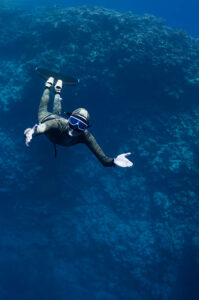
The importance of a safe accent from depths should be the first thing to learn when you begin scuba diving.
It all boils down to Bowle’s law and the physics of scuba diving which explain how nitrogen is expelled from the body during an exhale through the skin. It all begins when you start breathing decompressed air due to the ambient water pressure.
The nitrogen is absorbed in your body and remains in the fatty tissues and blood. More nitrogen is absorbed into your tissues as you dive longer and deeper. Actually, there is no problem as a diver remains at pressure but when the pressure around the scuba diver decreases during ascending, the nitrogen starts coming out of your tissue back into your bloodstream.
If the pressure around him is reduced too quickly while ascending, the nitrogen starts forming bubbles in his tissue and bloodstream rather than being exhaled.
This process seems too much like when you open a can or bottle of soda, releasing the pressure causes the carbon dioxide gas to lose its solubility and escape in the form of fizz or bubbles. This is known as “Decompression Sickness” which is also called “The Bends”.
So, the question is how to make a safe ascent. In this article, we will explain to you the 5 point scuba ascent in scuba diving.
What is the Qualification of a Safety Ascent?

This may seem like a trivial question but it’s one of the most asked questions and debated ones about scuba diving.
Some scuba organizations recommend 18m/60ft per minute to be the maximum ascent rate for scuba divers. However, this maximum ascent rate still results in some cases of decompression sickness among scuba divers.
Today 9m/30 feet per minute is generally more accepted as a safe ascent rate by scuba organizations and dive computers. For divers who haven’t got a dive computer which is a thing we don’t recommend, follow your smallest ear bubbles.
Almost all scuba organizations see that you must dive with a dive computer to be able to monitor depths as it alerts you when your accent is too fast, as it is now a standard feature in most dive computers.
How to Make Your 5 Point Scuba Ascent Perfectly?

Making the 5 point scuba ascent is taught in the PADI Open Water course by the acronym S.T.A.R.S:
S for Signal
Give the clear ready by making the start ascending hand signal (thumb head up signal) and wait to receive confirmation from all scuba divers that they understood that the dive is ending.
T for Time
Look at the time that is indicated on the dive computer you have to ensure you didn’t exceed the No.decompression limit.
If you exceed it, put into consideration to make decompression stops at the recommended depths and don’t forget to signal to your dive buddy for a confirmation. Don’t forget to time and fully complete your safety stops.
A for Airway
Look up and ensure there is a direct path to the surface. Search for obstacles such as boats and avoid them.
R for Reach
Make the ok signal to your boat or fellow divers by extending your arm above your head that also protect your head from hitting on anything that may arise above you. After that, turn around to keep track of anything behind you.
S for Swim
Swim slowly as you can to the surface. Don’t use your BCD to ascend until you surface. Once you become at the surface, inflate your BCD to help keep you buoyant.