If you are interested in scuba diving and want to give it a try as a sport, passing an open water diver course will be your first step to doing so.
You can find several scuba certification agencies that offer this basic course that teaches you the basic skills of scuba diving that are required to enjoy independent,safe diving without the help of a dive professional.
Scuba certification agencies differ from each other in several points, such as syllabus, styles and courses but all of them almostly cover the same basic skills in the open water diver course. Here is what you will learn in your Open Water Diver’s journey.
What You Will Learn in Your Open Water Diver’s Journey
In an open water diver course you will learn almost all the basic scuba diving skills that you will need to delve in the scuba diving world independently. We can divide the knowledge you will get her into two parts that we will discuss below.
- Practical skills and learning.
- Theoretical knowledge.
Practical Skills and Learning
- How to prepare and assemble your scuba diving equipment and gear properly for a dive and also how to disassemble it post-dive.
- How to properly make a pre-dive safety check. Ensure both your scuba diving equipment and your buddy’s equipment is in place and and are working properly before diving.
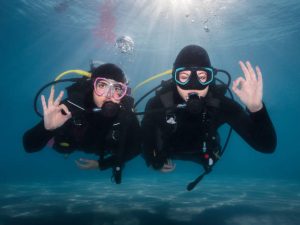
- How to make hand signals underwater in order to signal your dive buddy in emergencies and other situations.
- Learn about different scuba diving water entry methods, such as giant stride method, wading/shore entry, back rolee and seated entry.
- How to clear and recover your regulator in case of knocking out of your mouth.
- Several scuba mask’s skills, for instance how to properly clear a fully/partially flooded mask properly underwater. How to remove and replace your mask completely while breathing underwater.
- How to properly use the alternate air source of your buddy. Signaling to your dive buddy when you are out of air, then securing his alternate air source and conducting a safe ascent together.
- Buddy breathing. How to share one air source between you and your dive buddy as if you are in an emergency situation then ascending safely to the surface while buddy breathing.
- Buoyancy control. How to hover and regulate your buoyancy successfully underwater.
- Conducting proper ascents and descents by following safe methods.
- BCD Oral Inflation. Learn how to properly inflate your buoyancy control device / buoyancy compensator if the inflater can’t function properly.
Theoretical Knowledge
- Scuba Gas Laws which include, Henry’s Law, Boyle’s Law and Charles Law.
- How to read Dive tables.
- How to plan for your dive and calculate the dive times and decompression stops.
- The scuba diving risks.
- All you need to know about Decompression Sickness.
- Scuba diving safety rules.
You can find several scuba diving agencies offering more advanced skills in their Open Water Dive Course, such as, no mask swimming, underwater navigation, scuba unit removal and replacement, etc…
Just ensure you can properly learn and practice the mentioned skills in your Open Water Diver course. All you need to scuba dive with a buddy with confident is to be fine underwater.