Underwater navigation is almostly one of the hardest skills for a new scuba divers to grasp and also for experienced ones to get the hang of, especially when visiting new dive sites.
As scuba divers, we are used to following our Dive master and we don’t even make a note of where we are or the place of the dive boat until we get back to the anchor line and wonder how we got back full circle and didn’t even notice that we changed the direction!
In this article, we will give you some tips to ingrain your underwater navigation skills, so you don’t get lost again underwater.
Tips for Underwater Navigation
Underwater navigation is the process of determining and maintaining a course or position while submerged. It is considered a crucial skill for scuba diving.
Unlike surface navigation, underwater navigation faces unique challenges, such as limited visibility, lack of GPS signals, and the complex nature of the underwater environment.
The following methods often work in combination to ensure accurate navigation in the challenging underwater environment:
- Visual references.
- Compass bearing.
- The briefings of the dive site.
- The maps of the dive site.
- Dive site guide States.
- Draw a map on your dive slate.
Visual References
Before you jump into the water just take a few seconds to get things around you and keep it as a form of visual differences.
- Look at the position of the sun to help you determine your direction underwater.
- Note if the island, land mass or reef has a sloping way underwater and determine whether it can be considered as a startling point or not.
- Once you become underwater, take a good look at the shape of the bottom of your boat, especially if other boots are sailing around.
- Once you start descending either along an anchor or not, take some minutes when you reach the bottom to see some features. That will help you a lot to pinpoint the location of your boat.
- Whether you are diving in a wall or a ridge, ensure to take note of the direction of diving and always make your shoulder face the terrain feature.
Compass Bearing
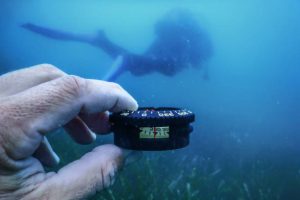
Before scuba diving, set your compass’s bezel to point you to the direction of the dive boat or the shore in case of shore diving. Once you set the bearing, it will not change while diving.
To return, rotate it in the opposite direction. If you don’t know how to use a compass, take your time to learn this invaluable skill from a skilled scuba instructor.
The Briefings of the Dive Site
Ensure to pay attention during the pre-dive briefings. When diving in a new dive site, your dive master will provide you with the pre-dive briefing. This information is the best way to know the lay of the land as well as some important features of your dive site.
Try and don’t forget the important terrain features that are pointed out and remember to spot them while diving to know exactly where you are if you get lost.
The Maps of the Dive site
Popular dive destinations have maps to its dive sites. You can find them available online or even at the local dive shops there. Buy one and study the site features and depths before diving.
The importance of these maps lies in clearly marking knowing marine life residents in that site in addition to indicating boss entry end exact points as well as normal currents.
Dive site guide States
Both popular wreck diving sites and reef sites usually have waterproof guide map states that you can carry with you on your dive as a reference. These are considered one of the great ways to know exactly where you are while scuba diving.

Draw a map on your dive slate
It’s important to map out the new dive site on your dive slate before going and you may also note an intended dive plan in the wanted direction as a reference underwater.
Don’t forget to take notes of the briefing of your dive before jumping in. Once you are diving in the site, it is preferable to note down certain landmarks on the map in order to find your way back easily when you decide to end your dive.