Do you ever feel like you’re sinking too fast or floating up when you don’t want to? Controlling your movement underwater can be tricky, but it doesn’t have to be.
The Peak Performance Buoyancy course helps you stay steady, move smoothly, and enjoy your dives more.
In this post, let’s explore together about 6 main reasons o enroll in the Peak Performance Buoyancy Course.
6 Main Reasons to Enroll in the Peak Performance Buoyancy Course
Ready to master your buoyancy and glide through the water like a pro? Here are six compelling reasons to enroll in the Peak Performance Buoyancy Course:
- Dive with less weight.
- Reduce your air consumption and stay underwater for longer periods.
- Become more relaxed underwater.
- Have better marine creatures encounters.
- Poor buoyancy control is considered one of the top causes of diver injuries
- Peak Performance Buoyancy is a key conservation course for scuba divers.
As with most specialty courses, scuba divers find the Peak Performance Buoyancy course easier and more fun than the Open Water Diver course.
This doesn’t mean that the open water course isn’t fun, but becoming a certified diver takes a lot more time and effort than engraining your diving skills. After finishing the Peak Performance Buoyancy Specialty course, there is no exam you need to pass, and, because it consists of only two dives, you can complete the course in 1 or 2 days.
Two Bonus Reasons to Enroll in the Peak Performance Buoyancy Course
If you don’t feel 100% comfortable when scuba diving with just a buddy, you should know the two Bonus reasons to enroll in the Peak Performance Buoyancy course:
- Gaining scuba diving experience with a PADI pro at your side.
- Improving your scuba skills and building confidence.
Can You Improve Your Buoyancy with Your Own.
The simple answer is yes, but this can be reached in a slow manner, especially if you don’t dive regularly.
Actually, dialing in your buoyancy independently can be challenging because:
- Many scuba divers dive while wearing too much weight and don’t realize that.
- As a human, we aren’t used to moving in three dimensions
- Adjusting your body position is considered counterintuitive. If you move a lot, you’re doing it in the wrong way.
- Do yourself a huge favor and enroll in the Peak Performance Buoyancy Specialty course (PPB for short).
Some divers may feel reluctant to complete the Peak Performance Buoyancy course. Joining the class is like saying, “I’m not great at floating yet”. In fact, the opposite is true. If you’re feeling awkward about enrolling in the PPB, try using one of the reasons below.
“I’m taking the Peak Performance Buoyancy course because”:
- I will have many benefits because I work as an underwater photographer or videographer.
- I’m aiming for my Master Scuba Diver™ rating and this course is one of the five specialties I’m taking.
- I want to protect underwater habitats.
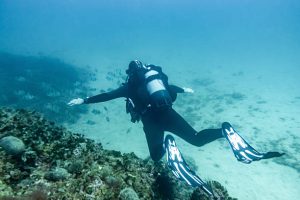
Peak Performance Buoyancy: What to Expect
The Peak Performance Buoyancy Specialty consists of two dives and (usually) a buoyancy clinic in a pool or calm, in addition to another one in the open water environment. You can start your training at any time and any place with the help of PADI eLearning®.
During the online part of the course, you’ll learn the basics of underwater buoyancy and preview the needed skills you’ll practice with your scuba instructor. If you are one of the PADI Club™ members, you will get a 20% discount on the Peak Performance Buoyancy Specialty course eLearning in addition to other PADI online courses.
During your first training session in the water, your instructor will dial in the amount of weight that is needed for you when scuba diving.
Another helpful exercise you will make is practicing hovering in front of a fixed object without rising or sinking more than 1 meter/3 feet. This exercise will help you realize how much you moved up and down when you thought you were (more or less) stationary.
By the end of the session, you will find yourself ready to try swimming through hula hoops suspended mid-water. And this isn’t a requirement to pass the course; it’s just a fun challenge.
Have more questions about scuba diving buoyancy? Ready to elevate your level at buoyancy control?
Start Your Course now with the best, DRAR DIVING Center.