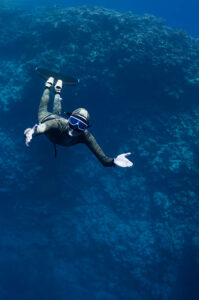
Scuba Diving is the activity that brings excitement and joy to your life. Exposure suits are one of the essential scuba diving equipment that play a vital role in providing scuba divers comfort, safety, and warmth while diving.
Wetsuits are a comfortable option in tropical or temperate waters, while drysuits are more ideal for diving in colder areas. In this article, we will give you some important information about the types of drysuits (neoprene drysuits vs. membrane drysuits).
Types of Scuba Diving Exposure Suit
Before delving into everything you need to know about dry suits, let’s briefly review the three major types of scuba diving exposure suits:
- Body Suits – Also called skin suits. These exposure suits have a snug fit and provide minimal amount of warmth and skin protection.
- Wetsuits & Semi-Dry Wetsuits – Wetsuits and semi-dry suits are considered the most common exposure suits for scuba diving. Wetsuits are made from neoprene, which insulate your body by trapping a thin layer of water between your skin and the suit. This thin layer of water is heated by your body temperature, keeping you warm in mild temperatures. This type of suit suits tropical and temperate water temperatures.
- Semi-dry wetsuits – These exposure suits offer more insulation than the standard type but lack waterproofing. The main difference between a standard wetsuit and a semi-dry wetsuit is the seal in both the neck and wrist areas which are usually made from rubber or silicone, whose role is minimizing water circulation inside the suit.
- Dry suits – Dry suits completely insulate divers from the water and prevent them from getting wet through a set of seals system at the wrists and neck in addition to watertight zippers. Scuba divers can wear undergarments under their drysuit in order to increase their insulation against colder weather.

When to Use a Dry Suit
In recreational diving, you should use drysuits for water temperatures under 15° Celsius (59 degrees Fahrenheit). Of course, This depends on your heat tolerance, dive depth, and duration.
Neoprene Drysuits vs. Membrane Drysuits
The material of drysuits can be divided into 6 main groups – coated fabric, neoprene foam, crushed neoprene, trilaminate, vulcanized rubber, and composite. These are mainly grouped into two main types: neoprene dry suits and membrane drysuits (also called trilaminate, shell, or three layer).
Neoprene Dry Suits
Advantages
- Neoprene dry suits are a very popular choice in case of scuba diving in cold waters as they are considered both affordable and practical, but let’s make sure whether they are suitable for you or not.
- The materials from which the neoprene drysuits are made can insulate your body. This means that you can feel comfortable when diving with the insulation offered by the neoprene drysuit without wearing a thick undergarment.
- Neoprene drysuits are also considered more durable than membrane drysuits. This means they are considered a better choice when there are sharp objects or rocky points while entering the sea from the shore.
- Lastly, Neoprene dry suits are highly comfortable due to their stretchy material.

Disadvantages
- Neoprene drysuits are both heavy and bulky, which may limit your mobility underwater and the suit will take longer time to dry. The weight and bulk of a neoprene drysuit may vary when traveling.
- Like a wetsuit, the materials of neoprene drysuits compress with depth, causing it to lose insulation qualities and some of its buoyancy. This difficults weighting.
- While the insulation properties of neoprene drysuits is regarded as an advantage, it also limits the type of undergarments that you can wear underneath.
- If you are diving in familiar water temperatures and the insulation provided by the neoprene drysuit is sufficient, you can consider this as an advantage, but in case of diving into colder or warmer waters in new dive destinations, the situation may need adjustment because of the limited number of undergarment choices.
- Neoprene drysuits have different thicknesses that are suitable for various water temperatures, like 7mm or 8mm, so keep in mind the water temperatures in which you plan to dive before choosing your drysuit.
Membrane (Shell/Trilaminate) DrySuits
Advantages
- Membrane drysuits are called trilaminate drysuits because they consist of three layers of materials that are laminated together. Scuba divers may prefer these over neoprene dry suits for their streamlined design, comfort, and customization options.
- The main advantage of a trilaminate drysuit is the high durability, neutral buoyancy, its light lightweight, in addition to the less space it takes when traveling and storing. They also offer freedom while scuba diving and minimize the effort needed to move around.
- Membrane drysuits have different designs, feature various zipper and pocket configurations and can be easily customized for the diver.

Disadvantages
- Shell suits don’t have insulating properties, so divers need to wear undergarments. The pros of this is that it allows for customizable exposure protection suitable for both cold and warm waters.
- Furthermore, membrane suits have less buoyancy than neoprene dry ones, this makes them less sensitive to pressure changes while diving. Keep this in mind when selecting dive weights.
- The biggest disadvantage of membrane suits is that they are more expensive than neoprene ones. They also need more routine maintenance because the used construction and material are considered more fragile than neoprene.