If you want to take a step to become a qualified scuba diver, the best thing to do is to enroll in a certification course. The next step is to master the scuba diving skills which are essential to keep you safe underwater. In our article, we will take you to get a glimpse of the basic scuba diving skills and how to perform them in theory.
Scuba Diving Skills
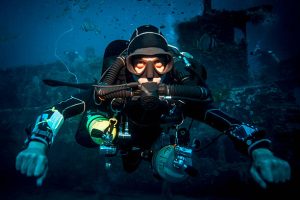
If you get a seat on the PADI Open Water Diver course, you will learn about 40 scuba diving skills from the best way to enter the water until you remove your gear correctly at the end of a dive. All of that will be illustrated to you by the instructor.
We will talk here about the 8 basic scuba diving skills that are very essentially to any diver to survive underwater, these skills are about:
- Your dive gear.
- The communication underwater.
- Controlling your buoyancy.
- Recovering and clearing your regulator.
- Clearing a Flooded mask.
- Releasing Leg cramps.
- Breathing Off Free-Flowing Regulators.
- Handling an Out-of-Air Situation.
Your Dive Gear
First off, you should learn to assemble your scuba diving equipment properly by following the next stips:
- Inspect your cylinder and scuba tank to make sure that the o-ring of the valve is seated properly.
- Make the buoyancy control device to face the back of the jacket by strapping it over the top of the cylinder, then tighten it securely.
- Take the regulators, then unscrew the dust cap. The first stage should be placed over the valve of the cylinder and orient it so that your second stages are on the right, then tiet it in its place.
- Attach your inflator hose to the buoyancy control device.
- Ensure to turn your air gauge before you turn your air on and the glasses of the gauge to be away from you.
- Turn the valve in a slow manner until fullness.
The Communication Underwater
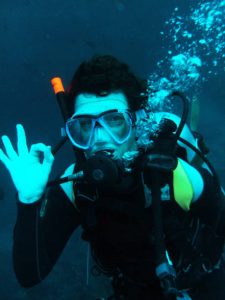
Although many people prefer to scuba dive to enjoy the quietude of the underwater world, communication among the diving team is an important thing to ensure your safety underwater. It is considered on the top of scuba diving skills that you should learn.
There are many types of communications you can practice underwater except speaking for sure, hand signals are the most common under normal circumstances. They are a set of universally recognized signals to convey important messages, for example:
- Ok Signal: if you want to say that you are ok or to ask “Are you ok?”, make a closed circle using your first finger and thumb.
- Descending Signal: if you want to go deeper, make your thumb point down.
- Ascending Signal: in case you want to go to the surface, make your thumb point up.
- Stop Signal: if you want to say “Stop”, hold a hand in front of you with your palm facing outwards.
If you want to recognize more signals, we recommend reading this article: “Up to 20 Diving Hand signals you should know underwater”
Controlling Your Buoyancy

Controlling your buoyancy is considered among the basic scuba diving skills, you should learn about negative, positive and neutral buoyancy during scuba diving training. There are many factors that can affect your buoyancy, such as:
- Your breathing technique.
- The weight of your additional equipment.
- The weight of the air content in your BCD.
If you want to fill your BCD with air, press your inflate button in short manners several times. To control your buoyancy underwater, add air to it slowly because if you do that too fast, this can lead to a dangerous, out-of-control ascending.
If you haven’t air in your cylinder, you can inflate the BCD orally by breathing into the mouthpiece after holding down the inflate button.
On the other hand, press your deflate button in case you want to release air from the BCD. you should be upright in the water to ensure proper escaping of the air.
You can find one or two emergency dumb valve to release air in any position you want.
Recovering and Clearing Your Regulator
If your regulator has been knocked from your mouth, follow these steps to recover it:
- Orient yourself to be upright in the water.
- Lean to the right side.
- Extend your arm behind you and down to your knee as you can until you sweep the regulator forwards again.
- Now, the hose of your regulator should be caught over your arm.
- Replace the second stage in your mouth correctly
Don’t forget to adhere to the first rule of diving (Never ever hold your breath underwater) by blowing small bubbles during the process.
After holding the regulator, you will need to clear it from water to be able to use it for breathing. You can do that by two ways including:
- Exhale sharply through it to let the water out of the second stage.
- In the center of the regulator, there is a button called the purge button. Press it to prevent water from entering your mouth and use your tongue as a splash guard.
Clearing a Flooded Mask
Clearing a Flooded mask is one of the crucial scuba diving skills, as it is considered a key to prevent any panic and avoid dangerous situations. You must know how to clear even a partially and fully flooded mask. Also learn how to remove and replace a mask underwater.
If you are a novice diver, you can find this stressful, so it is important to stay calm and always keep breathing.
The method of clearing a Flooded mask is the same for any amount of water you have in your mask, the steps include:
- Breathe deeply through the regulator.
- Hold the top of the frame of your mask in its place using your fingers.
- Exhale the air from your nose while looking slightly upwards to expel the water out of the mask.
- Repeat these steps many times to make sure that your mask is completely clear.
Releasing Leg Cramps

Having a leg cramp isn’t only irritating, but it can also prevent you from swimming properly leading to a dangerous situation. Fortunately, among scuba diving skills, you will find one to get rid of leg cramps and this skill is a good one on the surface too, it’s steps include:
- Make a hand signal to your buddy to inform him of the problem (open and close a fist, then point to the affected area).
- After grabbing your fin with the help of your buddy, pull it towards you with your leg being straightened and stretched as you do so.
- Extending your heel and calf will release your leg cramps.
Breathing Off Free-Flowing Regulators
If you have a regulator malfunction underwater, it will let air flow freely. This will make you able to breathe off it safely during ascents. Do this by peeling back the half of the mouthpiece allowing the free flowing air to escape in the water .
The next step is to ascend slowly while sipping the remaining bubbles until you reach the surface.
Handling an Out-of-Air Situation
Running out of air is considered a nightmare situation to divers, especially novice ones. You would never put yourself in such a situation if you kept your eyes closed on your air consumption. However, you should know well how to deal with this situation to be prepared for any emergency. There are two ways:
- If your dive buddy is near to you, you can use his alternate air source. First off, get he’s attention by making an Out-of-Air hand signal, then he will give you his spare regulator. Place it in your mouth and clear it. After that, ascend together at a safe rate.
If your buddy isn’t nearby and you are within 9 meters of the surface. The best option is to make a Controlled Emergency Swimming Ascent. Firstly, make sure you are in a neutral buoyancy, then be in an upright position and swim towards the surface at a safe rate while breathing continuously to prevent decompression sickness.