Are you an enthusiast of cave diving? Are you wondering how to be a certified cave diver? can anyone do this activity or does it require a lot of experience and cave diving training?
If you want comprehensive answers to these points, you have reached your destination. This article is your guide to get all the information about cave diving training.
Cave Diving Training and Certification
Cave diving is one of the types of technical diving, that’s why anyone can’t jump in the water and delve into a cave dive. Many cave experts stress the necessity of having an established open-water diving history before embarking on a cave diving trip, as you must have made at least 50 open-water dives before you consider taking cave diving training.
Once you begin that training, you will have a weak at least of actual study before starting practical cave diving training.
During classes of cave diving, scuba divers will learn a lot of skills, such as:
- Learn about the equipment they will use.
- Learn about the gas laws and how they affect diver’s bodies in depths.
- How to navigate through the cave and find their way if they get lost.
On doing cavern diving in the right way, you can jump straight into cave diving. However, experts recommend having experience as a cavern diver for at least two years before moving on to diving into the dangerous waters of the cave.
There are several certified organizations that can give you professional cave diving training and Certification. The most popular ones include:
- The National speleological Society Cave Diving Section (NSS-CDS).
- The National Association for Cave Diving (NACD).
- The International Association of Nitrox Technical Divers (IANTD).
- The Global Underwater Explorer (GUE).
Regulations of Cave Diving
Generally, there aren’t any laws that regulate what to do in any type of dive, but there are 2 common rules that any diver must be taught including:
- Don’t disturb the environment as much as you can.
- Removing fossils and artifacts from the cave is forbidden unless you have permission from a museum or a university.
Once you become a certified cave diver, you don’t need permission to do cave diving in a specific site, as your PADI cave diver certification works as a carte blanche for cave diving. There are no restrictions other than what the site specifies for you. Choosing the ideal dive plans and specific gas mixtures is up to you.
Guidelines for cave diving

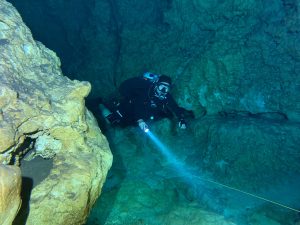
Caves usually have no visibility as a result, cave divers must have their own source of light which mostly are dive lights.
Most caves have guidelines that are placed in the caves to make sure scuba divers will find their way back to the entrance of the cave. These guidelines are usually placed by the past explorers and are called “Gold Lines” due to their yellowish color
These lines strings that made of beaded nylon which is smaller in diameter than a regular rope. They are placed throughout the caves’ main tunnels.
In the case of labyrinthine caves, there are also smaller, white lines placed through the side tunnels which usually end 5 to 10 feet near the main line.
As a cave diver, running a temporary line along a reel from the outside of the cave is your responsibility. This line helps you maintain a continuous guideline from the cave entrance to the main line. This provides you with a direct way to reach the cave exit.
To make this entry line correctly, tie off the line to a big rock at the entrance of the cave and make e secondary tie-off in case you lost the first one. You must swim along it with your hand around. This line should be far away from any obstacles to avoid snags.
You can tie plastic directional arrows to the lines to point to the exits. There are also dips which are similar to clothespines and are used for notation reasons to point out max penetration (the furthest point divers can reach inside a cave) and points of interest.
If you have the right equipment and sufficient air supply, your cave dive can last from 1 hour to 15 hours. Other rules to scuba dive safely must be considered especially the Rule of thirds.
FAQs

What is the equipment for cave diving?
Unexpectedly, you won’t need most of the equipment used in recreational diving while cave diving. Briefly, your gear for cave diving includes:
- A dry suits that provide you with more rugged exposure protection.
- More robust life support.
- Specific tools for cave diving, such as line reels, markers, lights, and regulators.
What is the cost of cave diving equipment?
You should expect to spend from 3000$ to 4000$ on the cave diving equipment.
What is the cave diving certification cost?
The PADI cave diver certification cost comes in around 1200$ to 1500$ and about 1000$ in case of any additional costs.
Is cave diving training for beginners?
No, cave diving training is for experienced scuba divers who have a PADI open-water certification.