Top 5 differences between snorkelling and scuba diving
If you are captivated by the beauty of the underwater world, old myths about shipwrecks, and mythological water creatures, you may be interested in scuba diving and snorkelling, the differences between the two, and which one will best suit your marine passion!
As much as we endeavour to clarify every detail about the diving world, you will find the top main differences between snorkelling and scuba diving in this article.
Which is better: snorkelling or scuba diving?
Scuba diving and snorkelling are both exciting, relaxing, and entertaining water sports that allow you to explore marine life and ocean wonders. The key differentiator is that scuba diving is more complicated, allows you to go deeper in ocean caves and tours of exploration, and requires the acquisition of specific equipment and techniques.
So far, the right question to ask is not which is better, but which is suitable for your interests and lifestyle.
Which is easier: snorkelling or scuba diving?
Scuba diving is relatively simple, with only a short period of training required to get started. 70% of the world is in your hands the moment you learn to breathe underwater, whether your diving goal is to swim with sharks, explore the ocean, or simply meet other adventurous people!
Despite the fact that snorkelling is unquestionably the easier of the two water activities. Scuba diving also requires attending a primary course as well as certification, whereas snorkelling only requires a special mask.
While snorkelling appears to be the obvious choice on the surface, scuba diving offers far more for those seeking adventure and interaction with the sea.
To give you a more solid idea about which one you should choose, and what are the benefits you will get, we will show the basic differences between snorkelling and scuba below:
1-What you will see
Scuba and snorkelling are similar to looking at stars through a telescope or going on a space flight to another planet. Whether scuba diving allows you to observe and get close up to marine life secrets and rare creatures that only divers can see, one of the top rare creatures examples only divers can see are:
Clownfish, Raja Ampat, Indonesia: the famous adorable fish also appeared in the Disney movie (finding nemo), glowing with its orange colour and black and white vertical lines, divers said watching it closely acting coyly, just like the movie, and building its house in the anemone, a flower like cnidarian that holds a symbiotic bond with the clownfish.
Seahorses, Bonaire; who doesn’t remember the little mermaid and the little adorable sea horses! Divers do a really interesting trick to attract sea horses to watch them closely, as they use visual scanning of rope sponges to find them. Then the hunting journey starts to catch this little mischievous curvy with distinct twigs like snout. The hunt, as exciting as the victory, can last as long as your tank. When the hunt is over, it’s time to relax and watch the flutter of that gossamer-wing dorsal fin as it moves forward. The tail, like a monkey’s, is prehensile — capable of grasping — and grips onto blades of eelgrass and the like to stay put in its fluid habitat. When diving house reefs on Bonaire, embrace the chance of scanning all the reef and its rare marine creatures.
Shipwrecks and caves
The pirate’s adventures await you, to invade the shipwrecks all along the Asian east coast to Nassau Bahamas, where most divers prefer to take splendid photos in the upright and intact location. The fact that this sunk wreck is a cruising ground for dozens of reef sharks adds to the excitement for divers exploring the location.
Beside the wrecks there are mysterious caves also, where you can enjoy the natural architecture, and splendid rock formations.
2-Essential scuba diving equipment vs snorkelling gear
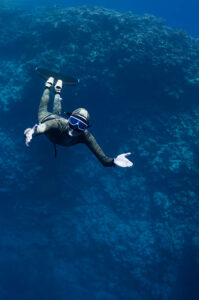
- Snorkelling requires less equipment than scuba diving. However, the fact that there is less technical gear does not diminish the importance of selecting that gear precisely. Snorkelling requires basics ( a mask to help you breathe oxygen from the air on the surface, fins to give you the minimal ease while moving underwater, and a snorkel).
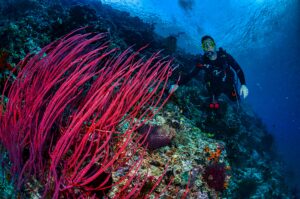
- Scuba diving requires a lot of systematic equipment, including a suitable diving mask, wetsuit, or drying suit, steel pressure tank, gas tank with attached breathing regulator which will work as your aqualung, swimming fins, computer diving. All of those gears will enable you to breathe normally under water, swim efficiently, and see more clearly, especially in night diving adventures.
3-Duration underwater and the depth you can reach
- A typical snorkeler can swim 3-4 metres down (12-15 feet). Snorkeler with experience may be able to reach 7 metres (25 feet)
- The max depth for a beginner scuba diver is 130 feet. There are organisations, such as PADI, NAUI, and SSI, that require “technical” certifications in order to go deeper and explore wrecks, caves, and other sites deeper than 130 feet.
- For scuba divers the duration they could stay underwater is average from 40 to 60 min. It varies from diver to another depending on the breathing rate, diving condition, and the depth.
- For a snorkeler the duration depends on whether the snorkel stays on the surface of water or underwater. A normal person can hold his breath underwater for 45 sec, experienced swimmers can stay from 1 min to 2 min.
4-breathing techniques
Scuba diving breathing techniques
- The prime and most crucial rule to remember is to never hold your breath!
- Calm breathing is essentially required.
- To be able to inhale oxygen, you must inhale slightly longer than you would outside water.
- A general rule would be to inhale for 4 seconds, then hold your breath for 2 seconds before exhaling for 4 seconds.
- Then do it again, you will be able to oxygenate your body as a result of this.
- Adjust your buoyancy with your breath and navigate on top of the reef.
- After you’ve completed your descent and reached neutral buoyancy, the goal is to use your breath and lungs to ascend.
- bring you up or down without the use of your BC inflator and deflator. It will give you greater control over your movement and allow you to use less air from the tank.
Snorkelling breathing technique:
It all depends on how you could manage your breath, and training on deep breath, there are three major functions to summarise the snorkelling breathe technique:
- Breathe deeply to ensure you get enough fresh air.
- Avoid inadvertently swallowing or inhaling water.
- Control flotation by adjusting ventilation.
5-danger and risks
Excitement and adrenaline adventurous can come with risks, as you may know there is no thing risk free, snorkelling and scuba might have a little bit of risks, undercontrol and can be manageable, if you are comparing between which one will be less hazardous we shall sum up the most predicted troubles you could face if you choose one of them:
Snuba diving is a combination of scuba diving and snorkelling
Snuba stands for Surface Nexus Underwater Breathing Apparatus. We could consider snuba diving as a connection between snorkelling and scuba, and one of the perfect choices for beginners, as it combines the benefits of both. All you need is to breathe via a regulator linked to an air supply. Instead of carrying an oxygen supply on your back, it will float comfortably on the water’s surface, and enjoy exploring the sea depth till 20 feet.