


Cave diving is a form of technical diving. It is an activity that combines scuba diving with cave exploration. With cave diving, you have the chance to explore the last untouched corners of the world and marvel at the formations of the ancient rocks and the new life forms that you will discover.
Unfortunately, the community of cave diving is extremely small. Actually, it is usually reserved for rescue missions and scientific research.
However, some divers are very attracted to cave diving and take it as an extreme sport. In this article, we have covered most of the important parts related to cave diving. If you are still interested, Read the next lines
What is cave diving?

We can classify scuba diving into 3 main categories: open-water diving, cave diving, and cavern diving. Scuba divers always start gaining experience through open-water diving which is a dive in which you can reach the surface by swimming straight up without facing any obstacles and the visibility is good.
On the other hand, in cavern diving, you can explore the naturally occurring caves which have a ceiling overhead and you can see well because the sunlight is in sight.
Both open-water diving and cavern diving are considered among the types of recreational diving in which you should have recreational-level training and certifications and the maximum depth of diving doesn’t exceed 130 feet.
Cave diving is something different as it is considered a type of technical diving that requires years of training and several certifications besides a different set of equipment. It also needs top-notch fitness.
The Equipment for Cave Diving
Cave diving is considered a type of technical diving because it involves high risks and requires high levels of experience. So, if you want a way to distinguish cave diver from open-water diver and cavern diver, just look at his equipment.
Masks
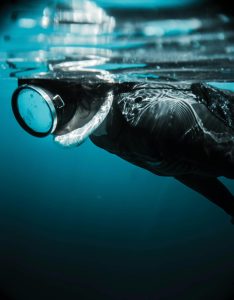
Cave divers don’t need to bring snorkels with them because they stay in the depths for long periods, therefore they need oxygen tanks instead.
Snorkels are used only by recreational divers, as they dive near the surface. Bring them with you while cave diving will be just an extra weight.
A simple standard solid black mask will be an excellent choice for cave diving. The advantage of the black color lies in its absorption properties. Any other color can cause the leaking of the distracted light into the mask and prevent the diver from seeing the entrances and the important spots. In case to protect their heads from damage, cave divers wear hoods made of nylon.
Fins

Black rubber non-flexible fins are preferred in cave diving. The reason to choose stiff fins is that divers during cave diving carry much mass with them. While moving through the water of the cave, they use controlled, short kicks in order to avoid stirring sediment.
Suits
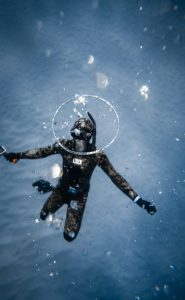
As a cave diver, you can use either a dry suit or a wet suit for protection. The difference between the two types lies in that the dry suits prevent water from entering and keep the diver’s body dry.
We can say that drysuits are the preferred and best choice for cave divers because it is made of neoprene “a synthetic rubber” that makes it doesn’t allow heat loss.
It also insulates air with the help of its double layer and the diver can wear extra undergarments. However, wetsuits are still sufficient for shorter cave divers in warm waters.
On talking about the accessories needed for cave diving, we can put flashlights and small diving knives at the top of the list. You will also need several gadgets that can help you during ascent and descent.
Different gauges will be needed to be able to know the depth and air pressure and you can fit them with a compass in one device. Of course, you will need extra oxygen tanks and cylinders.
Breathing in Caves
You can understand the dangers of diving under high pressure by doing a shaken-soda bottle experiment. When you shake a soda bottle and open up the cap quickly, the fizzy gas will burst and the bubbles will continue to climb up.
If you want to prevent that from happening, you can do that by opening the cap very slowly to let the gas out gradually, then you will find only a small amount of bubbles and the pressure will be decreased without making a miss.
Our buddies act much like a shaken soda bottle at high pressure underwater. On land, the air consists of 78% nitrogen and 21% oxygen. Our bodies use oxygen but nitrogen is dissolved in the blood and tissues without causing any harm.
When you dive at lower depths, the water pressure increases, and that causes nitrogen to be dissolved in large amounts in our blood and tissues. If you move fast while ascent and descent, nitrogen will be released too quickly and bubbles will be formed in your blood.
This condition is known as Decompression Sickness “DCS”. It causes joint pain and tightening sensation in mild cases. In serious ones, it can cause ruptured blood vessels, strokes, and heart attacks.
Adhering to dive tables is the best solution to follow to avoid getting Decompression sickness. Dive tables are used to calculate the quantity of time a diver should spend at a specific depth before deciding to ascent.
If you follow this table correctly, nitrogen will be slowly released from your body without any harm. Actually, following the golden rules of diving will help you avoid facing a problem that occurs underwater.
As a result of the unique circumstances that require diving under high water pressure. Divers carry with them scuba tanks that are filled with many special gas mixtures. The compressed air is on the top of them. It contains a mixture of gas consisting of 78% nitrogen and 22% oxygen. However this mixture is cheap and easily accessible, it isn’t the most popular among divers.
Nitrogen narcosis is also one of the serious conditions related to diving. Its symptoms are similar to the effect of drunkenness and laughing gas, as they occur suddenly due to too much nitrogen. This condition causes loss of concentration and drowning.
Nitrox is a more popular gas mixture that contains a higher percentage of oxygen (about 32% to 36% oxygen) and a lower amount of nitrogen. So, the chances of breathing too much nitrogen are lowered.
Unfortunately, breathing too much oxygen at high pressures is also dangerous because you may suffer from oxygen toxicity which can lead to sudden fatal seizures and drowning. On having a scuba tank filled with nitrox, you can only avoid oxygen toxicity by following very strict dive schedules.
Heliox can be either an available alternative mixed-gas mixture to air or nitrox. It is a mixture of 79% helium and 21% oxygen. It also has its strengths and weaknesses, but its weakness is far away from the intoxicating effects of nitrogen.
However, cave divers who use heliox as an air supply can lose heat about six times faster than if they were breathing any other type of air mixture. This makes them more susceptible to hypothermia.
The Techniques of Cave Diving

Since cave diving is considered a form of technical diving, cave scuba divers have many different techniques to practice it. Cave divers are usually taught to swim in two positions: in a prone position and face-down position.
In these positions, they bend their knees and elevate their fins above the body’s plane while diving. This position not only prevents stirring up sediment but also provides a good streamline and decreases resistance to the water.
While moving around the cave, cave divers use the “pull and glide” techniques in which they use the tips of their fingers to hook onto any place of cervices found in the rocks of the cave they dive through.
The rocks of the cave are usually similar to limestone in their hardness and porosity so, you can find many pockets to grab in. Divers grapple hold then pull and tease to enjoy easily gliding through the cave.
In case of changing their directions, cave divers use their feet to make short flutter kicks, and to propel themselves along, they can use them to push off the cave ceiling.
They can use the battery-powered diver propulsion vehicles (DPVs) to swim easily. There are many different types of DPVs, but the two behind DPVs are the most popular. With the help of DPVs, you can use less oxygen as the effort decreases and that can help you to increase the length of the dive.


