When we talk about scuba diving gas mixes, there are many misconceptions. Contrary to popular belief, scuba divers don’t only have oxygen to breathe underwater.
At the surface, we don’t breathe pure oxygen either, as the air around us consists of a mixture of various gases, mostly oxygen and nitrogen in addition to small amounts of carbon dioxide and other gases.
So, according to that, the scuba tanks also contain a mixture of gases that will allow scuba divers to reach further depths below the surface of the ocean.
The most common mixture used in scuba tanks is atmospheric air which is recommended for diving to 40 meters deep which is considered the safest acceptable depth by most scuba diving training agencies.
If you want to go deeper and explore much longer, it is recommended to use other mixtures, such as, heliox, nitrox and hydrox, as they are regarded as safer alternatives to compressed air.
If these mixes give you more diving freedom, but require specific certifications before you can use any of them, if you are interested in trying one of these mixes, we will give you a few quick facts about each mixture, so, go along with us.
3 Types of Scuba Diving Gas Mixes
We can categorize the scuba diving gas mixes into three types, including:
- Nitrox.
- Heliox and trimix.
- Hydrox.
Nitrox
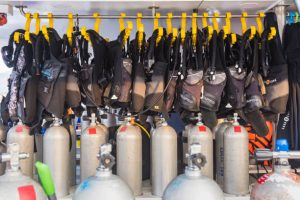
Regular air consists of 75% nitrogen, more then 25% oxygen and small amounts of other gases. Nitrox contains a higher percentage of oxygen between 22% and 40% of the total volume of the gas, but scuba divers usually use 32% to 36% which is known as EAN32 and EAN36 respectively.
Nitrox is considered the second most commonly used gas mixture in scuba diving, as with it you have lower chances to suffer from decompression sickness. It also offers longer bottom times but not as deep as you can dive with air.
For these facts, nitrox is an ideal scuba diving mixture for repetitive diving where scuba divers have to complete multiple scuba dives in a day up to a week and also for accelerating Decompression Stops which are done in water.
Unfortunately, there are several risks involved with diving using nitrox, as when you exceed the limits for a dive with nitrox, this can lead to inhaling oxygen at unsafe partial pressure leading to oxygen toxicity.
For this reason, you will need special training and to know how to deal with a gas analyzer before using it, as the smallest difference in the concentration of oxygen can affect your time and depth underwater.
Heliox and trimix
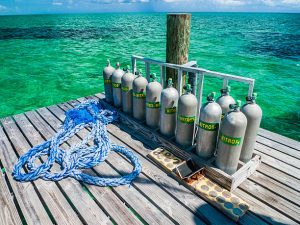
In the trimix mixture, oxygen and nitrogen gases are partially replaced with helium gas. With this mixture, divers can go beyond the limits of recreational diving (deeper than the limits of nitrox) with low risks of oxygen toxicity.
Scuba divers who use this mixture normally use different blends for each particular dive, but in general, there are three main blends, including:
-
Hyperoxic
This blend is different from the air in its high content of oxygen. This in turn restricts diving to shallower depths compared to normal air.
-
Normoxic
Nomoxic blend contains the same level of oxygen as normal air, so it offers diving to the same depths as normal air.
-
Hypoxic
Hypoxic blend has less oxygen concentration than normal air. With this blend, you can dive deeper but this also means that you can’t use it at the surface, so as a diver, you have to use what are called “travel gases” until you can swim to a depth where you can switch to hypoxic trimix.
Hydrox
Hydrogen is considered a cheaper gas and much more abundant than helium gas. This makes hydrox a cheaper alternative to heliox. Hydrogen also has almost no toxicity issues and can be used at different depths up to several hundred meters underwater.
The main problem with hydrogen is due to its extreme flammability when the mixture contains more percentage of both oxygen and hydrogen. Hydrox is a relatively new mixture and is usually used in extreme commercial scuba diving beyond the limits of trimix and heliox.