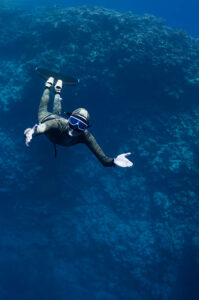
It’s possible that you might think that scuba diving has a scary side or even a dangerous, risky one. And that could possibly deter you from taking the plunge and miss participating in one of the most exciting and serotonin-producing activities, due to your incomplete vision, or the fear of the potential for not being able to breathe properly or handle it underwater, as well as an endless circle of overthinking about scuba diving and possible risks.
We understand your fear very well, and from our role in the diving community, and as much as we are concerned to enlighten all diving lovers about it, in this article we shall clarify everything about your suspicions, fears, and risk possibilities under water, to make you judge at the end whether it was like you imagine or much easier!
So let’s start with the most important questions that might come to your mind if you are deciding to go scuba diving!
What are the possible dangers while scuba diving?
We are not physicians to list all the possible hazards in scuba diving! But we are diving experts and through our work in the Drar diving centre, we faced a lot of emergency conditions and handled it professionally. And for years we tried to teach our trainees how to pursue any case while diving. So in the coming list we shall count the most common problems you could face underwater, and how to deal with them!
- Rupture of the eardrum: while swimming a lot of people suffer from ear pain due to neglect equalising their ears, so imagine how it would be in the deep ocean with more pressure! People go far with their imagination that the ear pain would be duplicated in scuba diving, where the water pressure increases the depth of the diver.The surrounding environment’s pressure impacts on the outer ear. Thus pressure in the outer ear increases when a diver descends.
- However, the middle ear is closed so that the pressure in the middle ear does not change. If a diver lands without equalising his ears, the increased pressure in the outer ear relative to the middle ear bends the eardrum inward, creating pronounced pain. The feeling of discomfort when the eardrum is bent is called so what is the solution then?
People can equalise their ears quite easily, if they trained well on this technique:
- Close your nose and gently pat against your pinched nose. You should feel something happen in your ears when they are equal. The equalisation of the inner ear pressure is usually accompanied by a gaping/clicking/“clear” sound and a feeling of fullness in the ears.
- It’s the same method you might have used to equalise your ear pressure when descending from high altitude on an airliner. If this method does not work for you, alternative methods will be used to straighten the ears. Your trainer will try to show you what is the most suitable for you.
- Inhaling water and dying (drowning), running out of air, this may be the most hazardous underwater incident. Drowning seldom happens when a diver suddenly panics or loses consciousness due to a serious medical issue unrelated to diving. Or an emergency such as running out of air or another one can lead divers to panic. Diver panic and subsequent drowning can be greatly reduced with appropriate training and the buddy system.
- We in the Drar diving centre are very cautious about this rule, that without a proven medical report, you couldn’t dive.
- If you have a heart or respiratory condition, a condition that could influence your diving, or any other ailment, then we told you that you should speak with a doctor who is more knowledgeable about your condition and diving medicine.
- Also a medical checklist will be sent to you after you receive your diving certification. It is crucial that you be honest on this list; not all of the things on it will prevent you from diving, therefore it’s necessary to talk to your instructor about any of them.
- Furthermore, to avoid the fear of running out of air, here is a small tip: always watch the pressure indicator, and be sure you ascend when your tank is two-thirds full.
- Fear of the aquatic creatures and fishes: fishes are friends, not food. Remember the famous phrase from the Finding Nemo movie? . So under the water you are a guest there, to explore the other side of marine life. The comprehensive biological existence will astonish you that you will forget your all fear there. Also, your diving instructor will be sure to teach you how to keep balancing there, and how to maintain the coral reef safe, as you are there to feel the peaceful rhythm of nature not to vandalise anything, so if you have any fears yet remember that fish are friends!
- Fear of an unmanageable ascent: A life saving target of diving is achieving neutral buoyancy. If you remain cool, controlling your buoyancy and staying at the right depth it will be easier. If you are not properly weighted, you may reach the surface. Additionally, if you panic, there’s a possibility you’ll ascend suddenly.
- Fear of sinking: If you are overweight and get off the boat without blowing up your BCD or wing, you will sink. Avoiding this is easy. Perform a buoyancy check before the dive and make sure your BCD is inflated before you get in the water.
*so we tried above to discuss the most common fears people before diving share they had, and try to give you practical solutions. Although practising and following a highly professional instructor will leash all your fears, thus diving is a very thrilling and a safe sport if only you follow the instructors and their tips. Chill and enjoy the adventure to the max, furthermore scuba diving could possibly be safer than skydiving!
Is scuba diving worth the risk?
Like everything in life , the worthy things depend on your point of view, and your life perspective, but what is life without adventure? All we can promise you that you will taste the serendipity of floating in the cold water, and enjoy the lightness, get overwhelmed in the blue ocean and free your mind from stress and fears, and that’s what diving will learn you, that there is a whole world beyond what you can imagine or see!
In conclusion we hope that we could fulfil your curiosity, and give you useful information to release your fear, and as usual drar diving blog wishes you a safe dive. And don’t hesitate to leave your questions in the comment below.