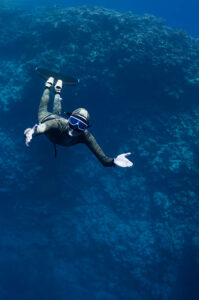
Some divers find it hard to equalize sometimes. Descending while your nose or ears are blocked can really hurt and feel uncomfortable.
That pain means you need to stop and go up, because ear and sinus squeezes can lead to long-lasting problems in hearing loss or balance (like vertigo), which can be risky underwater.
Equalization Techniques
Most divers prefer using the Valsalva maneuver. In this technique a diver pinch their nose and gently exhale while they descend and as needed during the dive. There are other equalization techniques that you can choose from and may work better for you.
Congestion
Cold or allergy congestion can block airflow which make it hard to equalize pressure while scuba diving.
Using Decongestants Before Your Dive
Many people use decongestants, such as pseudoephedrine hydrochloride (Sudafed) as a relieve for congestion, but you can find a few reasons to keep in mind when using decongestants before your dive.
- They may wear off while diving, which in turn can lead to a high risk of a reverse block (barotrauma while ascending).
- They may lead to side effects that are inconsistent with safe diving.
- They are associated with high risks of oxygen toxicity.

The Hidden Risk of Reverse Squeeze When Decongestants Wear Off Mid-Dive
Ear or sinus pain may cause a problem while descending. That’s why it is considered a bigger problem on your ascent.
From the fact that descending is optional and ascending is mandatory. Using a decongestant may help you to get to depth, but if the medication wears off while diving, it could lead to a painful and dangerous reverse block (or reverse squeeze).
How Decongestants Affect the Nervous System
Decongestants can have an effect on the central nervous system and cause side effects such as nervousness, restlessness, excitability, weakness, dizziness, and a forceful or rapid heartbeat.
Decongestant nasal sprays (like oxymetazoline (Afrin)) can lead to rebound congestion in case of wearing off.

Exploring the Link Between Decongestants and Oxygen Toxicity
In 2013, DAN besides the University of South Florida performed an animal study on the possible effects that pseudoephedrine can cause to mammals.
The conclusion of the study indicated that when a dive take pseudoephedrine in normal doses, this shouldn’t increase the risk of seizures (in the majority of cases), but they found a huge individual variability in susceptibility of getting oxygen toxicity—which in turn explain why some scuba divers get toxicity symptoms despite “safe” exposures.
The study also involved the very large doses which is achieved by using multiple over-the-counter drugs (having pseudoephedrine in its ingredients). It confirmed that this high dose increases the susceptibility to oxygen toxicity.
The researchers stated that the scuba diver shouldn’t exceed the daily dose of pseudoephedrine before diving, especially when he dives deep or uses gases instead of air.
Alternative Approaches
Consult with your doctor in order to control any allergy symptoms. It is recommended to use antihistamines or an inhaled nasal steroid. Like any other medication, take them for a while before diving to make sure not to experience the side effects that may have negative effects on your ability to dive safely.
Releve any symptoms of nasal congestion by using a humidifier or warm compress. When you receive the proper hydration, this can promote thinner mucus. Sinus-irrigation devices help clear the sinuses.
If you can’t clear your sinuses, have frequent ear pain or suffer from nosebleeds when diving, consult an ear, nose and throat (ENT) specialist to know what is the next step.