Underwater navigation can feel confusing at first, but once you understand the basics, it becomes one of the most confidence-boosting skills in diving. Whether you’re curious about using a compass, finding your way back to the boat, or avoiding long swims, these frequently asked questions cover everything you need to know.
After reading this underwater navigator FAQs guide, you will know the importance of underwater navigation in a simple way—so you can dive with confidence, stay oriented, and enjoy every moment below the waves.
What Techniques are Commonly Used to Navigate Underwater?
Underwater navigation uses different techniques to help divers stay oriented and get back safely to the starting point. These common techniques include natural navigation, compass navigation, and kick-cycle counting.
Natural navigation technique mainly depends on environmental cues, like current direction, sunlight, reef structures, sand patterns, and even sound in order to determine location and movement. On the other hand, in the compass navigation technique, scuba divers use an underwater compass to follow specific headings and planned paths accurately.
Kick-cycle counting helps divers determine distance by counting fin kicks over a set length. There are also additional tools that you can use to aid in navigation, such as underwater maps, slates, and dive computers that have GPS features further aid navigation or integrated compasses.
Any scuba diver can learn these skills in courses like the PADI Advanced Open Water or Underwater Navigator and help in improving their confidence, safety, and planning while scuba diving.
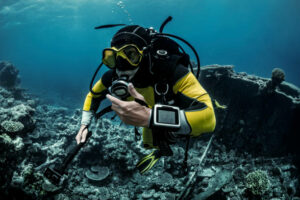
Will a Compass Work Underwater?
Yes, a compass can work underwater and is regarded as one of the most reliable tools for underwater navigation. Underwater compasses are waterproof and specially designed to be submersed. Thanks to being pressure-resistant, it enables scuba divers to function accurately at various depths and temperatures.
Underwater compasses resembles land-based compasses in their dependence on on the Earth’s magnetic field to point north, but include features related to diving, such as luminescent markers, lubricated dials, and wrist or console mounts.
With the help of the underwater compass, divers are able the follow headings, execute navigation patterns, and return to entry points or boats, especially in low visibility or new locations. Effective compass use is one of the basic skills that scuba divers learn in scuba courses, such as the PADI Advanced Open Water Diver.
What Makes a Good Underwater Navigator?
A skilled underwater navigator combines their technical skills along with strong situational awareness and mental discipline.
The vital qualities that make a good underwater navigator include paying close attention to details to be able to read bearings and observing landmarks, be confident in using navigation tools, such as compasses and slates, and the ability to stay calm in addition to making smart decisions under pressure.
Underwater navigators should also have a strong sense of orientation, easily adaptation to changing conditions, and a strong memory to remember underwater features and planned routes. Divers can develop these skills through practice and formal training during courses such as the PADI Underwater Navigator specialty.
Do Navigators Still Exist?
Yes, navigators absolutely still exist, both in the diving fields and in other fields like aviation, maritime travel, and land exploration. In diving, the importance of underwater navigators lies in leading dives, locating dive sites, in addition to conducting search and recovery operations.
In modern contexts, GPS and electronic tools may be used, but human skill still essential, especially underwater in which GPS signals cannot penetrate. With specialized training, such as the PADI Underwater Navigator course, scuba divers learn advanced navigation skills to become more confident and be able to solve problems underwater.
Even with modern technology, professional and recreational divers still use traditional navigation methods such as compass headings and natural references—which keeps skilled navigators just as relevant as ever.

Is PADI Certification Worth It?
Yes, PADI certification is widely considered a valuable certification, especially for divers who take scuba diving seriously. Like any of the most world’s recognized dive training organization, PADI (which refers to Professional Association of Diving Instructors) offers acceptable certifications for dive centers worldwide.
PADI courses are characterized by being well-structured, focus on safety, and designed to help divers progress from beginner to professional levels. For example, having the Open Water Diver certification means having a foundational qualification to lifelong access to recreational diving without the need to repeat the course.
PADI’s specialty courses and advanced certifications also reinforce diving skills in different areas, such as underwater navigation, rescue, and night diving. Many dive employers and tour operators specifically ask for PADI or any equivillent certifications.
When you invest in training, you work on increasing your safety, confidence, and enjoyment while being underwater, and this is important for both recreational and professional divers.
Become An Underwater Navigator with DRAR
If you are interested to become an underwater navigator and guarantee your safety and enjoyment underwater, enroll now in the Underwater Navigator course with DRAR DIVING Center.