Congratulations! You’ve completed your PADI Open Water Diver course which is a big achievement that only a small percentage of people in the world can claim. You now have access to an amazing underwater world few ever see. But with so much to explore, the question is: what’s next?
Beyond diving as much as you can, the right PADI specialties after Open Water can boost your skills, confidence, and enjoyment underwater. Here are five specialties that every new diver should consider to take their diving to the next level.
5 PADI Specialties After Open Water
Take your diving to the next level—these 5 PADI specialties after Open Water will boost your skills and confidence underwater.
- The Peak Performance Buoyancy Speciality Course.
- The Underwater Navigator Speciality Course.
- The Deep Diver Speciality Course.
- The Dry Suit Diver Speciality course.
- The Equipment Specialist Course.
1. The Peak Performance Buoyancy Speciality Course
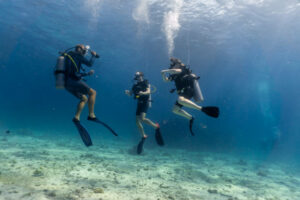
Buoyancy is considered one of the trickiest skills to master in scuba diving. Following a diver who is kicking up the seabed and ruining it for divers behind his is the only thing that you can face worse than being behind a diver with poor buoyancy… and try hard to never be that diver!
The Peak Performance Buoyancy speciality course is designed to help you build on the skills you learned in the Open Water Diver course.
In addition to that, the improved buoyancy comes with the opportunity to reduce the weights you need to carry. This in turn, can help in reducing air consumption and extending your dive time. It may sound a bit cheesy, but “take only photos, leave only bubbles” is really important.
When diving, consider yourself as a visitor to the reefs and wrecks, so it’s crucial to reduce the direct impact we cause to these fragile habitats. The PADI Peak Performance Buoyancy Course is considered one of the best specialties after Open Water because it will help you become a better dive buddy with less bad effects on the environment.
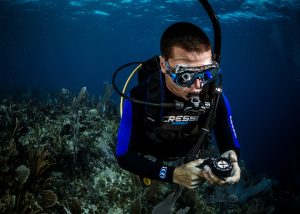
2. The Underwater Navigator Speciality Course
For many new scuba divers, the first few dives should be with a dive guide, or at least dive with a more experienced diver. But what happens when diving with a beginner diver like you or even with less experience? During the Open Water Diver course, you learn to navigate in a straight line and return the same way.
But, what if you want to deviate to spot something not “on the line”? Well, that’s the importance of taking the Underwater Navigator speciality course. When you know how to use natural navigational markers, like coral reefs, in addition to becomming confident in using your compass to make multiple turns and even being able to estimate the distance you’ve swam, this makes a massive difference to how much you are comfortable underwater!
3. The Deep Diver Speciality Course
When taking about scuba diving, deeper definitely doesn’t always mean better. Actually, the ability to dive beyond the limits of the Open water Diver course (18m (60 feet)), gives you an access to many more sites to explore. In deep diving, you have some new challenges which the Deep Diver speciality covers, such as how to manage your gas.
It is important to note that when diving beyond 18m (60 feet), you need to keep in mind the implications that the new depths will have on your gas consumption.
Although some people can feel it at shallower depths, the effects of nitrogen narcosis start to be a real factor at 30m/100ft. The Deep Diver speciality course is an excellent and vital step for those considering delving into the world of Tec diving.
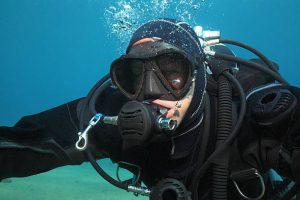
4. The Dry Suit Diver Speciality Course
We all dream of practicing scuba diving in the warm waters of a tropical paradise! Unfortunately, that’s not always the reality for some of us. A famous author in the UK once said, “There’s no such thing as bad weather, only unsuitable clothing!” And this can be applied to diving, too.
After talking to a few “warm water” and “holiday” divers over the years, it seems there’s a bit of hesitation around dry suit diving. Many scuba divers see it “difficult”, but that couldn’t be further from the truth.
In the Dry Suit Diver speciality course, you will learn everything from how to pick the right type of thermals to wear under your suit through to actually becoming more confident in diving with a dry suit. Dry suit diving is definitely an investment, as it opens up a whole other side of diving and destinations that might not come to your mind, like Scotland!
5. The Equipment Specialist Course
Regardless of the preparations you made and how you well looked after your kit, accidents happen and facing a problem in your kit is a probability. Does it have to end your dive day? If you’re at a dive center, they likely have spare gear or someone who can fix it—but what if you’re not?
Of course, you can’t plan for every eventuality, but the Equipment Specialist specialty course provides you with an introduction to the concept of a “save-a-dive” kit. You get the knowledge to be confident and experienced to make minor repairs to your equipment and helps you to avoid missing out on dives due to a problem that could be easily resolved with the right knowledge.
What you can’t fix is when forgetting your fins at the harbur and only realize on the dive boat 30 minute from land.
Once you get your Open Water Diver certification, there’s no “right” or “wrong” way to continue your underwater journey. It’s about choosing the right steps for you, but the key is to never stop diving, and never stop learning.
Can’t decide which specialty course to enroll in? We recommend for you the Advanced Open Water Diver course, which consists of five adventure dives each of which offer a glimpse into the specialties.
One of the adventure dives will be a deep dive and the other will be a navigation dive. For the other three dives, you can choose from any specialty that interest you. Each dive in this course may be credited toward the related specialty certification.