According to the experiences of many who delved into the adventurous world of scuba diving late, being a Senior Scuba Diver is considered both fulfilling and challenging. Exploring the underwater world for senior scuba divers can be a remarkable as well as a life-changing experience.
Dive in and explore with ease by following these 15 essential tips for senior scuba divers to stay comfortable, safe, and confident underwater.
Tips for Senior Scuba Divers
As we are becoming older, our passion for adventure doesn’t have to wane. Adhere to the next 15 essential tips for senior scuba divers to ensure memorable and secure scuba diving experiences:
- Know your limits.
- Know the dive briefing.
- Complete checks.
- Try to shorten your air conservation.
- Perform a complete buoyancy check.
- Recognize your buddy’s scuba equipment.
- Review your PADI training.
- Ascend slowly.
- Never hold your breath.
- Always return with spare air.
- Be a prepared dive buddy.
- Take only photos.
- Remember your trim.
- Enjoy being a senior scuba diver.
- Scuba strong lifestyle.
Know your Limits
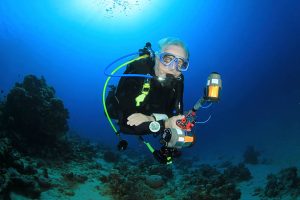
Pushing boundaries wholly differs from diving beyond your limits. Develop a positive mindset, address any fears rationally, and remember that you can still breathe underwater even if your mask is dislodged.
If you want to stay calm and centered, and improve your breath control, practice meditation regularly. Take your time and feel ready before scuba diving. It’s natural to feel some nerves, but don’t panic. If you’re not mentally or physically ready, skip the dive.
Know the Dive Briefing
Agree with your dive group or dive buddy on some points, such as:
- The maximum depth.
- The dive time.
- At which the dive will turn.
- Where is the dive spot?.
- Who will be the dive leader?
- What you will possibly encounter.
- A plan in case of separation.
- A plan in case of strong currents, or meeting nesting triggerfish, etc…
- Ask questions and highlight issues.
Complete Checks
- It is important to check both yours and your buddy’s equipment.
- Conduct a complete buddy check.
- Review hand signals with your dive buddy and maintain frequent communication with him.
When you communicate early with each other, this means you will recognize potential issues. When you complete checks with your buddy, both of you will feel confident.

Try to Shorten Your Air Conservation
Always keep a close eye at your air gauge, and also on your buddy’s air. A controlled descent will help you conserve air. Monitoring your air usage at various stages of a dive helps you adjust your dive plan accordingly.
If you feel your air consumption is higher than usual, try to stabilize your breathing, change your kicking technique, ascend slightly, or end your dive earlier.
Perform a complete buoyancy check
One of the essential tips for senior scuba divers is to conduct a buoyancy check immediately after entering the water and trying to establish neutral buoyancy at depth. Neutral buoyancy enables you to conserve more air and protects the marine environment and the diver as well.
Constantly adjusting buoyancy can accidentally cause damage to coral and marine life. Enjoy the sensation of weightlessness in the vast ocean, or the thrill of flying during a drift dive.
Recognize Your Buddy’s Scuba Equipment
Recognize your buddy’s wetsuit, snorkel, and fins (color, look, and shape) to avoid confusion underwater. Keep in consideration that water is 800 times more dense than air, which causes colors to fade quickly.
At 4.5m underwater, you can’t see the red color, orange disappears at 7.5m deep, yellow fades at 10m-14m deep, and you can’t see green at 22m. White is the only color you can see easily underwater.
Review Your PADI Training
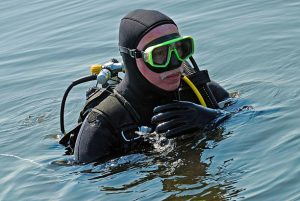
It is important to revise the 5-point descent and 5-point ascent in a regular manner until you master them. Understanding the physiology of scuba diving and honing its techniques is important
Ascend Slowly
Take your time while ascending (never exceed 9 meters (30ft) per minute). Follow the smallest air bubbles coming out of your mouth and keep a close eye on your dive computer. Adhere to the directions of your dive computer while completing a safety stop (every 5-6 meters (16-20ft) for 3 minutes at least).
Never Hold Your Breath
As a rule of thumb for senior scuba divers and other divers, don’t ever hold your breath, Because when diving, there are changes occurring on the volume of the lungs according to the different amounts of pressure at different depths.
Continuous breaths protect the lung from rupturing due to the expanded air, as normal breathing allows air to escape. Consistent inhaling and exhaling help maintain calm and conserve air. Holding your breath can lead to serious lung injuries, so maintain a slow and steady breathing pattern.
Always Return with Spare Air
A confident senior scuba diver checks their air gauges as well as dive computers at regular manners. Plan your dives to ensure you surface with at 50 bar (725 PSI) at least of air remaining. A general guideline is to use 1/3 of your air for the descent, 1/3 for the return, and keep 1/3 as a safety reserve.
Be a Prepared Dive Buddy
Establish a shared rhythm with your buddy, maintaining your own space while staying close. Always be aware of their location and check on them if you notice any unusual behavior. Keep within a few fin kicks for emergencies, and enjoy sharing your underwater discoveries and comparing experiences on land.
Diving is a buddy activity – if the gear is too heavy or the boat ladder is challenging, don’t hesitate to ask for help. After all, we are Senior Scuba Divers. Embrace scuba diving as the buddy sport it is.
Take Only Photos
Avoid touching marine life or collecting coral and shells. Once you are confident in your buoyancy, use your camera to capture the stunning underwater scenery.
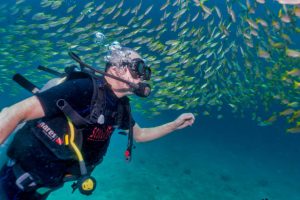
Remember your trim
Trim is much like buoyancy, as it can be negative, positive, or neutral. The ideal trim for most of the dive should be neutral (The body is in a horizontal position parallel to the bottom).
A Scuba diver having neutral trim should move forward smoothly without any change in his depth. A Scuba diver with his head higher than his feet (positive trim) should move upward while that with a negative trim (his head is lower than his feet) will move downwards when he kicks with his fins.
Try to maintain neutral trim by practicing hovering and adjusting weights as you need. Proper trim enhances buoyancy and conserves both energy and air for senior scuba divers.
Enjoy being a Senior Scuba Diver
Take the time to enjoy the unique underwater experience. Float quietly, appreciate your surroundings, and gaze in all directions to fully embrace the thrill of your underwater journey.
Senior Scuba divers are fortunate to explore the underwater world. Embrace the joy of scuba diving while promoting a sustainable lifestyle and protecting our oceans.
Scuba Strong Lifestyle
It is essential for senior scuba divers to incorporate strength and cardio exercises into your daily routine. Yoga and Scuba complement each other wonderfully. Yoga is also helpful in building strength and flexibility in addition to enhancing your underwater meditation experience. It also plays an essential role in improving breath control.
prioritize your diet. Ensure to consume clean and unprocessed foods, as your body will respond to that and become Scuba Strong.