When you float on the surface before scuba diving, you will have an exciting feeling. Whether the water is so murky and the bottom is invisible to you or clear enough to see angelfish that are found 40 feet below, most scuba divers can’t wait to start descending into the underwater world.
It’s a tempting thing for a scuba diver to skip the pre-dive checks and safety protocols to get underwater quickly. However, it’s better to take the time to follow safety procedures, as it is worth a few extra moments on the surface.
The proper 5-point descent takes only seconds and makes sure that a scuba diver is properly prepared before going beneath the waves.
The 5-Point Descent Technique

The steps of the 5-point descent technique includes the following:
- Signal.
- Orientation.
- Regulator.
- Time.
- Decent.
Signal
The first step in the 5-point descent technique is to signal to your dive buddy or other divers in your group sets that you are ready to descent by making the descent hand signal (thumb-down signal).
It sounds obvious, but it’s so important to make sure that all scuba divers in your group are ready to begin the dive before running through the descent procedure. Some divers may be fiddling with their masks or adjusting their weight belt and may be not able to focus properly on the steps unless you made the sign of descent.
Some conditions may also make it very difficult for you to remove the regulator or snorkel to speak. Boat engines or other noises may make it difficult for other divers to hear your words.

Orientation
The second Step in this technique is orientation. Although almost all training organizations recommend picking a fixed object on the surface as an orientation point, there are several ways for a diver to Orient himself.
As a scuba diver, you can use the sun as a directional orientation. The ocean currents can be also used.
Actually, using a compass is considered the most exact way for a diver to orient himself. This step from the 5-point descent technique is considered a great opportunity to sit combase headings..
Regulator
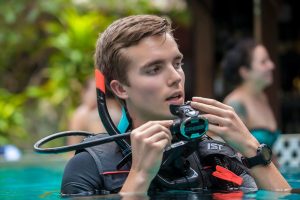
The third step is to exchange the snorkel For the regulator or to just confirm that each scuba diver has a regulator in his mouth before continuing descending.
The mouthpieces of the snorkel seem identical to those of the regulator, so a diver may accidentally descend while breathing from the snorkel instead of the regulator. It’s almost a nasty surprise because in rough conditions, you will have to switch from the snorkel to the regulator without completely removing your head from the water.
Time
The Last action you should take before deflecting your buoyancy compensator is to check the timing device. your bottom time Which is the time used for calculating the maximum dive time begins when you start to descend.
you should check your timing device immediately before descent. This helps to keep this time as accurate as possible. If you use a dive watch, this step will be a good opportunity to set the watch bezel or record your start time on a dive slate.
If you use a dive computer, you should confirm that the computer is turned on and ready to record the statistics of the dive.
Decent
The last step in the 5-point descent technique is deflecting your buoyancy compensator and descend. Ensure to deflate your BCD just enough to be able to slowly begin to sink then exhale to help yourself decent the first few feet.
Make sure to equalize your ears once on the surface before descending. That helps you to prepare them for subsequent equalizations and compensate for the initial pressure change near the surface.
Keep the inflator of your BCD at your hand to add ear to the BCD as you descend. You will need to compensate for the decrease in buoyancy as the water pressure increases around you.