The Red Sea in Egypt is one of the most remarkable diving destinations in the world which known for its rich marine biodiversity, vibrant coral reefs, and crystal-clear waters.
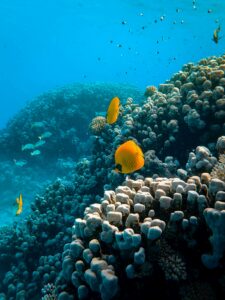
Before exploring its underwater beauty, it’s worth learning more about what makes this sea so unique—from its name and depth to its high salinity. As a result of being a home to hundreds of species of fish and both soft and hard corals, the Red Sea offers an unforgettable underwater experience.
In this article, we’ll share some fascinating facts about Red Sea that reveal why this extraordinary sea is so special.
Where Does the Name Red Sea Come From?
In fact, we don’t have unequivocal answer to this question, but there are several theories that explain this name, including:
-
Although the water in the Red Sea has blue color in different shades, the water can appear reddish brown during blooms of algae Trichodesmium erythreaum on the surface.
-
The ancient Greeks give it the name “Eritrean Sea” and the word “erithros” means red in Greek.
-
In some ancient languages, such as those of the Achaemenid people, colors were used to represent directions (Red meant south). The sea may have been named as a result of being in the southern direction it represents geographically.
-
Parts of the coastline have rocks rich in iron oxide which give these parts a reddish-brown color.
Location of the Red Sea
The Red Sea is an inland sea that is located between Africa and the Arabian Peninsula and connects to the Indian Ocean by the Strait of Bab al-Mandab, which is between Africa and the Arabian Peninsula in Asia.
It connects to the Mediterranean Sea by the Suez Canal. There are two bays, located to the north which are: the Gulf of Suez and the Gulf of Aqaba, surrounding the Sinai Peninsula.
Depth of the Red Sea
A rift valley runs along the center of the floor of the Red Sea, which is a deep cleft formed because of the stretching of the earth’s crust. The bottom consists of oceanic crust made of basalt.
Africa moves away from Asia (exactly the African plate from the Arabian plate) specifically in the Red Sea Rift – As a result, the depth here exceeds 3000 meters.
-
The maximum depth of the Red Sea reaches 3040 meters. The average depth is nearly 490 meters.
-
Around 40% of the size of the Red Sea is quite shallow (reaches a depth of 100 meters) and 25% rarely reaches 50 meters deep.
-
Only 15% of the Red Sea exceeds 1,000 meters in depth.
-
The Red Sea is about 2,250 kilometers long and reaches a maximum width of 306–355 kilometers near Eritrea. The height of Yemen is regarded as the narrowest place of the Red Sea: 26-26 kilometers, in which the strait of Bab al-Mandab is located.
Salinity of the Red Sea
The Red Sea is considered one of the saltiest reservoirs worldwide. The degree of salinity ranges between 36‰ in the south parts and 41‰ in the northern parts of the sea.
The average salinity here is around 40%. On the other hand, the average salinity of sea water around the world reaches 35‰. The salinity of the Red Sea is higher than that of the sea water by about 4%, and this is due to:
-
The low precipitation.
-
The high evaporation rate.
-
No rivers flow into the Red Sea.
-
The Red Sea has a limited connection to the less saline Indian Ocean.
Scuba Diving in the Red Sea
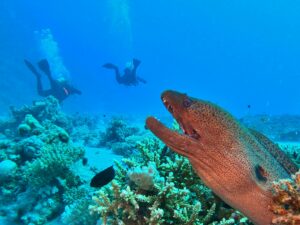
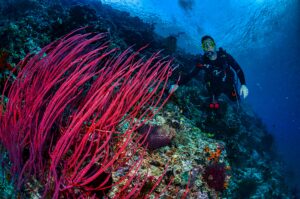
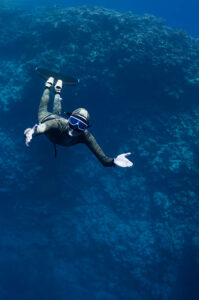
The Red Sea is known for its excellent scuba diving conditions in all seasons. Depending on the reef location, diving can be done from dive boats in Hurghada and Sharm El Sheikh, from shore in Marsa Alam and Dahab, by RIB in Marsa Alam, or from safari boats to remote reefs such as Rocky, Brothers, Zabargad, and St. John’s.
The Red Sea coast is covered with coral reefs, which attract scuba divers around the world. Scuba diving in Hurghada (from large comfortable dive boats) offers the chance to explore stunning coral reefs just a four-hour flight from Europe.