


Have you ever thought about what is in a scuba tank? Many people think that scuba divers have pure oxygen in their scuba tanks, but this isn’t true. In this article, we’ll discuss together about the component of the gas mixture found in scuba tanks (cylinders) and the effects of it on scuba divers.
We’ll also explore the issues related with breathing air at high pressure. (i.e. really deep) and how special dive tables as well as dive computers help divers minimize the risks during their underwater adventures. So, keep reading to discover the science behind scuba diving!
What is in a Scuba Tank (Cylinder)?
If you didn’t try scuba diving before, at least you surely know that scuba divers descend underwater with at least one tank (which is known as a gas cylinder).
What’s often misunderstood is “What is in a scuba tank?”. Many non-divers think that scuba tanks contain 100% oxygen. But in fact, in recreational diving, diverd usually use an air mixture containing (21% oxygen and 79% nitrogen) or a mixture of Enriched Air Nitrox (Containing about 22%-40% oxygen with the remaining percent nitrogen). Know about Nitrox diving from here.
In summary, scuba divers don’t ever dive with pure oxygen and when talking about technical diving, divers use a much more varied range of gases (including pure oxygen). But, In this article, we’ll focus on recreational scuba diving, which is considered the most common type of SCUBA diving.

*Scuba Facts*
If scuba divers used pure oxygen underwater, this oxygen can rapidly become toxic. This is because oxygen becomes toxic when pressure exceeds a certain level. Beyond this level, The maximum depth for using pure oxygen underwater is 20 feet (6 meters).
Since air has less oxygen (21% oxygen and 79% nitrogen), a diver can go deeper than 200 feet (60 meters) before the oxygen pressure matches that at 20 feet (6 meters) with pure oxygen.
Still, 200 feet (60 meters) is deeper than usual for air diving. The typical limit for air diving is about 130 to 165 feet (40 to 50 meters), depending on several factors.
Wait – Oxygen is Toxic?!
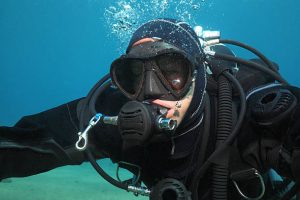
To know the exact reason behind how oxygen can become toxic, we should properly understand partial pressure in scuba diving. By understanding partial pressure, we can calculate the maximum depth for a gas or gas mix.
Partial pressure is the pressure of a specific gas in a certain mixture of gases. When you practice scuba diving, you breathe a mix of gases, such as oxygen, nitrogen, and, in technical diving, sometimes helium. Each gas contributes to the total pressure while maintaining its own individual pressure. This is called partial pressure, which is each gas’s share of the total pressure.
Moreover, diving subjects you to both water pressure as well as surface air pressure. The pressure on the surface of the air is 1 atmosphere of pressure (1 ata). After descending 33 feet (10 meters), this means another atmosphere of pressure is added.
So, if we suppose that we have descended to 66 feet (20 meters), the pressure will be 3 ata (1 ata of air and 2 ata of water).
As total pressure rises, the partial pressure of each gas increases accordingly. The partial pressure of a specific gas is determined by multiplying the total pressure of the whole mixture by the proportion of that gas in the mixture.
For example, breathing air with an oxygen percentage equal to 21% (.21). After descending to 66 feet/20 meters, the pressure will become 3 ata. So, if we want to calculate the partial pressure of oxygen at this depth (66 feet/20 metres), then it will be = 3 X .21 =.63 ata.
To avoid getting oxygen toxicity, the partial pressure of oxygen should be kept below 1.4 ata (or 1.6 ata for some applications). At 66 feet (20 meters) deep with pure oxygen, the pressure is 3 ata, which exceeds the toxicity limit.
Enriched Air Nitrox, which we mentioned before, contains more oxygen percentage than air does. Oxygen is added to reduce nitrogen, not to increase oxygen usage. This lets scuba divers stay underwater for longer periods.
But, because there is a high percentage of oxygen, this allows for shallower maximum depths, as 1.4 ata oxygen pressure is reached sooner than with air.
For example, using EANx36 (which has 36% oxygen), the oxygen partial pressure at 66 feet/20 meters will be 3 X .36 = 1.08 ata – which is nearly close to the limit, but still acceptable. The deepest allowable depth relies on the percentage of oxygen. Divers learn to plan the limits of your depth as part of their PADI Enriched Air Divers training.
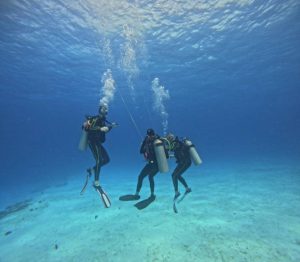
In conclusion, scuba diving is an exhilarating and rewarding activity that helps you explore the beauty of the deep blue. However, it is very crucial to properly understand the science behind scuba diving. By learning valuable information about (What is in a scuba tank?), you can prepare yourself well for your next scuba diving adventure.
If you’re interested in becoming one of the certified scuba divers and learning more about The details of scuba diving, it is recommended to sign up for the PADI Open Water Diver course. Alternatively, if you’re a certified scuba diver and want to get more information about gas mixes, the PADI Enriched Air (Nitrox) Diver is the best choice for you.


