If you are new in the scuba diving world, you might have noticed that scuba divers use different types of scuba fins. Some divers prefer blade fins (paddle), while others feel more comfortable in split fins.
Both fins help you move faster and easier in the deep blue, but what are the main differences between the two types and the advantages and the drawbacks of each type.
Split Fins vs Blade Fins: What is the Main Differences
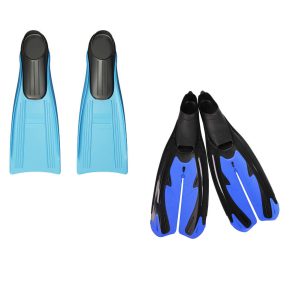
Split and blade fins are mostly different from each other in both propulsion power and air conservation. Read the next lines to know the different characteristics of each fin type.
Power & Speed
Split Fins is considered a relatively new option for scuba divers. They have the shape of the tail of a fish with a slit down the center. This slit creates a vortex that doesn’t only help pushing scuba divers forward but also to get optimal speed underwater.
Split fins work just like a propeller: water flows smoothly on the upward fin stroke by the help of the slit, causing a foil shape from the two sides of the blade. This shape enables you to move forward through the water when you produce the right lift.
However, wearing split fins will not make you swim faster than your ordinary speed. If your kick is longer and harder when wearing these scuba fins, the flow-through design of these fins becomes less efficient. It also gives you less forward momentum.
Blade fins, On the other hand, are considered more powerful than the previous type as they work on pushing water back to allow you move forward through the water. Blade fins have varying length and stiffness— which are two important contributing factors to both the speed and the needed kicking force.
The greater stiffness of these types of fins allows you to have more forward speed, but kicking will be harder. Scuba split fins, on the other hand, don’t have the same rigidity of blade fins as they are considered lighter and more flexible.

Efficiency
Split fins work on channeling any surface water in their opening and out of it instead of the slides resulting in a spring-like action. This provides a more effective and powerful kick, resulting in reducing the drag and effortl, and this leads to greater efficiency.
Meanwhile, blade fins work on spilling water over the sides of their blades while kicking. This reaction causes these fins to be less efficient than split fins. This also causes more drag, and you’ll have to move many forward propelling. All these previous factors make many scuba divers prefer split fins iver blade fins.
Air Conservation
Upward fin strokes can’t push you forward like other techniques of underwater kicking and finning. That makes split dive fins more efficient to wear when doing these types of kicks than paddle fins.
You can use Scuba split fins easily in many scenarios, as these fins don’t need divers to kick hard, helping them consume less air. In contrast, paddle fins need more kicking force leading to consuming more air, which in turn makes their dives shorter.

Using
Since split fins are considered more energy-efficient, they’re regarded the ideal type for the following people:
- Casual divers.
- Inexperienced scuba divers who don’t have a good kicking technique.
- Scuba divers suffering from ankle or knee problems, and others who get cramps quickly.
Split dive fins cause less joint pressure in addition to no pain while developing the right kicking motion, as the less powerful feeling of your strokes. These types of fins also are suitable for scuba divers having lower-body injuries because they are doing well for muscle rehabilitation and strength.
However, many divers assume that split fins aren’t powerful enough for scuba diving in harsh currents. That’s why split fins are the ideal option in easy dive sites having little or no current.
In contrast, Blade fins are suitable for technical dives or dive sites having strong currents, as blade fins provide you with more powerful kicks.
Scuba divers can also choose these types of fins when they need fast speed to chase fish. And if you’re a certified scuba divemaster, blade fins are considered ideal to perform a diver rescue. These types of fins are very useful when you carry another scuba diver to shore or to the boat, as they are great at supporting weight.

Split Fins vs Blade Fins: Which is Better?
To summarize the previous points that we’ve discussed above, with split fins, you will have more efficient thrusts and conserve less oxygen. But these types of fins have some drawbacks as well, such as reduced swimming speed in addition to kicking power. Blade fins are considered excellent in both departments as they provide you with stronger force underwater. Blade fins can be also used in many different situations, from technical dives to rescue ones.
Although split fins have some advantages over blade fins, deciding whether they’re better than the latter isn’t easy. In the end, your needs underwater will define the types of fins you should choose. It is recommended to go anywhere in the deep blue with both split and blade fins.