Scuba diving is all about efficiency beneath the surface, and nothing impacts your underwater agility more than the right pair of fins.
Whether you’re gliding effortlessly through tropical reefs or battling strong currents in deep waters, the style of fins you choose can make or break your dive. But -without doubt- finding the perfect fit might seem overwhelming.
This guide will break down the different styles of scuba diving fins, the unique blade designs that influence performance, and how to ensure the best fit for comfort and control. Ready to make a splash with the right fins? Let’s dive in!
Types of Scuba Diving Fins
Fins are classified into two main different styles: full-foot fins and open-heel fins. As you can understand from their names, the two different styles of scuba diving fins are quite self-explanatory.

Full-foot Fins
Full-foot fins feature soft, flexible foot pockets which wrap around your whole feet including your heels. There is no need to dive booties and you can wear barefoot under them. Many scuba diver prefer to wear neoprene socks with these types of scuba diving fins as they provide them with a little bit of extra protection.
Pros of Full-foot Fins
- Have a cheap price.
- less bulky, making them easier to carry.
- Allow direct transfer of energy from a divers feet to the fins.
Cons of Full-foot Fins:
- No flexible size, they either fit or they don’t.
- Unable to wear booties with them.
- Hard to put on and take off.
Open-heel Fins
Open-heel fins feature foot pockets which cover the whole feet except the heels. Instead of a foot pocket, straps hold your foot to the fins. You can wear them with dive booties.
Open-heel fins are considered bigger than full-foot fins, the reason for that is to accommodate the extra bulk of the booties.
Pros of Open-heel Fins:
- Flexible.
- Easy when wearing and taking off
- The ability to wear dive booties with them offer additional thermal protection against other hazards.
Cons of Open-heel Fins:
- Are considered expensive in addition to the cost of buying dive booties.
- Are large and bulky.
Styles of the Blades
Scuba diving fins are considered one of the essential pieces of scuba equipment, as they propel you through the water by the blades. Scuba diving fins come with different styles and each style has their pros and cons. The five main styles of the blades that we will talk about are paddle, vented, channel, split and hinged.
Paddle Fins
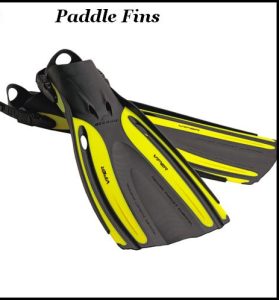
Paddle fins are standard fins which have the simplest design with a flat blade. They function like an oar, propelling you forward with each kick.
Vented Fins
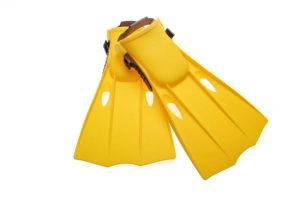
Vented fins are better than paddle fins because they have vents at the base of the foot pocket through which water passes on the recovery stroke of the kick cycle while blocking it during the power stroke. With these vents, vented fins are considered more effective than the standard paddle fins.
Channel Fins
Channel fins use various materials in the blade, allowing it to flex in the water. When flexed, it shapes into a “U” channel that traps water, creating a jet that in turn increases propulsion.
Split Fins
Split fins feature a split middle the down of the blade and function like the wings of a plane. Instead of pushing water backwards, Split fins move you forward by creating lift as water flows through the splits.
This technique makes kicking using split fins extremely easy. However, some divers find that this type doesn’t offer much manoeuvrability either when changing directions or trying to stop abruptly.
Hinged Fins
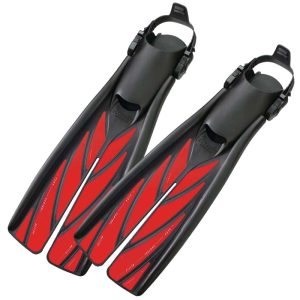
Hinged fins feature a pivoting blade that will angle itself when kicking in order to make your kick cycle work better. This design is achieved by bungee bands or flexing bars along narrow blade sections.
Fitting your fins
Finally, How do you choose the right scuba diving fins? If it is your first time to buy your first pair of fins, a paddle fin or vented fin will be the best option because these types have a standard design and are very cheap.
A standard fin helps you determine your kick style. If your legs are strong and your kick is powerful, then, paddle and channel fins will give you better control underwater. If your kick isn’t powerful then split fins will enables you to move better underwater while expending less energy.
It is essential to have the proper fitting because an ill-fitting fin may lead to blisters or cramps during use. The best way to ensure you have the best fin fit is to try them on. In case of choosing open-heel fins, don’t forget your dive booties to try on with your fins.
Fin sizes are different between the different manufacturers, a specific size in one brand of fins won’t always match another brand’s. Some manufacturers may even have a different size to every model.