Besides a mask and snorkel, a pair of fins are probably considered the first pieces of scuba diving equipment you will purchase, and this for good reasons.
Quality fins improve diving by enhancing your movement and propulsion. With so many styles and types for any budget, choosing fins can be challenging.
There are two main types of scuba fins: the close-heeled or full foot fins and open-heeled fins. Keep reading this article to know more about the different types of fins.
Types of Fins
Fins come in various styles, each designed to enhance movement and efficiency underwater. Choosing the right type depends on your scuba diving needs and preferences.
The different types of fins include:
- Full Foot Fins/ Close-heeled Fins.
- Open-heeled Fins.
- Conventional Non-split Fins.
- Split Fins.
- Pivoting Blade Fins.
- Force Fins.

Full Foot Fins/ Close-heeled Fins
They are also known as full-foot pocket fins. The close-heeled fins cover the foot completely like a slipper. They are considered worn barefoot with an open toe end. You will find them cheaper than open-heel fins in general, so it’s crucial to try these fins and ensure they have a snug fit allowing toe movement.
Too tight ones can cut circulation and pinch your foot leading to blisters or chafes. On the other hand, too loose ones can slip off your foot when you hit the water or kick.
Open-heeled Fins
Open-heel or half-pocket fins cover the front foot and use a heel strap for support. The heel strap on the open-heel pocket fins can be adjustable or fixed.
Non-adjustable straps are elastic and fit snugly around the heel. Adjustable heel straps feature buckles on both sides of the foot, allowing you to adjust the fin to fit your foot. While you can wear this type of fin barefoot, it is recommended to wear them with the right size Dive booties (neoprene boots) under them.
When using this type of fins, you should take your boots with you, as you need to keep their thickness in mind when testing for fit.
Conventional Non-split Fins
It is one of the basic types of fins that have a fairly rigid blade with ridges and a flexible tip. It is also considered one of the good scuba fins that you can wear in stronger currents, which makes it a very popular choice for many divers.
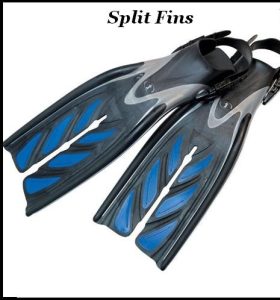
Split Fins
This design features a fin blade divided by a central slit. Split blade fins cost more but can provide you with improved propulsion and agility than the standard fins. However, some scuba divers believe they are not a better option than conventional fins in strong currents.
The only technical difference between the split and non split fins is the kicking style (finning technique). When wearing non-split fins, use your normal kick. On the other hand, with split fins, it is more effective to use small kicks (such as flutter kicks).
Pivoting Blade Fins
These fines have been adopted by some manufacturers, such as Mares. They feature a flex-point in its structure in addition to a V-shaped area made from softer plastic. Its role is to scoop water to have better traction and speed, allowing you to use alternate kick strokes you can’t use with splits.
Force Fins
A California-based manufacturer produces these types of fins to reduce water turbulence and minimize the diver’s kicking effort.
Force Fins are so special because of their design that closely resembles fish tails with a v-cut at bladed and they have an open toe pocket that is designed with adjustable heel straps. Although this design is made from polyurethane, it enhances speed but limits agility.
In Conclusion
As always, while purchasing your SCUBA Fins consider the good fit and features that is suitable for your diving needs.