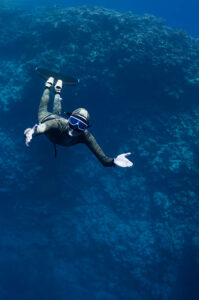
When you start to learn how to dive, you will practice some diving skills, such as, neutral buoyancy, replacing your mask, regulator recovery, etc…
Unfortunately, these skills don’t include learning about the different finning techniques, for example, modified flutter kick or frog kick which can help you improve your movement and better impact your environment.
In the best situations, your dive instructor will tell you to kick from your hips instead of the way like riding a bicycle. This is largely because his instructor didn’t speak about that. This is considered a real shame because each finning style has huge value and can be applied depending on the chosen dive site or the conditions of the chosen day regardless of whether you are a technical diver or recreational diver.
Modified Frog kick is your best choice if you are diving in a silty wreck, delicate reef or cave tunnel. Flutter kick or frog kick will be the best finning technique when diving in open ocean with distance to cover.
Whether you are a new scuba diver, a dive Pro or a seasoner diver, you should give each finning technique a chance. Ask your dive buddy to film you to be able to see what you are doing and improve.
Put into consideration that some techniques may feel harder at first than others as you will not be used to moving the muscles and some techniques may be harder or easier depending on the used scuba fins for instance, frog kick isn’t easy if you are using split fins.
In this article, we will dig into each of these finning techniques a little more and talk about where to use each one in addition to the benefits and drawbacks.
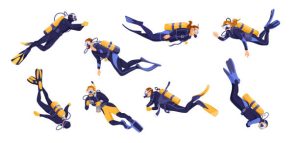
Finning Techniques Every Scuba Diver Should Know
The finning techniques that we will talk about in this article include the following:
- Flutter kick.
- Modified flutter kick.
- Frog kick.
- Modified frog kick.
Flutter Kick
You probably have learned flutter kick first, as it is the only option for most people who are taught about other finning techniques.
With this technique, a scuba diver will propel himself through the water covering ground fast while using the minimal effort.
Unfortunately, it’s considered less effective when you are looking for controlled movement for tight turns and won’t cause minimal disturbance to the surrounding environment.
Execute flutter kick by extending your legs behind you and slightly bent your knees. At the beginning of the kick, ensure that the power comes from your hips and your thighs should do most of the work.
To flutter kick by, move one of your legs up while simultaneously moving the other down, creating an alternating up and down movement like when you are practicing freestyle swimming. The depth of your kick must be relatively shallow to conserve energy as possible.

Benefits of Flutter Kick:
- The fastest type of finning technique.
- Provides you with a strong propulsion to get to your destination quickly.
- Learning and performing it is so easy.
- The best technique for basic open water diving scenarios.
Drawbacks of Flutter Kick:
- Isn’t considered a very controlled propulsion technique.
- Isn’t recommended for underwater photographers and technical divers in different environments because it causes stirring up sediment.
- Wrongly performing it throws off trim, buoyancy and breathing control.
The Best Type of Fins You Can Use:
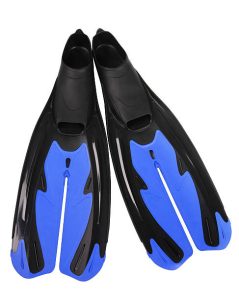
- The paddle fins are the best fins to work well for flutter kick because they provide a lot of power while kicking.
- Split fins can also be a good choice as they are designed to be efficient and give you a lot of thrust with minimal effort.
Modified Flutter Kick
The modified flutter kick is considered a variation of the standard flutter kick which is characterized by the slow controlled, less power motion. This technique helps divers to conserve energy and causes less disturbance to the environment of the underwater world.
Scuba divers usually use this technique when they navigate a tight space or explore delicate structures in which big kicks can damage coral reefs.
The modified flutter kick is different from the normal flutter kick in the following points:
- Your knee should be more bented.
- The fins you wear should be still parallel to the ground.
- Your kicking motion should still be initiated from the hips.
- Your thighs should do less work.
- You shouldn’t move your knees so much.
Your movement in the modified flutter kick requires moving one of your legs up while moving the other down which creates an altering up-and-down movement. The motion should also be steady and smooth while keeping the tips of your fins closer together.
This will result in a small kick which reduces the risk of disturbance to the underwater environment in addition to conserving more energy.
It is considered a good technique for low-current environments. If you are a flutter kicker by nature, you may find it easier to adopt this technique instead of frog kick and modified frog kick.

Benefits of Modified Flutter Kick:
- The best technique for silty overhead environments, as with this technique, you can control the amount of silt that you are kicking.
- Provides you with steady and slow propulsion..
- With it, you can conserve more air and prolong the time of your dive in silty conditions.
Drawbacks of Modified Flutter Kick:
- The least efficient type of finning technique.
- Provides you with very little propulsion.
- Isn’t suitable for most scenarios of diving.
The Best Type of Fins You Can Use:
- Split fins are the best fins to work well for modified flutter kick, as they will provide you with the sufficient thrust with minimal effort and also the ficking motion is easier with this type of fins.
- Flexible paddle fins are considered another good option because of their designs that provide a balance between efficiency and power.
Frog Kick
The frog kick is a type of finning technique that is popular among scuba divers for its power, efficiency and minimal disturbance to the underwater environment. This technique is inspired by the movement of the leg’s frog and is suitable for scuba divers wearing large fins or diving in confined spaces.
The frog kick is also considered the best technique for technical diving and scientific diving or for any diver who doesn’t want to disturb the environment as much as possible.
This technique keeps your leg up and allows you to have a better control of body position in the water column.
You can perform this technique easily, just position yourself parallel to the ground and bend your knees. Push the knees out and back in a sweeping motion to generate forward movement and complete the kick by straightening your legs, then bring your fins together.
Glide for a moment to allow the momentum from the kick to carry you forward then start the next kick. It is considered the effective technique for low visibility environments because it produced less silt and debris.

Benefits of Modified Frog Kick:
- It is the recommended finning technique for technical divers because it provides controlled propulsion in addition to the tight body position in the water.
- Considered a very propulsion tool.
- You can use it easily with short distances and tight spaces.
- When practicing it, you can brake and hold position easily in the water column.
Drawbacks of Modified Frog Kick:
- Isn’t considered the fastest type of the finning techniques.
- To perform it correctly, you will need some practice and training.
The Best Type of Fins You Can Use:
- Jet fins are considered a popular choice for frog kick technique because of their stiffness and the power that can be provided from it. They also are incredibly durable and can withstand the wear and tear.
- Some paddle fin brands can also be other good options unless they aren’t very long or flexible.
Modified Frog Kick
The modified frog kick is considered a variation of the frog kick. It is the best technique when scuba diving in confined spaces and navigating delicate underwater environments because it increases control and maneuverability.
It is the finning technique in which technical and scientific divers should be well-versed and it is thought to be useful for recreational divers who look for more control.
Follow the next steps to perform the modified frog kick:
- Maintain a horizontal body position while looking slightly forward and your face down.
- Bend your knees and keep your legs bent instead of bending them in the traditional frog kick.
- The last step is to sweep your fins in a circular motion while being closer to the ground.
Thus technique requires from you to have smaller and more controlled movements that allow adjusting your position and maintaining a steady pace without excessive water movements or disturbing the surrounding environment.

Benefits of Modified Frog Kick:
- The technique of choice for some technical divers due to its tight control of body position in the water.
- Provides you with strong propulsion.
- With this technique, you can easily brake and hold position in the water position in the water column.
Drawbacks of Modified Frog Kick:
- Isn’t very efficient as the other finning techniques.
- To be able to perform it correctly, you will need much training and practice.
- Isn’t considered the fastest one.
The Best Type of Fins You Can Use:
Jet fins and paddle fins can work well for this technique because of their stiffness and also provide excellent control and propulsion.