Beneath the surface of our oceans, a silent symphony of sound pulses through the deep. Sonar—once hailed as a marvel of underwater navigation and exploration—has become a double-edged echo.
While it guides submarines and maps the seafloor, its invisible waves ripple far beyond their intended targets. Increasingly, scientists and divers alike are raising concerns about the effects of sonar on divers and sea creatures, revealing a hidden tension between technology and marine life.
From disoriented dolphins to divers reporting strange sensations, the underwater world is speaking back, and it’s time to listen.
What is Sonar?
It is a common fact that light doesn’t travel well beneath the waves – even in clear waters, the visibility is usually good at the first tens of metres. What is not common is that sound travels very well and far underwater.
The reason behind that is that water is much denser than air, as a result of that, it has the ability to respond faster and better to acoustic pressure waves (sound waves).
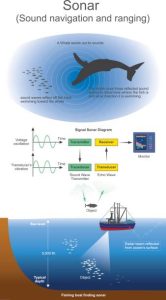
Due to these properties, sonar is used in ships to navigate through the ocean and to “see” under water. The word “sonar” refers to sound navigation and ranging.
Sonar equipment sends sound pulses or pings, and then analyses (read) the echoes. Factors like the timing, amplitude, phase and direction of the received echoes, you can tell what’s beneath the waves (the seafloor, coral, fishes, canyon walls, and of course ships and submarines).
Most vessels – from small, private boats to large commercial tankers – rely on sonar. However, navy sonars are stronger compared to your off-the-shelf sonar used for finding fish.

What are the Effects of Sonar on Divers?
The effects of sonar on divers is considered a difficult topic to study, because it isn’t an ethical thing to deliberately expose humans to harmful levels of sound.
However, some navies and accidental exposures have reported anecdotal cases. Studies have explored human hearing underwater—with and without neoprene gear.
It is not a surprise to know that humans don’t hear well under water, because we’ve evolved to live on land. Still, a sonar sound would be heard for divers as a mid-to-high pitch sonar sound underwater.
When talking about naval sonars, human divers described the sound as “unpleasant to severe” at levels of roughly 150dB re 1 µPa (decibel refers to a reference pressure of one micropascal, which is the standard reference for underwater sound).
That would be about 10 kilometers away from a military sonar. Keep in mind that underwater sound isn’t like the sound we receive in air—they’re too different physically to compare in between.
The limits of human tolerance are roughly 180dB re 1 µPa, which would be around 500m from military sonar. At these levels, humans might experience disorientation, dizziness, temporary memory and concentration impacts, or temporary hearing loss.
There is no information about what levels the Australian divers were exposed to, but they only have minor injuries.
Stronger, closer, or longer sonar exposure can cause more severe physiological or health impacts. In extreme cases, in particular for impulsive, sudden sound (which sonar is not), sound can lead to damage to tissues and organs.
What Does Sonar Do to Marine Animals?
Some of the information on the effects of sonar on divers under water comes from studies and observations of animals. While marine animals usually don’t have outer ears (except for sea lions), marine mammals have inner ears that have the similar function of ours.
Noise can harm their hearing, same as ours. This might be temporary, like the ringing ears or reduced sensitivity you may suffer from after a loud concert, or it can be permanent.
Marine mammals in deep water depend on sound to a greater extent than most humans do. Because sound helps them in navigation, hunting, communicating with each other and to find mates.
Toothed whales as well as dolphins have evolved a biological echo sounder or biosonar. They make clicking sounds and listen for echoes. So, interfering with their sounds or hearing can throw off important behaviors.
Finally, sound may also have an effect on non-mammalian fauna, like fishes, which depend on acoustics instead of vision for many of their life functions.