Is Your Dive Gear Still Keeping You Safe?
Scuba gear isn’t immortal. Even the highest-quality equipment has a life span, and ignoring that fact can be deadly. According to DAN, gear-related issues are considered the reason behind 15% of scuba diving fatalities. That happens due to poor maintenance or misuse.
If your mask fogs up constantly, your regulator isn’t working smoothly, or your fins fight you more than they help, it’s time to replace your scuba gear.
Whether it’s discomfort, fit, or function, faulty gear turns a peaceful dive into a risky struggle. This guide will explain to you when to replace your scuba gear. Because underwater, comfort isn’t a luxury. It’s survival.
When to Replace Your Scuba Gear
Even well-maintained dive gear has limits. Knowing when to replace it isn’t just smart — it’s lifesaving. Here are the main dive gear we are going to talk about:
- BCD (Buoyancy Control Device).
- Dive Computer.
- Dry Suit.
- Fins.
- Mask.
- Regulator.
- Snorkel.
- Scuba Tank.
- Wetsuit.

BCD (Buoyancy Control Device)
Any local dive shop can patch a pinhole-sized leak, but if your BCD has been patched repeatedly, you should replace it. Other signs of wear like broken buckles, frayed straps or leaking valves means that your BCD has reached the end of its useful life.
If your BCD is an older integrated-weight one, you should upgrade it. Early weight-integrated BCDs had complicated systems that are harder to ditch in emergencies than today’s models. Do you need a little help to find a replacement? This article will help you.
Dive Computer
Many dive computers can last for years and years, but there will be a time when the device can’t be serviced by a qualified technician. When you has a piece of equipment that can’t be properly maintained, stop using it.
Divers should also replace their dive computers when they no longer meets their needs. Although introductory computers have several great features, they aren’t considered suitable for technical diving.
Similarly, the low-end computer that you get as a new scuba diver may feature a small screen that you will find it hard to read as well as uses confusing symbols. New dive computers feature large, easy-to-read displays so that you will wonder how you could ever dive without it in your hand.
Dry Suit
From the definition, a dry suit should keep you dry. But if you find that the suit is repeatedly patched, or noticed any signs of mold, then, it’s the time to replace it with a new one. Having a broken zipper is considered a reason for the replacement.
Fins
Fins are considered the longest-lasting piece of scuba equipment. The need of new features, or just losing a fin are regarded the main reasons for replacement.
Another reason to decide to replace your fins is if they aren’t meeting your needs. If you are suffering from muscle cramps due to the blade fin, switch to a more flexible split fin. On the other hand, if your fins don’t provide you with the sufficient propulsion, then, it is the time to buy stiffer fins.

Mask
The first part in your scuba mask to wear out is its strap. If your mask fails to adhere to your face on the surface, you should replace it.
In the next stage, the mask skirt comes to wear out. The skirt is very crucial to maintain a good seal around your your face.
Test your seal on land by pressing the mask toward your face without using the strap. If your mask no longer adheres to your face on the surface, The replacement is a must. Lastly, even a minor crack in the lens makes the mask unusable. Ensure to replace a cracked mask immediately.
Regulator
The importance of a scuba regulator lies in providing you with breathing gas underwater. It’s likely the most important piece of dive gear to look after.
It can be hard to spot issues with a regulator because its internal moving parts aren’t visible. For this reason, it’s critically important to service your regulator every year.
If you detect any cracks or bulges in the hoses, bring it in. Even very thin cracks in the plastic are still a concern. Lastly, a free-flowing or hard-breathing regulator should be checked right away.
Just like a car needs routine maintenance, your regulator also requires regular servicing to work properly. In case of having a so old regulator, you can no longer service it, it’s time to purchase a new one.
Also, if your regulator causes excessive jaw fatigue, replace it with a new one that’s compact and made of lighter materials.
Snorkel
Snorkels are durable and can last for years. The damage can mostly occur on the mouthpiece and hose portion are the most likely. So, replace them when needed.
Scuba Tank
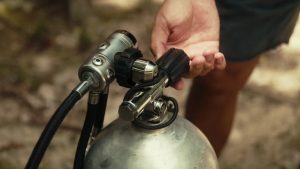
You should inspect your scuba tank visually each year and hydrostatically every 1 to 7 years depending on local regulations. A tank that fails in these tests should be replaced.
Wetsuit
A wetsuit is perhaps the most under-replaced piece of equipment. The life span of the most types of wetsuits is three years, five years max. A wetsuit may look fine, but its appearance can be misleading. Neoprene compresses while scuba diving and loses its ability to insulate by time.
Other reasons to replace a wetsuit include: accumulated salt crystals, rips or tears, the suit no longer fits or it just plain stinks.
Signs of Using Your Scuba Gear for Too Long Include:
- Servicing isn’t possible and it is time to replace your scuba gear.
- Parts are pricey enough that keeping the gear becomes expensive.
- It’s so heavy that you end up paying overweight baggage fees on every trip.
- The gear no longer fits.
- Your scuba gear is too basic for the more advanced adventures you will conduct.
Don’t keep using old gear just because you’re attached to it or it was with a high cost. If the gear is still usable, sell it if possible and invest in something that meets your needs.