Mastering your buoyancy is one of the most rewarding steps you can take as a diver. After completing the PADI Peak Performance Buoyancy course, you will be able to move through the water with ease, conserve air, protect the reefs, and feel completely in control beneath the waves.
Whether you want smoother dives, better trim, or effortless hovering, this course takes your skills to the next level and transforms the way you experience every dive.
Why to Enroll in the Peak Performance Buoyancy Course?
Some may wonder, “I learned about buoyancy control on the Open Water Diver course, Why I need to take another course?”
Actually, it is a fair question, and as a simple answer- if you aren’t one of those rare divers who could float like a genie in the water, then YES, the Peak Performance Buoyancy Specialty course is very important for you to take. The reasons for that including:
- The ability to dive with less weight.
- Enjoy with a lower consumption rate and extend your bottom time.
- Become more relaxed underwater.
- Better encounters with marine life.
- With a bad buoyancy control, you have high percentage of diver injuries.
Peak Performance Buoyancy is considered, without doubt, one of the most important conservation courses for scuba divers.
What is the Peak Performance Buoyancy Specialty course?
Like most specialty courses, the Peak Performance Buoyancy Specialty course is considered easier and more fun than the Open Water Diver course. That doesn’t mean that you won’t enjoy in the open water course, but to turn from nondiver to a certified diver will demand a lot more time and effort than improving your skills that already have mastered.
You don’t have to pass any exams when reaching the end of the Peak Performance Buoyancy Specialty course, and, because the course only consists of two dives, this course can be completed in just 1-2 days.
Two extra reasons: If you don’t be comfort 100% when diving with just a dive buddy, the Peak Performance Buoyancy Specialty course will help you in the following:
- Gain diving experience under the suprivision of a PADI Professional.
- Improve your scuba skills and be more confident underwater.
What about Learning Buoyancy Independently?
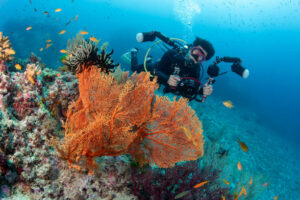
Can you get better at buoyancy independently? Yes, but if you don’t practice scuba diving at regular manners, it will take from you longer time.
Enhancing your buoyancy control independently can be a challenge because:
- Many divers are heavily weighted and don’t realize that.
- As a human, we aren’t used to moving in three dimensions.
- Adjusting your body position is a counterintuitive process. Too much movement means you’re doing it wrong.
You do a huge favor to yourself when you enroll in the Peak Performance Buoyancy Specialty course (PPB for short).
Som may feel reluctant to enroll in the Peak Performance Buoyancy course, because they find enrolling in the class as an addmission that they don’t have good buoyancy. In fact, the opposite is true. If you feel that about signing up for PPB, try using one of the reasons below.
I will enroll in the Peak Performance Buoyancy because:
- I work as an underwater photographer/videographer.
- I’m working towards my Master Scuba Diver™ rating and this course is one of the five specialties I should take.
- It is important to me to protect underwater habitats, I don’t want to be that person who damage marine life.”
Peak Performance Buoyancy: What to Expect
The Peak Performance Buoyancy Specialty course consists of two dives in addition to a buoyancy clinic in a pool or calm, open water environment. The PADI eLearning enables you to start your training anytime, and anywhere.
During the online part, you’ll be taught the fundamentals of underwater buoyancy in addition to previewing the scuba skills you’ll practice with your instructor in the in-water sessions. The members of PADI Club™ get a 20% discount on the Peak Performance Buoyancy Specialty course eLearning besides with the other PADI online courses.
During your first in-water session of the training, your instructor will calculate the needed amount of weight for scuba diving.
Another helpful exercise you will do to practice hovering in front of a fixed object without rising or sinking more than 1 meter/3 feet. This will help you realize how much you moved up and down when you thought you was (more or less) stationary.
NOTE: This isn’t from the prerequisites to pass the course; regard it as a fun challenge.
Start Your Course
If you have more questions about scuba diving buoyancy control, or want to become a pro at buoyancy control? Communicate with the BEST, Contact us in DRAR DIVING Center and our experts will answer all your questions.