DIN, K- Valve, International, A-Clamp, DIN 477, Yoke Connector… Do these terms sound familiar to you? Well, these terms may have already come across to you on your scuba diving training and trips. All of these terms refer to the type of method or valves that are used to connect your diving cylinder or scuba tank to the first stage of your octopus or regulator.
If you remember, the job of “the first stage regulator” is to reduce the pressure of the air coming from the air tank (from high pressure to intermediate one) and relays that air to “the second stage regulator” as a last step to reduce the pressure and make the air breathable.
While regulators are considered more familiar, scuba valves also are an essential part of every scuba diver’s underwater breathing equipment as it is the piece that is responsible for opening and closing the air tank. It’s also the piece that connects to your regulator, so it’s important for every scuba diver to know the importance of both.
Regard this article as your guide to scuba valves. By the end of it, you will be knowing the main components of scuba tank valves, attachment methods, and the most common styles of scuba valves available on the market.
What is a scuba tank valve?
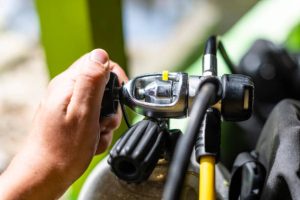
All scuba tanks have a scuba tank valve. The job of this part is attaching the first stage of the regulators to the scuba tank. The scuba tank valve is the item that allows the air to flow from the tank, into the scuba regulator, and finally into the mouth and lung of a diver.
In the USA, a K-valve is the most commonly used scuba tank valve, you can find other scuba tank valves on tanks in other areas of the world. All scuba valves do the same job, though, you may find adaptors attaching various types of regulators to the different scuba valves.
Main Components of Scuba Valves
While there are several styles of scuba tank valves available in the market, they almost have the same components, which include:
Knob
The knob is the part that opens and closes the valves, from which you can control air flow. Turn the knob left (counterclockwise) to open the valve and turn it right (clockwise) to close it.
O-Ring
Scuba valves have an O-ring, whose job is creating a secure seal between the valve and regulator. However, this o-ring can sometimes be on the regulator itself, depending on the using method of connection or attachment.
Burst Disk
It is a thin copper disk that can be considered a safety feature, as it ruptures once the internal pressure of the tank reaches a certain level, this helps divers avoid serious injuries.
Snorkel
The snorkel of the valve isn’t the snorkel that you wear. It is a type of tube that extends from the bottom of it whose job is stopping debris from flowing through the valve when you invert the scuba tank.
Yoke vs DIN Fittings
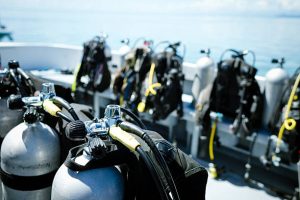
Before talking about different types of scuba valves available on the market, let’s describe the two ways by which the valve attaches the regulator to the scuba tank.
Yoke
It is also called the A-clamp or international fitting, it was considered the standard connection for many tanks worldwide. A yoke regulator connection involves an oval metal brace that fits over the tank valve in addition to a rotating black handle made of plastic which is used to tighten the metal yoke screw of the regulator onto the tank valve.
The O-ring, which sits on the yoke’s valve itself instead of the regulator, expands due to air pressure when creating a seal between the regulator and valve. As a result, the O-ring of the yoke valve will get damaged or wear out at the end, leading to air leaks that can cause minor to major disruptions in the air supply if you don’t replace it.
However, the yoke fitting is the most common fitting worldwide and is still the ideal connection for tanks having average pressure ratings.
DIN
DIN (which is an abbreviation to the Deutsches Institut Für Normung) is a German-standard setting which is becoming more popular recently. You will find this type more widely used outside the United States and is irreplaceable for both deep and technical scuba divers due to its ability to withstand higher maximum air pressures (above 3000 psi).
What distinguishes a DIN fitting from other types is having a thicker and more dependable “captured O-ring” seal, as well as attaching to the regulator connector rather than the tank valve.
In addition to that, the connector of the regulator doesn’t have an oval metal brace, leading to be less bulky and no need for a clamp attachment. As a result, it can be screwed directly into the DIN compatible valve.
Common Types of Scuba Tank Valves
Although there are many different styles of scuba tank valves in the market, as a scuba diver, you should be familiar with three of the most common ones, which are, the J-valve, K-valve, and DIN valve.
J-Valve
J-valves have a unique reserve mechanism, but similar to K-valve in several features. One of its unique features, a spring that closes airflow in case of any dropping of the tank pressure below around 500 psi. The reserve will open when pulling the rod which is attached to the reserve lever.
As a result of being replaced by reliable tank pressure gauges,J-valves are no longer recommended. But if you do use them, it is important to ensure to disable the reserve mechanism tuen the reserve lever downwards) before every time you go diving in order to prevent the valve from cutting off the air supply while there is remaining air.
K-Valve
K-valves are the most common type of scuba tank valves. You’ll find this type on most tanks, especially in the US. They are considered the simplest and use yoke attachments in order to create secure connections with compatible regulators. Briefly, scuba divers slip the attachment of the yoke regulator over the K-valve, then tighten a screw against the valve’s rear.
DIN Valve
DIN valves are for scuba tanks with air pressures over 3000 psi. As its name suggests, these specialized DIN valves have DIN attachments that connect to regulators.
You can know a DIN valve from its appearance, as it has a wide hole connection with no O-ring on it. Scuba divers simply screw the DIN fitting of the regulator into the internal threads of the DIN valve.

Scuba Valve and Regulator Converters
Although manufacturers build scuba tank valves and recommend valve-regulator connections, there are many converters or adapters that provide dual compatibility of both valves and regulators, for example, the DIN to Yoke Filler Adapter of the tank and the Aqua DIN to Yoke Converter of the regulator.
These adapters not only make no need to make a rush purchase for a brand new regulator when there is no compatibility with the renting scuba tank, but it also saves your time and money that you may spend on service repairs.