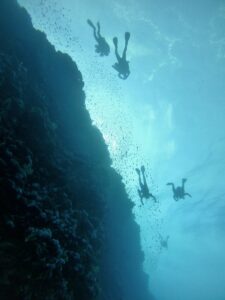
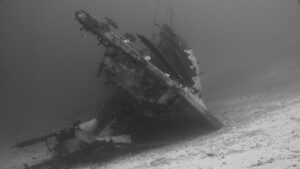
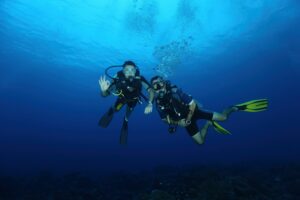
If you’re a scuba diver looking for a truly unforgettable dive, the SS Thistlegorm should be at the top of your bucket list. It is widely regarded as one of the world’s greatest wreck dives, as it combines fascinating World War II history, remarkable underwater exploration, and abundant marine life.
Resting beneath the waters of the Red Sea since 1941, the SS Thistlegorm continues to captivate divers from around the globe with its dramatic story and remarkably preserved cargo. Let’s know more about it in this article.
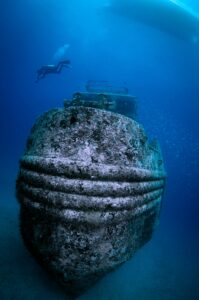
Origins of the SS Thistlegorm
On 6 October 1941, the SS Thistlegorm reached her final destination on the seabed of the Red Sea. After 80 years of that, this iconic shipwreck becomes one of the most renowned dives around the world.
Just 18 months before it sank, the 4,898-ton, 128-meter steamship was built by Joseph Thompson & Son in Sunderland, England.
Like all other ships owned by Albyn Line, She was named after Scotland’s national flower, and “Thistlegorm” means “Blue Thistle” in Gaelic—a name that became meaningful after her sinking.
From Mission to Wreck
In June 1941, following merchant trips to the US, Argentina, and the West Indies, the Thistlegorm was carrying a 120mm anti-aircraft gun and a heavy-calibre machine gun and was drafted to re-supply the British 8th Army during World War II.
The crew left Glasgow, Scotland heading to Alexandria in Egypt, sailing in a 16‑ship convoy around the South coast of Africa to bypass Mediterranean threats.
After twelve thousand miles, they stopped at Sha’ab Ali to wait while the Suez Canal was cleared following a tanker hitting a mine. Two weeks into anchorage, at 1:30 am, two German planes dropped bombs into Hold 4 after failing to find a troop carrier, igniting the ammunition and ripping the Thistlegorm apart. The ship sank in less than ten minutes.
HMS Carlisle, moored alongside, could rescue only nine crew. The Captain received an OBE, a sailor earned medals for rescuing another, and the wreck was declared a war grave after the tragedy.
The Legacy of the SS Thistlegorm
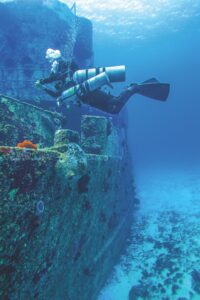 After 15 years more, Jacques Cousteau discovered the Thistlegorm, a story documented in “The Living Sea, The Silent World, and National Geographic (1956)”. In the 1990s and after the development of Sharm-el-Sheikh, the Thistlegorm was promoted from a local secret to one of wreck dives around the world.
Today, The wreck is a hub for scuba diving and wartime history. In addition to the prop and guns, her intact cargo is what attracts most, including BSA and Norton motorcycles, Morris, Bedford, and Ford trucks, rifles, UC-MkII tanks, aircraft and radio parts, plentiful munitions, Wellington boots, and two steam locomotives that were blasted to both sides of the wreck.
And the marine life inside it is a whole different world. You can have encounters with tuna, lionfish, barracuda, lionfish, batfish, morays, sweetlips, and stonefish. If you are searching for crocodile fish, go to the decks, while the hawksbill turtles can be found in the blue.
The bow and midships stand upright, while the stern lies detached and rotated 90 degrees. The SS Thistlegorm Project offers impressive 3D maps and tours. It offers more than a single dive. If you want the full entertainment, start with an orientation around the exterior, then follow with a second dive to explore the holds and cargo.
The site here has no strong currents, and you need to have excellent buoyancy, so you aren’t permitted to dive unless you have a PADI Advanced Open Water Diver Certification with not less than 20 logged dives. PADI Enriched Air Nitrox is a recommended choice but useful specialty to have.
Preserving the Thistlegorm for Future Generations
As a result of being a staple stop for liveaboards, and being only 3-4 hours away from the shore, the Thistlegorm draws about 200 divers every day. Her popularity has led to decline, with poor buoyancy, mooring lines, looting, and diver’s bubbles all speeding up the damage of its skeleton.
Thanks to efforts by HEPCA, CDWS, Save SS Thistlegorm, and others, conservation is underway, giving the wreck a chance to be preserved for maybe another 80 years.