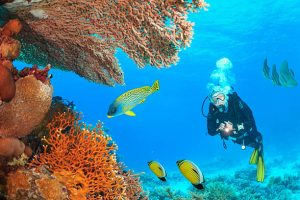
The words ‘scuba diving’ most likely evoke visions in most people of colorful coral reefs, teeming with a variety of marine life, and the general peace of the undersea environment. Scuba diving, however, has been a critical part of one of the boldest projects humans have ever embarked upon: space exploration. Word Root: Human The development of astronauts by NASA, to be able to cope with all the trials that lurk outside Earth’s atmosphere, has found a most unlikely and yet effective ally: under the surface of the water. In exploiting underwater environments, similar to the use of weightlessness simulation during space travel, NASA has been able to train astronauts with the necessary experience for their extra-terrestrial missions.
The Zero-G Challenge
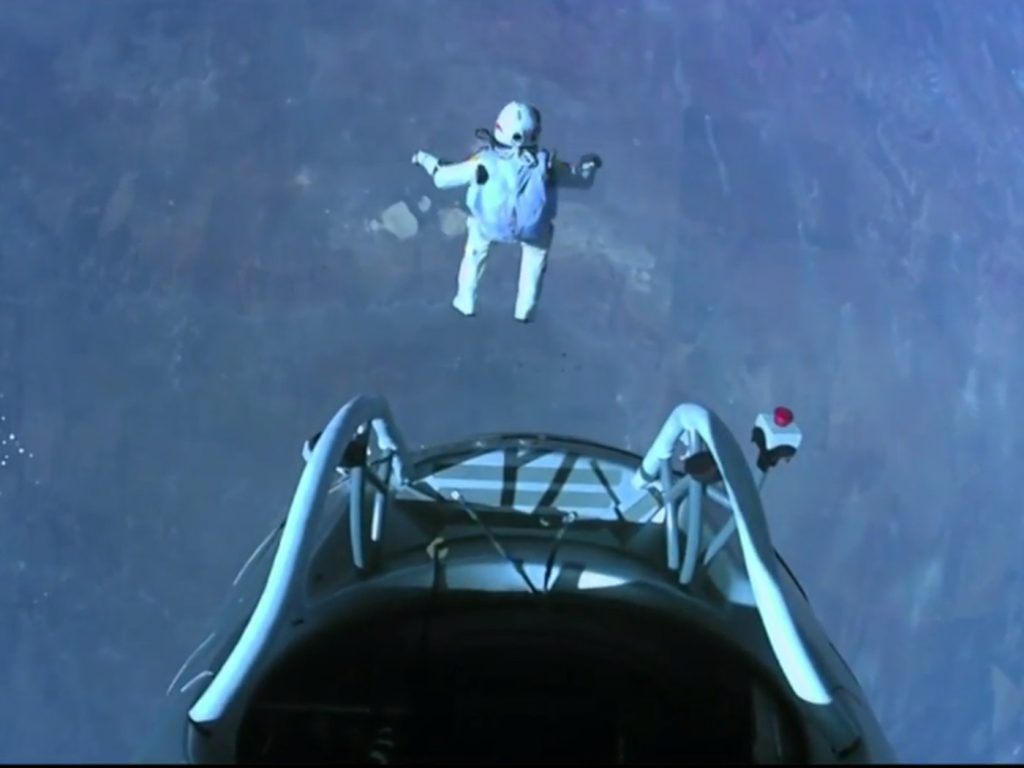
Perhaps the greatest difficulty of space is existence without gravity; this is typically referred to as microgravity or weightlessness. Everything is in a state of “free-fall”; thus, basic functions, such as moving, eating, and simply manipulating tools, become overly complicated. Mastering this feeling on Earth would be critical for providing training to astronauts to undergo; hence, it became necessary to perform this as an exercise for NASA. Whereas the parabolic flights — which take place in aircraft, widely referred to as the “Vomit Comet” — offered only short bursts of microgravity, NASA required something a bit longer and more controlled for comprehensive training.
The Birth of Neutral Buoyancy Training
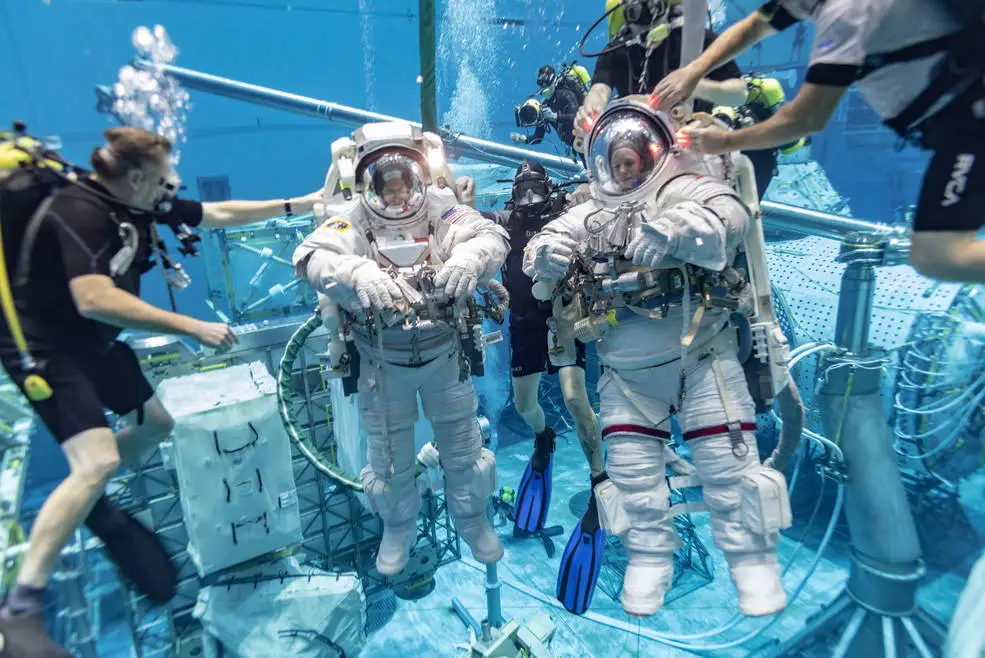
It comes from the world of scuba diving. Underwater, divers experience neutral buoyancy—a state in which they neither sink nor float, simulating the sensation of weightlessness. In the mid-1960’s NASA began work on experiments within an underwater environment to see if they could effectively simulate astronaut conditions in space.
It was a simple idea: if you wheeled astronauts into a swimming pool and very carefully balanced their buoyancy, the environment would closely match space. This process, known as Neutral Buoyancy Training, allowed astronauts to float free and practice some of the work they would be doing on spacewalks: maintenance work, construction, and their own locomotion devices and tools.
Neutral Buoyancy Laboratory (NBL)
In the early 1980s, not quite a year after underwater training had been implemented, NASA realized how effective it was and stepped things up by developing the Neutral Buoyancy Laboratory. Situated at the Johnson Space Center in Houston, Texas, the NBL boasts one of the largest pools in the world: 202 feet long, 102 feet wide, and 40 feet deep. It contains over 6.2 million gallons of water and offers more space for full-size mockups of spacecraft, space stations, and other equipment.
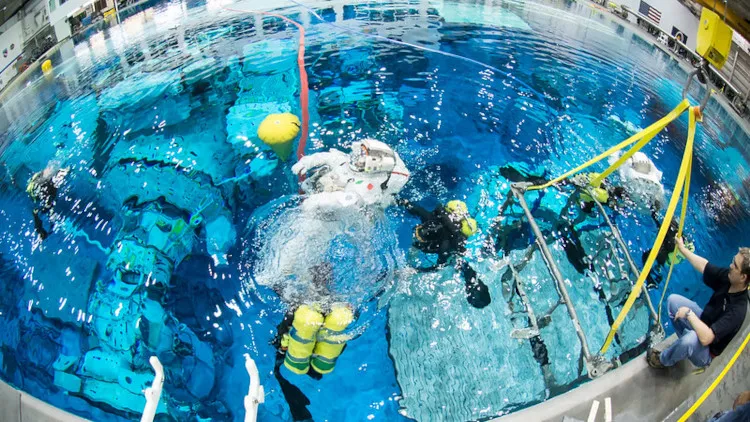
Dressed in one-of-a-kind spacesuits, astronauts plunge into the NBL for simulated spacewalks, also known as EVAs. Their suits are weighted for neutral buoyancy, the condition under which astronauts can float unaided in the water, as they can in space. For astronauts in training, the NBL is their classroom for complex maneuvers; it allows them to fine-tune techniques and develop the confidence to sustain them through the missions with the help of scuba divers and support teams.
Decades before they ever reach orbit, Neutral Buoyancy Training has played a crucial role in making many of NASA’s most historic missions a success. In the Space Shuttle era, astronauts spent hundreds of hours inside the NBL as they prepared for EVAs needed to repair satellites like the legendary Hubble Space Telescope servicing missions. More recently, astronauts use the NBL to rehearse the assembly and maintenance of the ISS, which requires complex coordination and teamwork akin to a weightless ballet.
This is not rare, and the extent to which this underwater training at the NBL makes its astronauts ready is usually pretty comprehensive. Thus, it is not uncommon for an astronaut to say that his EVAs in space are considerably close to his trained sessions at the pool. It was done to prepare the astronaut for every sort of scenario to be encountered working in outer space, where even small blunders can turn out to be very expensive.
Scuba Diving Continues to Play Its Role in Space Exploration
As such, with NASA and other space agencies gearing up for the future missions to the Moon, Mars, and beyond, scuba diving and Neutral Buoyancy Training will only continue to play a vital role in the preparation of astronauts. For that reason, its importance is great, enabling astronauts to gain sufficient skills and reduce the bridge between Earth and space concerning skill acquisition.
This means that the input of scuba diving into the space program gives a pointer to the all-rounded versatility and importance of underwater environments in the endeavor for scientific and technological advancement. Utilizing this principle of neutral buoyancy, in turn, NASA can create a simulation of weightlessness in space, thereby preparing astronauts for incredible challenges in space exploration. This partnership between scuba diving and the space program has been so important in astronaut training that it has remained at the core as humankind continues to push forward with ever greater ambitions in space. Happy and safe diving!