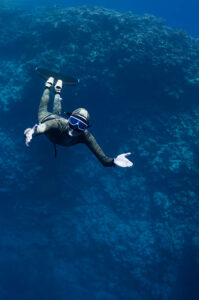
For adventure seekers, diving is considered an extraordinary journey in which you conquer your fears and uncover the ocean’s mysteries. But in this world, your safety have to be a periority, that’s why you should be equipped with the right gear.
Whether you are a seasoned scuba diver or just a beginner, you should know that the proper scuba diving equipment is considered vital for a safe and enjoyable diving experience. The common questions that are often asked “Is wearing a wetsuit when scuba diving mandatory?” and “Can I go scuba diving without a wetsuit?”
In this article, we will discuss the importance of wetsuits in scuba diving, and explain when and why they are an essential part of your scuba experience.
Understanding Scuba Diving Basics
Before we dive deeply in the world of wetsuits, let’s revise together the basics of scuba diving. To practice scuba diving safely, you should master buoyancy control and adapt to the environment underwater. Water temperature is a key factor, as your safety and comfort are paramount.
In addition to that, the exposure to UV rays is another important factor for you to keep in mind in case of not wearing a wetsuit when scuba diving. The intensity of the ultraviolet rays can be dangerous when spending extended periods on the surface of the water during your surface intervals between dives, and this is where wetsuits become crucial.

What is a Wetsuit?
A diving wetsuit is considered a garment or device that is made from neoprene and designed to protect a diver from the marine environment underwater. you can find two types, the first is the full-body wetsuit which covers the whole body and the other is the shorty wetsuit (shorties) which provides more freedom but less coverage.
Benefits of Wearing a Wetsuit When Scuba Diving
Wetsuits are a vital item in your scuba diving gear, as they provide many benefits. Here’s how they enhance your diving experience:
Thermal Insulation as well as Temperature Regulation:
One of the important benefits of wearing a wetsuit when scuba diving is keeping you warm in cold waters.
They are designed to trap a thin layer of water between your skin and the neoprene material, which is heated by the body’s temperature then warms you up. This layer insulates your body and prevents heat loss in order to keep you comfortable even in chilly waters.
Protection from Marine Life and Hazards:
Wetsuits provide protection against underwater hazards, as they shield your skin from abrasive corals, jellyfish stings, rocks, and other potential threats from marine creatures.

Buoyancy Control and Comfort:
Wetsuits help you to maintain neutral buoyancy, as it enables you to maintain your position in the water and adjust your buoyancy.
Moreover, wetsuits are designed to have a snug fit over your body in order to reduce the movement of the water inside the suit, which enhances your comfort and reduces drag while moving through the water.
Is Wearing a Wetsuit When Scuba Diving Mandatory?
Deciding whether wearing a wetsuit when scuba diving is mandatory or not depends on the temperature of the water, sun, surface temperature, in addition to the diving environment as well as the dive site.
Wetsuits are vital in case of diving in cold waters but optional in warmer waters. They’re also essential in case of diving in environments, such as caves and coral reefs in which they can protect you from sharp surfaces.
Here are some scenarios:
Coldwater vs. Warm-Water Diving:
Upon diving in cold waters, wetsuits are considered vital for thermal protection. However, in warmer waters, some divers may choose to wear thinner or shorter wetsuits, rash guards, or skinsuits for UV protection and minimal insulation instead.
Different Diving Environments:
The diving environment also can affect whether to wear a wetsuit or not. For instance, exploring coral reefs or caves with sharp surfaces makes wearing a wetsuit essential to protect you against scrapes and cuts.
Tips for Choosing the Right Wetsuit for Scuba Diving
A wetsuit isn’t only considered a piece of diving equipment, it is also your protective companion against the chills, dangerous marine life, and the challenges of buoyancy while scuba diving deeper.
Keep in mind these factors when choosing the right wetsuit for scuba diving:
Prioritize Fit and Comfort
Choose the proper Sizing and Fit: A wetsuit should have a snug fit without restricting your movement. Make sure it fits snugly to minimize water entry but flexible enough for easy movement.
Understand Thickness and Material
Balancing Insulation and Mobility: Choosing the write wetsuit thickness depending on the temperature of the water. Keep in mind that thicker suits provide more warmth but can reduce your flexibility.
Activity-Based Selection: Different water activities require specific wetsuit specifications. For example, scuba diving required different specifications than stand-up paddleboarding (SUP) because of the constant submersion. On the other hand, surfing, with its intermittent water exposure, concentrates more on water temperature and less on wind conditions.

Utilize Temperature Guides
Using a wetsuit temperature guide will help you understand the impact of varying water temperatures on the type and thickness of wetsuit you should choose.