Scuba diving is an exhilarating adventure, but it is important to understand the limits of your scuba tank to get a safe and enjoyable experience. The duration of a scuba tank depends on several factors, including its volume, the depth of the dive, and the diver’s breathing rate. However, as you dive deeper, the pressure increases, causing air to compress and deplete faster.
Understanding the scuba tank limits and planning your dive accordingly ensures you have enough air to safely return to the surface. Deep dive with us in this article to know more.
What is the volume of a scuba tank?
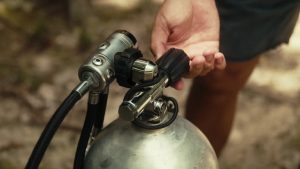
The 80 cubic foot aluminum tank is considered the most common scuba tank used in the United States for recreational diving which has a working pressure of 3000 PSI.
In Europe, this tank is known as a 10-liter tank that has a working pressure of 200 BAR, which is a crucial specification.
What are the Scuba Tank Limits?
The simple answer is: “about an hour”.
The scuba tank limits depend on the various factors that were mentioned before. Typically, a scuba tank containing 200 bar (3,000 psi) can last for (30 to 60 minutes) at a depth of (10 to 18 metres (30 to 60 feet)).
However, in case of diving deeper or having a faster breathing rate, you will need to use the air supply more quickly. This in turn will reduce your decompression limit.
Reduce Air Consumption
To extend the scuba rank limits and reduce air consumption, follow the following tips:
- Know how to practice buoyancy control properly to avoid any unnecessary movements that can result in increasing your air consumption.
- Learn using efficient finning techniques to be able to move through the water effortlessly.
- Choose a diving cylinder that is suitable for your needs.
What Factors Determine How Long the Air in a Scuba Tank Will Last?
The scuba tank limits depends on several factors, including:
Tank Volume
The aluminum 80-cubic-foot tank is considered one of the most common tanks when talking about recreational diving. This tank holds about 80 cubic feet of compressed air which has 3000 pounds per a square inch.
However, you can find in the market variable sizes and materials of scuba tanks that are suitable for different applications (Search to learn about the difference between aluminum and steel tanks).
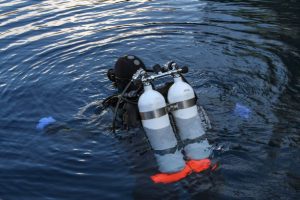
Scuba divers who delve into very deep or long dives may choose scuba tanks having a greater internal volume. Petite divers using very little air may prefer using smaller tanks to be more comfortable. A larger air tank lasts longer underwater, assuming all other factors are constant.
Working Pressure
Scuba tanks are usually filled with air compressed at a pressure of 200 or 240 bar (Around 3,000 or 3,500 pounds per square inch / psi). Higher pressure increases the tank’s air capacity, and in turn increases dive time.
Breathing Rate
Your breathing rate is also considered a vital factor that can determine the scuba tank limits. Faster breathing depletes your air supply more quickly. So, it’s crucial to learn the proper technique for breathing and practice buoyancy control properly to reduce your air consumption.
Depth
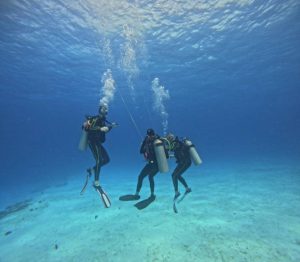
As you descend underwater, the pressure around you increases (learn how depth affects pressure in scuba diving). This increase in pressure underwater does not only affect the air inside your scuba tank, as it is already compressed to a high pressure and the scuba tank is regarded as a rigid container.
However, the pressure of the water does compress air that exits the tank as it leaves the tank and moves through the regulator system. The quantity of air in 1 cubic foot of space at the surface will only have ½ a cubic foot of space at 33 deep due to the water compression.
Therefore, the air quantity of air filling a diver’s lungs at the surface will only fill half of his lungs at a depth of 33 feet. As the diver goes deeper, the quantity of air that is required to fill his lungs will be greater with each breath, and he will also need to use up the air in his tank.
Air Supply Is Not Always the Limiting Factor: as in many cases, a diver must finish his dive before he reaches his scuba tanks limits. Examples include reaching the time limit for safe diving (where enriched air nitrox might be useful) or coming up with a dive buddy who has run out of air.
Dive plans and sites differ, and having air left doesn’t always mean a diver should or will stay underwater until it runs low. In the end, there are many factors that can determine how long the air in a tank will last for a particular individual and dive.
This is the reason why this question may have different answers. Predicting the scuba tank limits underwater needs you to understand the physics of water pressure besides tank volumes, and air consumption rates.
However,Whenever divers ask how long their tank lasts underwater, the answer is always: not long enough!