There’s something surreal about standing at the water’s edge after dark, dive gear strapped on, and torchlight flickering over the waves.
The world is quiet, your breath louder, and your heartbeat just a little faster. Night diving isn’t a fantasy—it’s a very real challenge, filled with beauty and unpredictability. It demands focus, trust in your gear, and the calm to move through unfamiliar waters with intention.
But for those who prepare well and respect the unknown, it offers something unforgettable: the chance to see the ocean not as it appears, but as it truly is when no one’s watching.
Introduction for Night Diving
Before delving into the world of night diving, you should prepare yourself well and be well-informed by your scuba instructor.
In this article, we will delve into the important aspects of night diving, from the potential risks you should be aware of, to your preparation checklist. What you are waiting for, Let’s dive in.
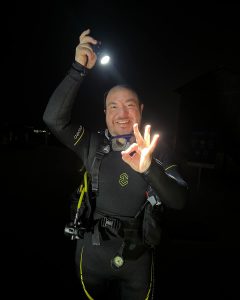
Understanding the Potential Risks in Night Diving
In night diving, you may face huge challenges, including limited visibility, and disorientation, in addition to the harm that may be caused by nocturnal marine life. You should understand these risks first, then be prepared to mitigate them to enjoy with your safe and enjoyable experience.
Limited Visibility:
Unlike traditional scuba diving, in which daylight reveals your surroundings, night diving only depends on artificial light sources besides your inner senses. Your field of vision becomes tunnel-like (which based on the type of your torches). Unfortunately, this may increase the chances of losing orientation or missing obstacles.
The Solution
- To overcome this obstracle, you should purchase a backup dive light besides your backup one.
- As a tip from Experts of Drar, sweep your light slowly to scan your surroundings and stay close to your buddy within visual range.
Disorientation & Loss of Direction:
Without sunlight and unless having clear reference points, you can easily lose track of depth, direction, or even your way up -especially while ascending and descending-.
Unexpected Marine Life Behavior:
At night, under the waves of the ocean, nocturnal marine life emerges while other marine life (which become active in the daylight) becomes more defensive or inactive. This shift can lead to surprising or even startling encounters.
The Solution
To overcome this obstracle, follow OUR Tips:
- Stay calm.
- Avoid aggressive torch movements.
- Observe instead of interfering.
- Before diving, collect your information about the local marine life you may encounter at night in YOUR area.

Buddy Separation:
With your restricted vision at night, you can easily be separated from your partner. Losing sight in the dark makes regrouping difficult.
The Solution
Follow the next ORDERS:
- Establish pre-dive signals and protocols for separation.
- Use tank lights or reflective markers to maintain visibility.
- Keep communication simple and frequent.
To overcome all problems related to BUDDY separation, Read this article: Lost but Not Alone: Handling Dive Buddy Separation
Increased Risk of Panic or Anxiety
While you are diving in the dark, you may suffer from highly psychological stress, especially if you aren’t mentally stable. It is a must to be stable, as Panic at depth is dangerous.
The Solution
Delve into the World of Night Diving when you are comfortable with your gear and DIVING IN GENERAL. Then, follow the next tips:
- Stay relaxed.
- Breathe slowly.
- Brief yourself on what you may expect by diving with an experienced instructor in night diving “if it is your first time. (or a good dive buddy -if you are both experienced).
Here are a Good ARTICLE from drar to become a dogdive buddy: Underwater Companions: How to Become a Good Dive Buddy
Equipment Failure Goes Unnoticed
The colours -that you can see in the Daylight– or any small leak might not be immediately obvious by yourself in Darkness. There are many other problems that may appear and become permenant while being in the dark, that can in turn become silent risks Leading to DEATH Underwater.
The Solution
- Conduct a thorough pre-dive gear check.
- Use equipment you’re familiar with.
- Carry backups for all the essential equipment, such as signaling tools, lights, even a backup mask if possible.
What You Should Prepare for Night Diving
Necessary Equipment and Techniques
Ensuring that you have your essential scuba diving equipment for night diving is vital. This includes backup lights, a reliable dive light, reflective surface markers, and a glow stick in case of emergencies.
In addition to that, learning buoyancy control and communication techniques are essential because they are considered vital skills to practise for your night adventure.
Don’t depend only on glow sticks as safety devices as they are mainly used for marking your tank or fin tips for a clear visibility. For emergencies, don’t forget to carry a fully functional backup torch that can be easily accessed.
Mental Preparedness
Night diving can be an intense experience, and it’s important to mentally prepare for the unique environment and potential challenges it presents. This includes being comfortable with your equipment, maintaining spatial awareness, and staying calm in low-light situations.

Be Gear Savvy
Night diving offers an incredible perspective of the underwater world, but your safety depends heavily on thorough equipment checks. Ensure your primary and backup dive lights are fully charged and functioning properly. Your lights are your lifeline, don’t take chances.
- Purchase yourself with a surface marker buoy (SMB) in addition to an audible signalling device, such as a whistle in order to increase visibility as well as communication at the surface.
- Choose a mask that have a proper fit, provides a wide field of vision, and doesn’t fog easily.
- Your wetsuit should suit the local water temperature because if you are cold underwater, you will be distracted.
To have a clear visibility underwater, add a reflective tape to your fins or tank. Preserve your body heat by wearing a hood or beanie to provide you with added protection from unintended bumps in low light. check every piece of equipment twice before descending, unreliable gear has no business in the dark.
Brush Up On Compass Skills
Navigating underwater is already a skill, and it is considered a big challenge that faces scuba divers in night diving. Revise all compass navigation techniques and practice your favorite one before delving into a new night adventure.
Take your time to understand how a dive compass behaves under real conditions and identify the natural landmarks in the choosen dive spot to be able to detect them at night, like sand channels, coral edges, or mooring lines.
To improve both visibility and orientation, use a backlit or glow-in-the-dark compass. Proper navigation won’t only keep you on course, but it also will guarantee your safe return to the entry point.
Practice Going Slowly
Before delving into the world of night scuba diving, it’s important to practice moving slowly and deliberately. In the dark, you can hardly see potential hazards or obstacles, so it is important to take your time and maintain a controlled pace to be safe.
Moving slowly in the dark will enable you to observe the nocturnal marine life and appreciate the unique sights that come to life after dark.
In addition to that, physical preparation and mental readiness is also essential for night diving. Take some time to be mentally prepared for the different atmosphere and the sensory challenges that come with diving in darkness. Keeping calm and focused is the golden key to make the most of your night dive experience.
Dive with a Buddy
Diving with a buddy is a must in night diving. Having a dive buddy offers an extra layer of safety and support in case of emergencies or unexpected situations.
Ensure to be close to your buddy to communicate clearly throughout the dive, and establish proper signals and a plan to be able to stay together in low visibility conditions.
With the proper preparation, skills, gear, and mindset will guarantee having safe and highly rewarding night diving adventures. Enjoy the magical beauty of the hidden world after the sun sets.
Dive It During The Day
Before delving into a night dive adventure at a new site, it’s highly recommended to visit the site during the day first.
This enabled you to become familiar with the topography of the site, in addition to entry/exit points, and any potential hazards such as surge zones or sharp corals. you’ll also gain valuable reference points to help you know the orientation in case of the limited visibility of the night.
Exploring the site during the day enables you to observe the behavior of marine life, as some of which may shift dramatically after sunset. Recognizing these patterns adds both excitement and safety to your night adventures.

Night Dive Preparation Checklist
- Primary dive light (tested & charged).
- Backup dive light (Ensure to make it easily accessible).
- Personalize your gear by marker light or glow stick (To become visible in darkness).
- Surface marker buoy (SMB).
- Audible signaling device (Such as., whistle).
- Compass (preferably illuminated)
- Dive computer or timer.
- Clothing to keep you warm in the water.
- Bright tape or easy-to-see accessories.
- Communication signals you and your buddy agreed on before the dive.
- Getting to know the dive spot in the daylight.
✨ Conclusion: Embrace the Glow Below
Night diving isn’t just a dive—it’s a transformation. When the last light of day fades and your torch cuts through the velvet dark, you’re not just exploring the ocean, you’re discovering a side of yourself: calmer, braver, more attuned to every shimmer and silence.
With careful preparation, sharp awareness, and a respect for the unknown, night diving reveals the ocean at its most magical. So suit up, breathe deep, and let the darkness unveil a world that only a few dare to know. The night is waiting—glow below.