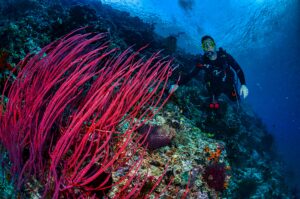
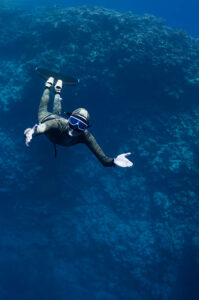
Although any scuba diver loves to dive in warm, crystal clear blue waters with high underwater visibility as you can see. We can say that reality is so different. While many scuba divers are blessed with access to the clear Waters, many others dive in lakes or in waters that offer poor visibility.
But what drives a diver to dive in these spots with poor visibility if he has alternatives? In this article, you will know 10 reasons to try scuba diving in low visibility.
10 Reasons to Try Scuba Diving in Low Visibility
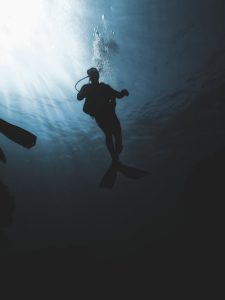
If you are a scuba diver and feel bored from practicing traditional scuba diving, here are you 10 reasons to try scuba diving in Low visibility:
- It requires remaining aware and alert.
- It makes you appreciate clear water and good visibility.
- It is a relaxing experience.
- It sharpens your scuba diving skills.
- It is the ultimate test of a good diving buddy.
- It makes you appreciate the little things.
- It tests your navigation skills.
- It pushes you for good underwater communication.
- It requires special scuba diving equipment and preparations.
- It’s a thrill of danger.
It Requires Remaining Aware and Alert
For beginners, scuba diving in low visibility forces divers to focus on the job at hand. There are no distractions from stunning coral in front or a brilliant fish zipping by. Spend your time in the dive concentrating on trying to focus on what is coming up ahead in front of you.
This forces you to slow down your movement and concentrate. You also have to focus your attention on what’s coming up ahead. Under poor visibility conditions, you must remain completely aware of your diving buddy’s position, orientation and surroundings.
The lack of distractions makes you focus more on monitoring depth gauges and air pressure more frequently. The diver who is having this experience becomes aware of his buoyancy and air consumption
In addition to trying to improve awareness of scuba Diving skills. It is just like being an aircraft pilot who is flying through fog, you have to tend to become more reliant on your instincts and instruments.
It Makes You Appreciate Clear Water and Good Visibility
If you haven’t got your Open Water Diver certification and used to dive in tropical islands with miles of clear water that hasn’t any suspended particles which you can see your dive boat and the sea bed all the time, you will find it very difficult getting used to murky water.
Doing many low visibility diving Adventures will ensure that you never take the good visibility for granted.
It is a Relaxing Experience
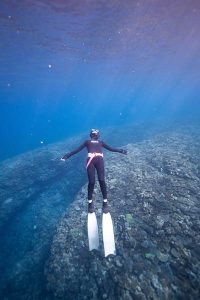
You may find scuba diving in Low visibility in addition to night diving almost relaxing , as while you are diving almost blind, the lack of distractions that make you intensively focus on checking your instruments in addition to the sound of your breathing is considered meditative.
This sense of relaxation is mainly caused by the high sense of awareness of the limited visibility around you and surrealistic swirling or particles in front of you.
It Sharpens Your Scuba Diving Skills
Love visibility solving your scuba skills is it forces you to use every single you have learned it in your diving courses which make you and turn a better diver throw the process the skills you will practice include:
- Using a compass to hold your bearing.
- Tring to fin without disturbing any particles that could further ruin visibility.
- Watching the exhaled bubbles to be able to determine the orientation.
- using new dive signals.
- using the flashlight or sound as a type of communication in these conditions.
It is the Ultimate Test of a Good Diving Buddy
Scuba diving in poor visibility is the best type of Diving if you want to evaluate your compatibility and competence with your diving buddy and also you as a good dive buddy.
This type of Diving can make or break your reputation as a good dive partner as you need to keep in contact with your partner and also be able to constantly communicate with him despite the poor visibility.
You need to have skills on being able to swim within arm’s length and to also maintain visual contact as it’s crucial skills in low visibility. The possibility of losing your buddy is high during the dive, so you have to create prearranged plans about the strategy of searching for each other and meet up as a surface.
It Makes You Appreciate the Little Things
Low visibility will make you more appreciative for the little things that you can see on the dive. The possibility to spot anything in poor visibility is low, so any little Marine creatures you will spot will be considered exciting for you.
It Tests Your Navigation Skills
With low visibility diving, you will use all your compass navigation skills. As a result of finding no features, you can do visual navigation and the navigation using a compass is the best and only way to find your bearings.
It Pushes You for Good Underwater Communication
Underwater communication becomes a challenge, as you can’t see the hand signals your body makes for you. As a result of that, you will only use a flashlight or tap your tank to create sound signals. This will add another element of novelty to scuba diving in Low visibility.
It Requires Special Scuba Diving Equipment and Preparations
Low visibility diving and night diving require some amount of special scuba diving equipment, such as:
- powerful dive lights.
- Reflector tape to be added on your BCD.
- A buddy line.
- Chemical glow sticks to be able to light up your anchor line .
- A compass that glows in the dark.
- A navigation tow line reel to find the way back to your boat.
- Gauge dials.
For those who are freaks with scuba gear, this means many new shiny toys to be added to their dive gear.
It’s a Thrill of Danger
Although low visibility diving is considered entirely dangerous, it’s somehow thrilling. As deep diving fascinates you, scuba diving in low visibility has the element of danger or challenge that makes this type of diving more compelling.
The challenges you may face can be losing your buddy, losing your bearings, getting lost or even getting disoriented. All of these scenarios can be a challenge to the more experienced divers and test their diving skills.