Commercial diving vs. Recreational diving presents two unique facets of the diving world, each with its own specific traits and methodologies.
Whether you’re an enthusiast eager to explore underwater realms or aiming for a professional diving career, it’s crucial to grasp the distinctions between these two types of diving. This understanding helps you select the path that aligns best with your passions and aspirations.
What is Commercial Diving?
Commercial diving encompasses a range of occupations. Some commercial divers are employed on offshore oil rigs, while others work in local lakes and rivers. Below are some of the most common commercial diving jobs:
- Offshore Diving.
- Onshore Diving.
- HAZMAT Diving.
- Diving Engineer.
- Public Safety Diving.
- Salvage Diving.
- Diving Engineer.
- Underwater Demolition.
- Saturation Diving.
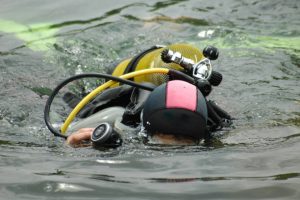
Commercial divers utilize different gear compared to recreational divers. Many don’t use scuba tanks; instead, some use rebreathers, while most rely on a surface-supplied breathing apparatus for their air supply.
Most commercial scuba divers wear a full face mask equipped with a communication device to talk with other divers or a surface team. Depending on their job and conditions, they might use a mask that leaves the top and back of their head exposed or a helmet covering their entire head, commonly known as hard hat diving.
Commercial divers usually work in extreme conditions for long periods. As a result of this, commercial diving is considered one of the most high-paying jobs for scuba divers.
Commercial Diving vs Recreational Diving: In Brief
In essence: commercial divers earn their living by working underwater, while recreational divers plunge beneath the waves for enjoyment. It’s comparable to the difference between operating a big rig and taking a leisurely drive for pleasure.
So, are professional divers like scuba instructors and divemasters considered commercial divers? That’s a great question. Even though PADI® professionals earn a living by diving, they are not classified as commercial divers in most countries.
Commercial divers perform tasks like salvage, welding, and maintaining underwater infrastructure, often in challenging conditions for extended periods that may last for days. In contrast, recreational dives typically do not go deeper than 40 meters (130 feet).
Commercial Diving vs Recreational Diving: The Key Differences
Commercial diving vs Recreational diving in specific points, let’s see:
1. The Purpose:
Recreational diving is all about exploring and appreciating the underwater world while enjoying the sport in a safe manner. Divers participating in this activity are certified to dive within specific depth limits and are required to adhere to safety protocols set by certification organizations.
However, commercial diving is profession-focused and job-related. It involves working in industries like construction, underwater repairs, equipment inspections, or search and rescue, requiring advanced skills and certifications to safely complete specific underwater tasks.

2. Training and certifications:
To engage in recreational diving, one must obtain certification from an accredited organization like PADI. This process entails completing a training program that includes classroom theory, confined water practice sessions, and a series of open water dives under the supervision of a certified instructor.
Conversely, commercial divers are required to complete more comprehensive and specialized training programs. These certifications are issued by commercial/professional diving schools and typically demand greater experience and technical expertise, including proficiency with specialized equipment in addition to training in underwater work safety.
3. Equipment and technique:
In recreational diving, basic gear like masks, regulators, fins, and buoyancy compensator devices (BCDs) are utilized.
On the other hand, commercial divers rely on specialized gear like communication-equipped helmets, umbilical breathing systems, underwater welding and cutting tools, and hydraulic lifts. They also require advanced skills in managing underwater currents, ensuring safety in hazardous environments, and performing rescue operations.
4. Experience:
Recreational diving allows for greater flexibility in terms of age and physical condition, as divers can select their dives and avoid difficult conditions and deep waters. Nevertheless, adhering to safety protocols remains essential for a safe diving experience.
Commercial diving demands greater experience as well as physical fitness, as it involves extreme conditions like prolonged dives, deep waters, poor visibility, sustained physical effort, and lengthy decompressions in diving bells. It also requires a full medical exam and strict adherence to safety standards.
Commercial Diving vs Technical Diving
The distinction between commercial and technical diving can often be unclear, as both types involve prolonged underwater stays and dives beyond recreational depth limits.
Additionally, both commercial and technical divers use equipment like rebreathers and full-face masks. They also undergo specialized training to handle scuba diving in more demanding environments.
The primary distinction between these two diving types lies in:
Technical divers dive for leisure and select their diving locations, while commercial divers are paid professionals who dive in assigned locations.