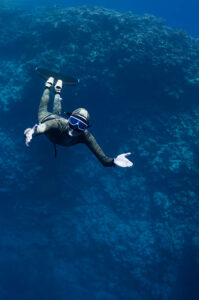
Diving overweight might seem harmless, but it can quickly turn a great dive into a hard and tiring one. Carrying too much weight affects your control, comfort, and air use underwater.
In this article, we’ll explain why diving overweight is a bad idea and how proper weighting can make every dive safer, easier, and more enjoyable.
Why Diving Overweighted Is a Bad Choice
Being properly weighted is key to safe, comfortable, and controlled diving. Here are why diving overweighted is a bad choice
- You Use up the Air in Your Tank Faster.
- An Overweighted Diver Is a “Disaster Diver”.
- Extra Weight = Increased Risk.
1. You Use up the Air in Your Tank Faster
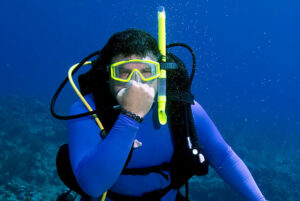
Any extra kilograms/pounds you’re carrying underwater are forcing your body to work harder than necessary. Extra exertion means you need more oxygen, this causes you to breathe heavier and drain your scuba tank (cylinder) faster.
If you want to extend your bottom time, ask your PADI Instructor to give you information about the PADI Peak Performance Buoyancy course. In this course, you will learn how to drop a few kilograms/pounds and is considered your easiest way to enhance your air consumption while scuba diving.
2. An Overweighted Diver Is a “Disaster Diver”
A scuba diver with too much weight often plunge straight to the bottom. Diving overweighted means you will crash onto the reef and drop onto divers who have descended a few moments before you.
Scuba divers with too much weight often have problems in buoyancy while diving. They will swim along and won’t realize they’ve descended – until kicking something, and the damage is already done.
If you are a new diver, you should understand that your buoyancy isn’t supposed to be very good, so it is recommended to stay about four meters (15 feet) above the reef. Don’t listen to any diver would signal you to look at things if you are struggling to hold your position in the water.
3. Extra Weight = Increased Risk
In addition to causing damage to marine life and other scuba divers, diving overweighted means you are putting yourself at risk. Actually, nearly 90% of diving incidents Divers around the world are resulted from diver error according to Alert Network (DAN).
As we previously mentioned, diving overweighted means your body has to work harder. If you’re not fit enough for scuba diving, kicking into a current can cause a challenging swim turn into a medical emergency.
When you’re wearing too much weight while scuba diving, any failure in your equipment, such as having a BCD that fails to inflate or a dropped weight pocket can become hazardous in a hurry.
If you had a weight pocket fall out while diving, you can ascend slowly and safely. But when the same thing happen when diving overweighted, you may end up with Decompression Sickness (DCS) or another diving injury caused by raped ascending.
Are You Diving With Too Much Weight?
There are a few signs you should be aware of to know whether you are diving overweighted or not.
- When startingthe dive, your descending rate is higher than everyone else.
- Insteed of enjoying your scuba dive,you feel exhausted .
- Ftrequently adding/dumpingair to your BCD during the dive (a dozen times or more).
Frequently adjusting your buoyancy is a red flag that you’re diving overweighted. When diving overweighted, it is necessary to add more air in your BCD (about one pint per half kilo/pound).
More air in your BCD can cause greater buoyancy fluctuations while diving because the air expands and contracts while ascending and descending.
How to Know If You’re Properly Weighted
The needed amount of weight for scuba diving is a personal thing. Two scuba divers having the same weight may need different amounts of weight depending on these factors:
- Exposure Protection– Both thick wetsuits and dry suits need more weight than shorty ones.
- Body Composition– Individuals having a higher percentage of body fat require more weight.
- Tank (Cylinder) – Steel tanks (cylinders) are typically negatively buoyant during the dive; conversely, aluminum tanks can start negative and become positive.
Scuba Diving Weight Calculator
We have many helpful articles about the proper amount of weight you need as a diver with different scuba configurations. When diving in saltwater with the most common scuba cylinder (an 11-liter aluminum 80), here’s a quick way to calculate the needed weight to use.
Start with:
- In case of wearing a full wetsuit (5-7), you need 10% of your body weigh
- You may only need 5% when wearinga 3mm wetsuit
- When choosinga dry suit, you may need 15% (or more)
Next, add 2 kilograms (4 to 5 pounds) in order to offset the buoyancy of the tank at the end of the dive. Then, conduct a buoyancy check.
At the surface, You should hover at eye level while taking a full breath. When exhaling, you should descend slowly and avoid dropping to the bottom as a rock.
To do a buoyancy check at the end of a dive, Give your weights to your buddy and check if you can still descend when you exhale. Ensure not to go deeper than 6 meters (20 feet).
Enjoy Longer, Safer Dives
If you are looking for more enjoyable longer, and relaxed dives, taking the Peak Performance Buoyancy course is a great step to take to achieve that. Completing this course will take from you one or two days. Most divers are pleasantly surprised by how much they will find their diving skills and confidence enhanced in a short period of time.
Enroll in the Peak Performance Buoyancy Course with DRAR
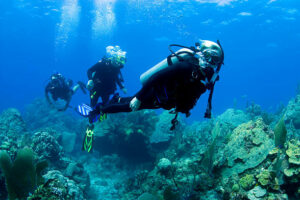
Take your diving to the next level with the Peak Performance Buoyancy Course at DRAR DIVING Center. You’ll learn how to control your position underwater with ease, use less air, and move smoothly without disturbing marine life.
Perfect buoyancy means safer, more relaxed, and more enjoyable dives—and our experienced instructors are here to guide you every step of the way. Enroll now and feel the difference on your next dive.