If you love exploring underwater or are thinking about learning to dive, one of the most important things you’ll need is a scuba tank. It’s the part of your gear that gives you air while you’re under the water.
But not all tanks are the same. They come in different sizes, materials, and with different features. In this article, we’ll explain what scuba tanks are, what features they have, how to choose the right one for you, and how to take care of it so it lasts a long time.
What Are Scuba Tanks?
High-pressure cylinders are considered relatively small, but very strong containers that hold a large amount of compressed gas. SCUBA is defined by the ability to carry your own gas supply. It is an acronym for “self contained underwater breathing apparatus”.
Whether it contains regular filtered air, enriched air nitrox (contains a higher percentage of oxygen with lower nitrogen content) or even trimix (consists of three-gas combination) for technical diving, a scuba tank is an essential piece of gear. Visit the local PADI Dive Center or Resort nearby to get advice about tanks.
Standard Features of Scuba Tanks
1- Cylinders are made either from steel or aluminum alloy, or other composites.
- Steel cylinders are durable and resistant in addition to being negatively buoyant but need care to prevent internal rust. Steel cylinders have the highest capacity.
- Aluminum cylinders are more susceptible to external dents, dings and scratches than steel cylinders, but better resist internal corrosion.
2- A valve controls airflow and connects to the regulator via DIN or yoke system. An o-ring seals the regulator to the valve of the tank.
- Single tank valves, which are made from chrome-plated brass, are the most common.
- Technical divers may need dual-cylinder manifolds, Y-valves or H-valves in connecting two regulators with one cylinder.
- Many valves feature a burst disk (which is a thin copper disk) that lets air escape upon rupturing if the pressure in the tank pressure to a high level.
3- A current visual inspection decal confirms the tank was checked for corrosion inside and out within the past year.
4- Tanks need to undergo periodic pressure (hydrostatic) testing. Test intervals differ by region, ranging from two to seven years.
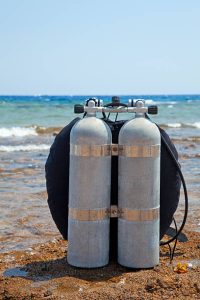
Optional Features of Scuba Tanks
1- The size of the cylinder in addition to its pressure rating tells you about its capacity.
- The capacities of the tanks made in North America range from 6 to 40 cubic foot pony bottles to 45–150+ cubic foot main cylinders.
- On the other hand, tanks made in metric system countries have capacities that range from 1 to 4 litre pony bottles to 6–15+ litre main cylinders.
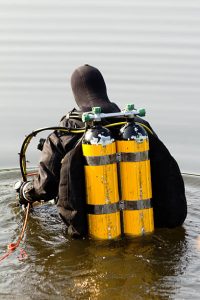
2- Enriched air tanks must meet oxygen service standards and have green and yellow markings to be easily identified, interested? Enroll in a PADI Enriched Air Diver course.
3- Cylinder boots (plastic, vinyl and rubber) stabilize rounded-bottom tanks and protect their surfaces from damage.
4- Other accessories for cylinders are (mesh protectors) that cover the cylinder, (valve covers) that block water and dust from the valve opening, and (carrying handles) that simplify tank transport.
How to Choose a Suitable Scuba Tank
Whether you own a single tank, multiple ones or even none depends on the type of dive activities and keeping in mind the location. Choosing a suitable cylinder should be based on size and capacity.
- The large size is generally better, unless you’re smaller and need to carry it for a long distance. Visit your local PADI dive center or resort and ask for advice from the dive professional.
- After knowing the suitable size, decide between steel or aluminum.
- Depending on the regulator, choose between yoke or DIN valves.
- Consider picking a tank boot or mesh protector, and don’t forget to get extra o-rings.
- Ensure your new scuba tank features a visual inspection decal, or an enriched air inspection decal instead in case of using it for NITROX diving.
Maintenance
- Always secure your tank to prevent falls or movement, as it can cause damage or harm you.
- After rinsing the cylinder and valve with fresh water, store it in a cool, dry place, but ensure not to be completely empty, as storing it with some air inside helps keep moisture out.
- Your tank should be visually inspected every year and underge pressure testing once required.
- Follow maintenance guidelines according to the instructions of the manufacturer.