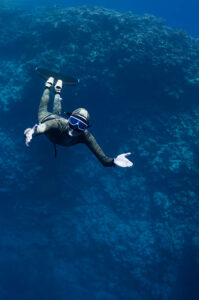
Actually, good buoyancy control is considered the most important skill in scuba diving. However, many novice scuba divers realize after becoming certified divers that they aren’t confident in their ability to control buoyancy underwater.
During your PADI Open Water Diver Course training, you can find a small number of exercises that mainly focus on buoyancy control, as a result, you can find many experienced divers who haven’t learned this skill properly.
If you are interested in learning this vital skill, in this article, you will know the importance of this skill in diving and 5 tips for perfect buoyancy control.
Why is Buoyancy Control Important?
As a scuba diver, your buoyancy control is your ability to control your body, depth underwater and relative position.
Good buoyancy control can make you maintain your intended tips without feeling worry about unknowingly sinking below or even rising above that depth. This is what we call neutral buoyancy (the perfect buoyancy control) which is the ultimate goal for any scuba diver.
Without good buoyancy control, you may suffer from many problems, such as:
- Losing your orientation underwater
Beginner scuba divers Can tell you how easy it is to lose your orientation underwater if you are not paying close attention.
- Unknowingly floating up to the surface of the water
Some scuba divers have been seen unknowingly floating up to the surface before ending their dive. This can be dangerous for several reasons, including physiological risks of rapidly ascending while many boats are passing overhead.
- Unwitting sinking below the planned depths
This problem can even happen to experienced divers when there isn’t a bottom to stop them.

Attaining neutral buoyancy and maintaining it while scuba diving can protect you and the environment underwater including coral reefs. You don’t want to damage the magic ecosystem for which you have come diving to see. One wrong fin kick can damage years of coral growth if you aren’t able to control your buoyancy and keep a safe distance from the reef.
Another benefit of attaining perfect buoyancy control is that you will need to expend less effort underwater. The perfect buoyancy control helps you enjoy the dive more by being relaxed throughout.
you will not only be comfortable, but also will use less air and extend your dive. Actually, the reason for the fast air consumption is that a diver usually burns more air in an extra unnecessary effort due to his poor ability to attain good buoyancy control.
5 Tips for Perfect Buoyancy Control
If you are a novice diver or a diver having a problem related to your buoyancy, here are 5 tips to attain perfect buoyancy control:
- Pay close attention to your breathing.
- Use the appropriate amount of weight.
- Maintain proper trim.
- Use visual references.
- Notice any unnecessary movement.

Pay Close Attention to Your Breathing
Paying close attention to your breathing is considered to be the most important tip for perfect buoyancy control as it is an essential factor in attaining good buoyancy control.
As a novice divers, ignoring your breathing is usually the main reason you don’t have good buoyancy control. However once you start to pay attention and be aware of your breathing your buoyancy control will get much better very quickly until maintaining perfect buoyancy control.
When you try to float in a swimming pool, you will notice that you will float easier if you inhale a deep breath into your lungs, as the increased volume of your long will keep you above the surface of the water.
If you exhale that air, you will start sinking. You can use your breathing in the same way while diving. When we talk about neutral buoyancy, you will find yourself floating up a little bit when you take a deep breath and in the same way when you breathe the air out, you will sink down a little bit.
It’s a mistake to Try to adjust your buoyancy through using the inflate and deflate buttons on your BCD, for example:
- When you feel yourself floating up and quickly raise the hose to release some air.
- When you sink more than you want and rush quickly to add some air back into your BCD.
Actually, in that way you are entirely ignoring that the main cause of these minor changes in your buoyancy is your breathing.
As a diver, you will rarely need to adjust the air in your BCD while diving; it’s only necessary when you change depths drastically on your descent and ascent. You will also need to compensate for increased buoyancy of the tank when it gets lighter on air while diving.
Besides these situations, you will never need to touch the buttons of your BCD while being underwater. Simply, you will need to adjust your breathing based on what you want your body to do under the deep blue.
Use the Appropriate Amount of Weight

There is no doubt about the importance of the weight belt to ensure that we will sink when we let the air out of the BCD while starting the dive, but that doesn’t mean that we should strap on as much as we can find to ensure that we will sink.
Actually, we should just strive to use the right amount of weight to make us sink below the surface with a deflated BCD, as you will become more negatively and as you sink, so there is no more weight necessary other than the appropriate amount that gets you under the surface to begin your dive, in addition to an extra bit to compensate for the scuba tank which become lighter while diving.
Many divers, even the experienced ones, who dive with an extra amount of weight will find significant drawbacks to this, including:
- They have to add more air to their BCD in order to achieve neutral buoyancy at depths. If they want to make a slight change in their depth, they will suffer from expanding or compressing the amount of air inside their BCD and in turn will have to continue adjusting the BCD much more than if they have used the appropriate amount of weight.
- Because we need more air to attain neutral buoyancy (perfect buoyancy control), they will become bulkier underwater, as a result of this, they will use more energy in order to propel themselves while diving and consume their air quicker.
- As a result of wearing weights on the hips, the overweighting will lead to dragging down the lower half of the body making it harder to attain and maintain proper trim underwater.

You may be wondering about how you can know the amount of weight for perfect buoyancy control. You will address this in the buoyancy check in your Open Water Diver course. In the buoyancy check, you will make the next steps:
- Fluting vertically and motionless at the surface of the water.
- Holding your normal breathing in your lungs.
- All the air out of the BCD.
If you are using the appropriate amount of air, you should:
- Float at your eye level
- Start sinking when exhaling your breath.
This technique is only used to know how much weight you need to descend.
You should put into consideration adding an extra kilo or two if you do the buoyancy check with a full tank, as your tank will become more buoyant as you use air while scuba diving. If you ignore that, you will find yourself floating up a bit while making your safety stop.
Don’t forget to do another buoyancy check if there is any change in scuba diving equipment, diving conditions or you have been out of water for a long time as these factors can affect your optimal weight.
Maintain Proper Trim
Trim refers to the body positioning of a diver. The ideal trim on the water is to be in a completely horizontal position with stationary arms. In that way a diver can easily kick himself through water while maintaining constant depth.
It’s a common thing to see divers with their legs below the rest of their bodies. For novice divers, this is due to the unnatural feeling of the horizontal position or it may be due to overweighting their belt as we have mentioned before.
Regardless of the reason, the result of this bad trim is that a diver may kick the bottom causing damage to the environment or causing bad visibility by stirring up sand. For these reasons, it’s necessary to adjust buoyancy frequently while diving.
If you are having a problem related to maintaining the proper trim, try to redistribute some weight to your upper body. Use your tank strap for this by threading some weight directly on to it or using special pockets which are designed to clip to the strap of the tank. Many newer designs of BCDs come with integrated weight pockets for this purpose, so buy one if you want to achieve perfect buoyancy control.

Use Visual References
An important tip to help you attain perfect buoyancy control is to learn how to effectively use your visual references to make sure you are aware of your position and surroundings.
If you learn this well, you will be able to notice any slight changes in your depth and also adjust your buoyancy before you float or sink much or below the intended depth. Your dive guide or dive buddy can be regarded from the important visual references. It’s a common thing to lose yourself in the beauty of the underwater world but you should also be aware of the divers around you.
This is not only for keeping your group together and organized, but also to notice if you unknowingly change your depth in comparison to other divers. In that way you can adjust your buoyancy before changes more drastically.
It will be so important to use natural visual references, for instance, if you take a look at the bottom of the sea every now and then, you will notice if you are floating up much more than you want or sinking too close. If you are practicing wall diving, you can use visual references on the wall in order to maintain constant depth.
Notice any Unnecessary Movement

Most scuba divers know that scuba diving should be a peaceful and relaxing activity. When we see divers during a dive are constantly flailing their arms or kicking chaotically, this tells us that there is something wrong, but do we notice that we usually do the same?
Actually, if you have seen a video of yourself underwater, you will not believe how much you were doing without realizing. The jerky movements in your arms and legs seem futile attempts to correct your bad buoyancy.
You will never need to use your arms while diving as doing so is considered a waste of effort. All you need to do is to only strive for relaxed, gentle, near-effortless kicking.
Your fins are considered powerful enough that you don’t need anything more to do. If you find yourself wasting energy through unnecessary movements, you will likely need to revisit the previous points to correct the cause of your bad buoyancy control.