The sun has dipped below the horizon, but the real show is just beginning. When the sun goes down and the stars come out, the ocean changes. Your diving experience becomes more calm and dark, but full of life you don’t see during the day.
If you’ve never explored the sea after dark, here are seven compelling reasons why your next adventure should begin under moonlight.
What is Night Diving?
From its name, night scuba diving is considered a type of scuba diving activity that is done during the period after sunset. Unlike regular diving experiences, you will need special scuba gears such as a dive light to enhance visibility.
You may feel intimidated, but you should enjoy it if you want to try a unique ocean experience.
You may think that spotting nocturnal marine life is the biggest reason for practicing night diving, but Night diving has many cool things that make it worth trying.
Reasons to Practice Night Diving
If you are a diver, you certainly have heard about night diving, but have you tried it, yet? If not, then keep reading to know some reasons why you should try night diving at least once in your life.
- Seeing true colours.
- Bioluminescence.
- Hidden creatures come out to play!
- Using different equipment.
- See the true colors of the reefs.
- Enhance your sense experience.
- Observe different animal behaviour.
Seeing true colours
We all know that diving is a very exciting activity, but night dive is something that is even more thrilling! As we dive deeper during the day, it’s harder for us to differentiate the real colour of the object that we see.
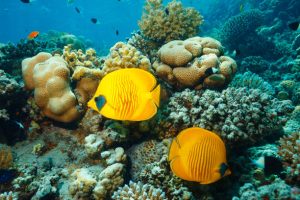
You won’t have this problem during night dive! With the help of the light from your torchlight, you are able to see the true colour of those marine life. Corals & fish that look amazing at daytime is even more dazzling at night.
Many underwater photographers especially love night dives as torchlight can keep most of the colour spectrum. This makes the photos appear to be more vibrant & colourful.
Bioluminescence
One of the reasons that attract divers to go for night dives is the bioluminescence phenomenon. As the water turns inky dark, you will have to rely on your torch to see your surroundings. However, you will need a dark environment to be ab to spot these luminous planktons. To see it, all you need to do is cover up your torchlight by simply pointing towards your chest & wave your arm around the water. You will then feel like you are in the bioluminescent scene of the movie Avatar! We do it during the safety stop time so you will have a magical experience to end your dive!
Hidden creatures come out to play!
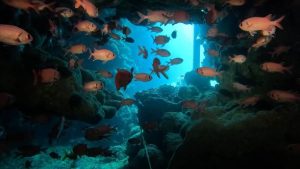
Night dives will definitely change your perspective of the underwater world. They allow you to see the marine life that are hidden during the day time. For example, many shrimps, crabs & lobsters will show up at night. It’s hard to see this marine life in day time as they are almost stay hidden in a camouflage environment. This makes diver hard to spot them. They will become active at night & will come out from their hidden place to hunt. You might even be lucky enough to see sharks passing by. Seeing a shark at night is definitely more exciting than in day time!
Using Different Equipment
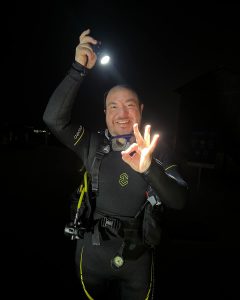
One of the difference between day dive & night dive is the equipment. Doing a night dive means that you will need a torchlight to give you the additional light to see the underwater world better. You will need to rely heavily on the torchlight to see everything around you. Using a torchlight is definitely something that is unusual for most of the divers as we rarely use it for day dive. So a night dive will give you the chance to use it & see all the sea creatures using artificial light. Torchlight is very crucial during night dive. You can only get attention from your buddy & show hand signal using the torchlight in the pitch black water.
See the True Colors of the Reefs
During the day, the colors under the water can appear muted or washed out because of the bright sunlight. However, at night, with the only light coming from your dive torch, you get to see the true colors of the reefs and marine animals.
In fact, certain types of lights, particularly blue UV lights, can intensify these colors. This is called UV night diving or fluorescent night diving, where you use UV lights and yellow visors that enable you to see psychedelic-like colors from the corals or sea creatures.
Fluorescent night diving is possible because of a certain type of protein that is found in some corals that can absorb the blue light and reflect them in different colors. The results are corals that glow in vivid colors like yellow, green, and sometimes pink or red.
Enhance your Sense Experience
The darkness that comes from the lack of natural light might deter some divers but, in a way, this limited visibility can sharpen your other senses.
As you begin to rely more on your touch and hearing, you’ll pick up on tiny details that may often get overlooked during a day dive, including the sound of ocean currents and sea creatures.
Observe Different animal behaviour
During the night, some animals behave differently. Stingrays and sharks prefer to hunt at night, despite the fact that they can be seen during the day. But it’s not just them.
The coral opens its polyps to feed, lobsters emerge from their hiding places in search of food, and octopi swim freely. In other words, a night dive provides an opportunity to observe the food chain in action.
Night diving is a very exciting journey as everything changes at night. The part of water where you go diving regularly may look completely different to you when you go for a night dive. The only light that you get when doing a night dive is the one from your torch.
So you will be become very focused on what’s right in front of you only. As you can rarely see those big stuff at night so you turn your attention to macro that you might missed during day dive.
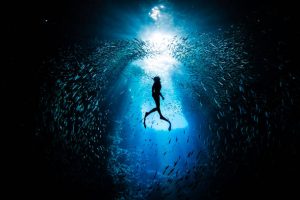
Night diving can be intimidating for divers, it’s an activity that challenges divers outside of their comfort zone, but the sense of accomplishment that you feel right after finishing a night dive is beyond measurable!